
Table of Contents
It's important to keep in mind that the same investment can be reasonable for one goal and unsuitable for another because the target amount, deadline, liquidity need and ability to absorb a loss are different for different goals. This is similar to how the same type of frosting can be suitable for one type of cake but not suitable for another type of cake. For example red velvet frosting is suitable for red velvet cake but maybe not for blueberry flavored cake. Keep in mind that this article explains a decision framework, not a model portfolio.
Start With the Goal, Amount and Date
To turn a broad wish into a real investment goal, you must build a clear framework using a Goal, Amount, and Date.
A broad wish like "I want to save for a house" has no plan. You transform it by defining four specific pieces:
- Target Amount: The exact sum you need (e.g., $60,000 for a down payment).
- Target Date: The month and year you need the money (e.g., December 2031).
- Current Savings: What you already have saved today (e.g., $10,000).
- Planned Contributions: The amount you will save regularly (e.g., $600 each month).
- The Result: "I will save $60,000 for a house down payment by December 2031 by starting with $10,000 and adding $600 every month."
Without a target date, you cannot define your time horizon (how long you will hold an investment). A goal with no deadline fails for three reasons:
- Wrong Investments: You cannot choose between safe options (like savings accounts for short timelines) and growth options (like stocks for long timelines).
- No Math: You cannot calculate how much money you need to save each month.
- No Urgency: You lose accountability and will likely skip saving.
Time Horizon, Risk Tolerance and Risk Capacity
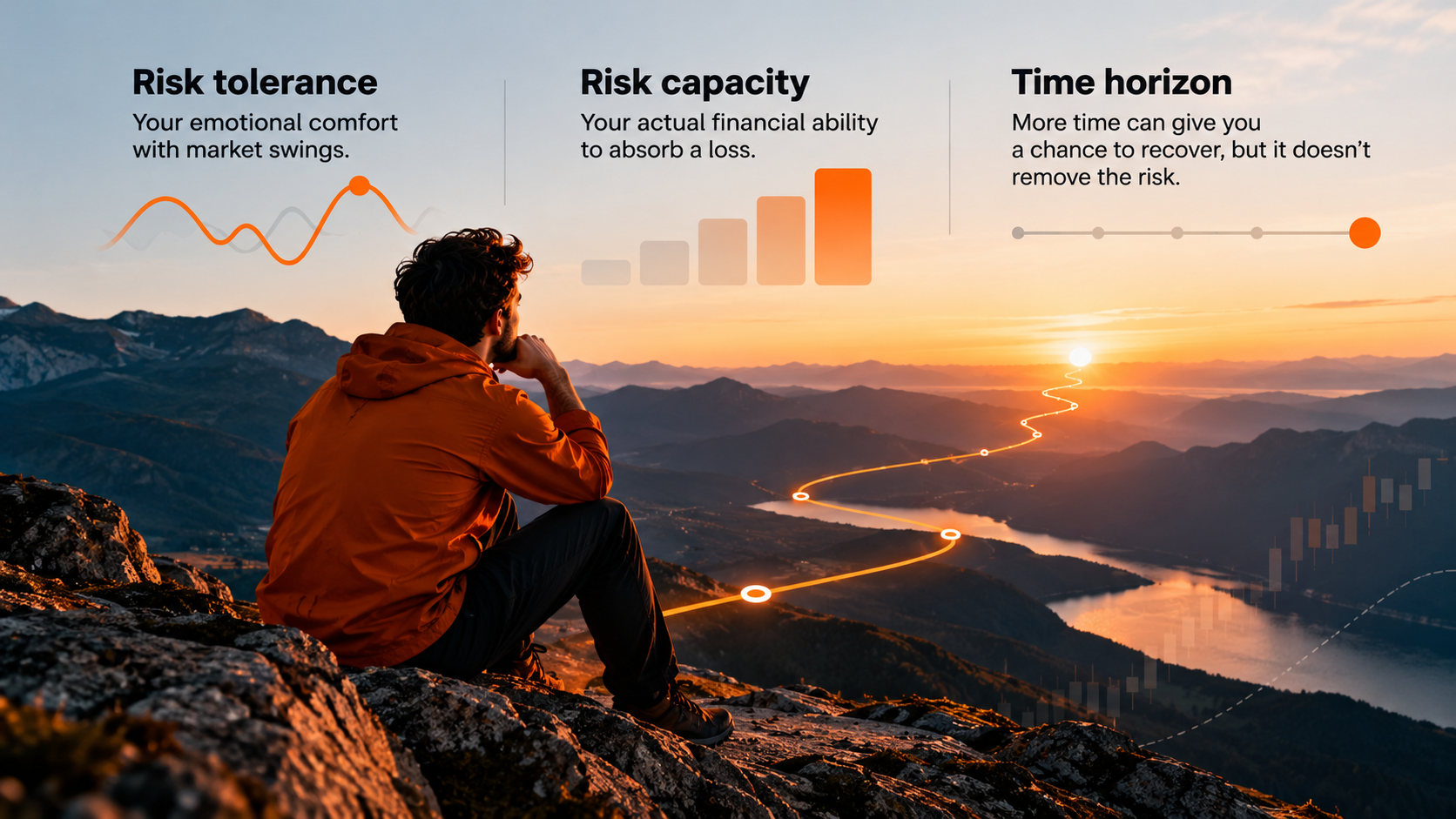
Risk tolerance is your emotional comfort with market swings, while risk capacity is your actual financial ability to absorb a loss. A long horizon may provide more recovery time but does not make a risky asset safe. For example, having 30 years until retirement gives you time to recover if you lose money, but it does not remove the risk. A risky investment is still risky.
Before Investing for a Goal
Before investing, secure your foundation so you never have to sell assets at a loss during an emergency.
- Emergency Savings: Keep 3 to 6 months of living expenses in a separate, safe account.
- High-Cost Debt: Pay off credit cards or high-interest loans first.
- Foreseeable Expenses: Set aside cash for any planned costs coming up in the next 2 to 3 years.
- Access to Cash: Ensure your cash is liquid and free of withdrawal penalties.
Spain and EU Rules
Asset Protection: The Spanish Fondo de Garantía de Depósitos (FGD) protects bank deposits up to €100,000 per person, per bank. A similar €100,000 limit applies across the EU. Spain's FOGAIN offers the same €100,000 coverage for investment accounts.
Tax Advantage: Spanish residents can transfer money between local investment funds (Fondos de Inversión) without triggering capital gains tax. You only pay tax when you cash out.
How Strategy Changes by Goal
Different goals call for different strategies, and that means different mixes of assets. Below is a quick look at how allocations might shift depending on what you're saving for. Keep in mind the specific assets listed are just examples to illustrate the idea, not a recommendation for what everyone should hold. Your right mix depends on your own timeline, risk tolerance, and situation.
Buying a Home in the Next Few Years
If you're buying in the next few years, the main risk isn't missing out on growth, it's having less money than you expected right when you need it. A market drop the month before your deposit is due can hurt a lot more than a market drop you have years to recover from.
If your date is flexible: you can afford to hold a bit more risk, maybe a modest equity allocation early on, then shift into cash and short-term bonds as the purchase gets closer. If the market dips, you can simply wait.
If your date is fixed (like a signed contract or a set closing date): that flexibility disappears. In this case, most of the money should already be sitting in cash or very short-term, low-volatility instruments well before the deadline, since you won't have time to recover from a downturn.
Building General Savings Without a Fixed Date
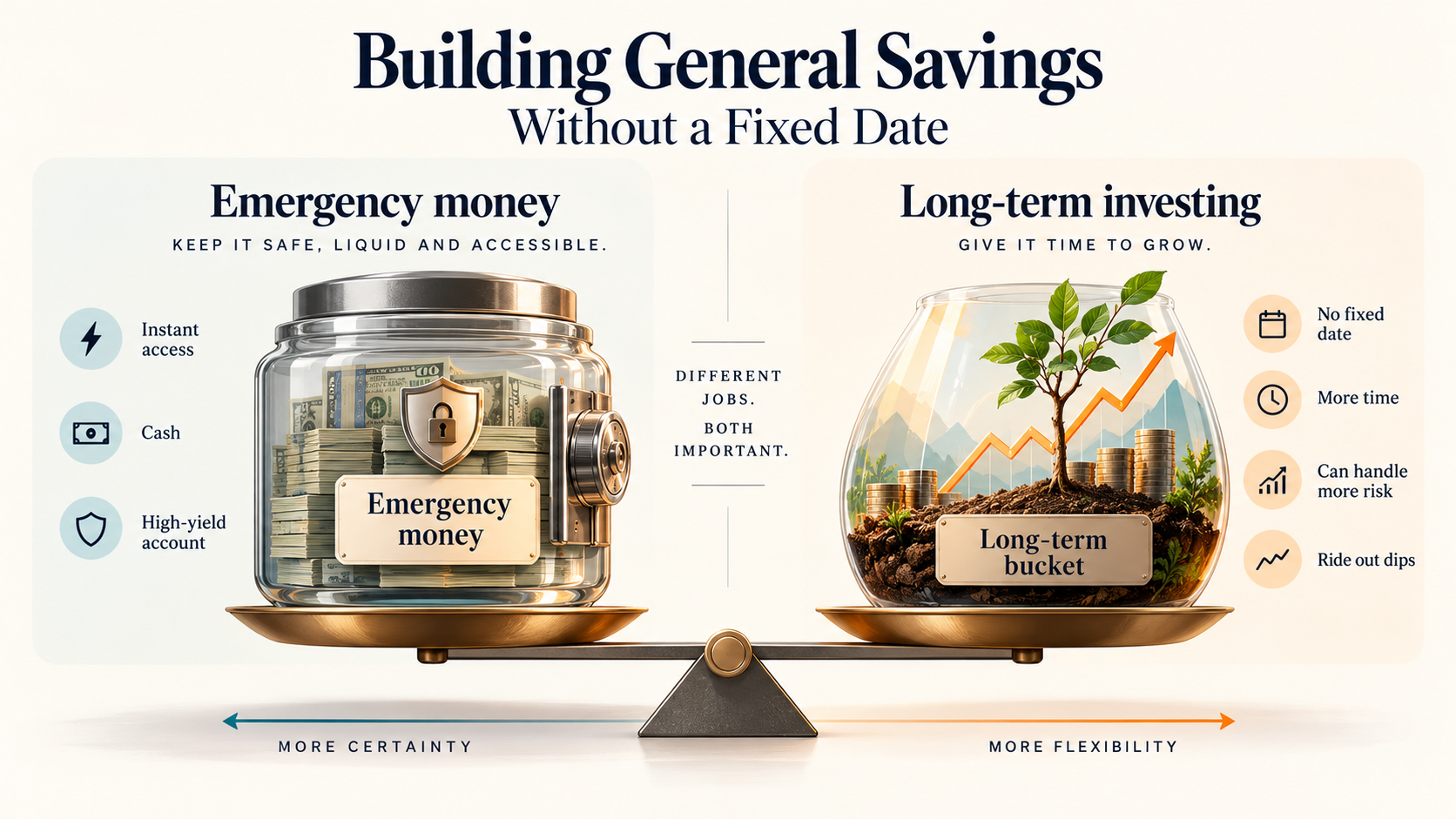
Without a fixed date, you can trade some certainty for growth, since there's no deadline forcing you to sell at a bad time. However, "savings" is really two buckets. Emergency money needs to be accessible instantly, so it stays in cash or a high-yield account, not invested. Everything else can behave more like long-term investing, since you have time to ride out dips. The less certain you are when you'll need it, the more risk that money can handle.
A Long-Term Goal
When you are investing for a long-term goal, you are building an investment strategy to help your money grow over many years while managing the bumpy ride along the way.
- Diversification: Don't put all your eggs in one basket. Spreading your money across different investments—like mix of stocks and bonds—helps ensure you aren't wiped out if one single company or sector fails.
- Contributions: Making regular, steady additions to your account builds momentum. It keeps you moving forward, regardless of whether the market is up or down at any given moment.
- Rebalancing: Over time, some investments grow faster than others, which changes your original plan. Periodically resetting your portfolio back to your target mix keeps your risk level right where you want it.
- Short-Term Volatility: Be prepared for a wild ride. To chase bigger long-term growth, you often have to accept higher short-term ups and downs. Market drops can be stressful, and it is important to remember that prices can swing wildly and unpredictably.
Planning for the long term isn't about predicting the future. It is about setting up a balanced system that you can stick with through all kinds of market changes.
Several Goals at Once
The bucket approach means dividing your money into separate "buckets" based on when you need it and how much risk you want to take. Instead of putting all your money into one big portfolio, you treat each bucket like its own independent mini-portfolio.
It's like organizing your clothes. Instead of throwing every shirt, pants, and pair of socks into one giant pile, you use separate dresser drawers for different types of outfits.
- Separate Dates: You group your money by when you will need to spend it.
- Separate Amounts: You calculate exactly how much money belongs in each group.
- Separate Risk Limits: You choose different investment styles for each bucket. Money you need tomorrow stays in cash. Money you won't touch for ten years goes into riskier investments like stocks and/or crypto.
While this system keeps you organized, it creates two major challenges:
- Extra Complexity: Managing three or four separate buckets takes a lot of work. You have to constantly move money between buckets as time passes and your goals change.
- Duplicate Exposures: You might accidentally buy the same exact investment in two different buckets. For example, if Bucket 2 and Bucket 3 both own the same tech company stock, you are taking on way more risk in that one company than you realize.
Goal Comparison Table
Worked Example: From Target Amount to Monthly Contribution
Say you're saving €30,000 for a deposit in Spain, and you already have €12,000 put away, with 24 months to go.
- Gap: €30,000 − €12,000 = €18,000
- Time left: 24 months
- Required monthly contribution: €18,000 ÷ 24 = €750/month, assuming zero growth
That €750 is the number you can actually count on, it just comes from saving. If you assume a 4% return and lower your monthly contribution because of it, you're now depending on the market cooperating with your exact timeline. Returns are an average over time, not a guarantee for any specific two-year window. Build your plan on the contribution that gets you there with no growth, and let any actual returns be a bonus that gets you there early, not a number you're relying on to make your investment goals work at all.
Where Crypto May or May Not Fit
Crypto is a volatile allocation whose suitability depends on your investment goals and capacity for loss. Money required on a fixed near-term date may be particularly exposed to timing risk.
Even with new European laws in place, official European Supervisory Authorities (ESAs)—including the European Securities and Markets Authority (ESMA)—continue to issue strict warnings regarding digital assets. Regulators warn that many crypto-assets are highly speculative and retail consumers face the very real possibility of losing 100% of their invested money.
Reviewing the Strategy as the Goal Gets Closer
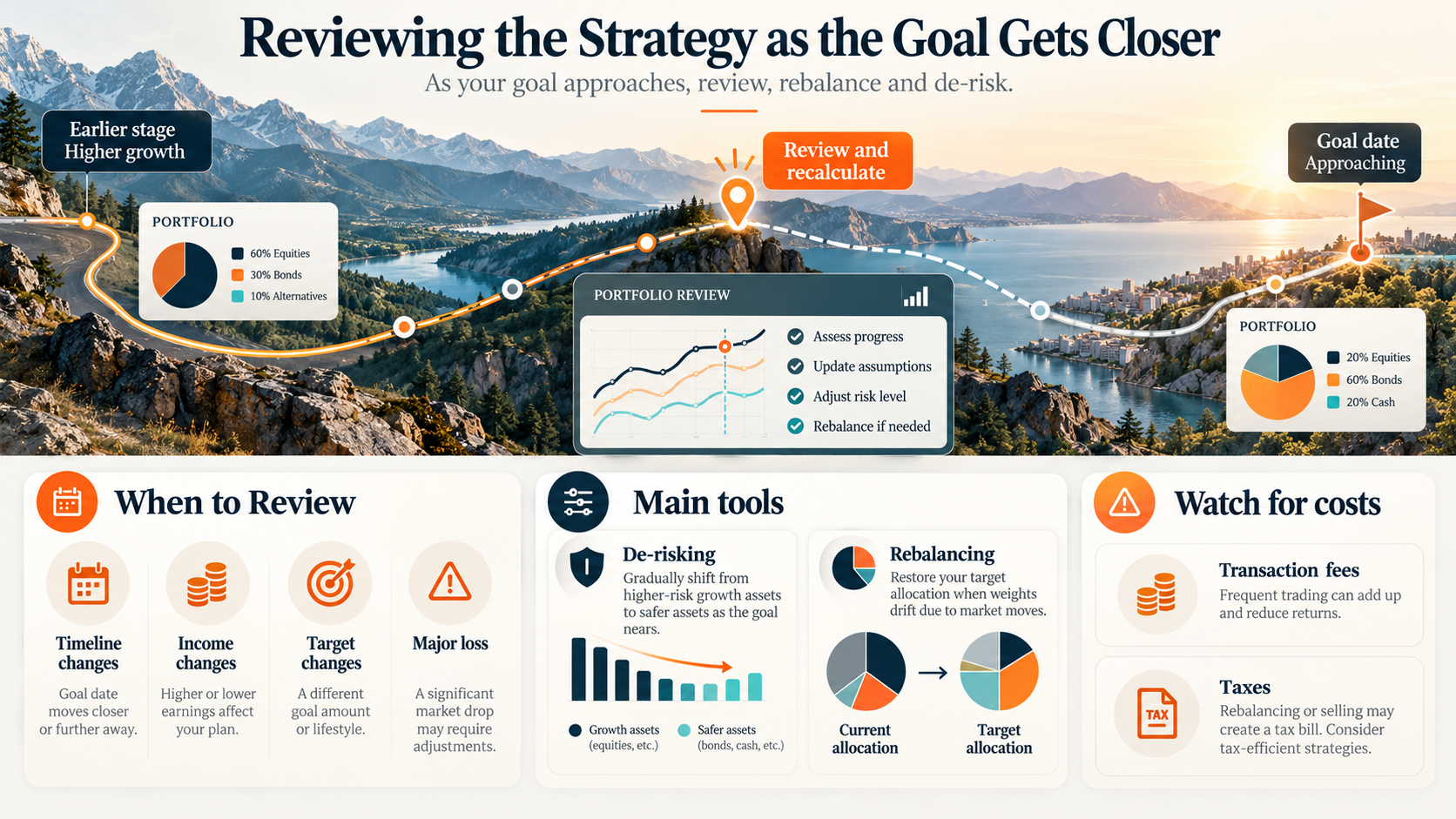
When you set a big financial goal, you can't just set it and forget it. As you get closer to your target date, you need to check in on your plan.
Think of your investment strategy like a GPS. If you change where you are going, the GPS needs to recalculate.
You should sit down and look at your investment strategy whenever major changes happen.
- The Timeline Changes: Your goal date moves closer or further away.
- Income Changes: You get a big raise, or you lose a job.
- Target Changes: You decide you need more or less money than you first thought.
- Major Loss: A market crash or an emergency wipes out some of your savings.
When these triggers happen, or as your deadline approaches, you will likely use two main tools:
- De-risking: This means moving your money into safer places.
- Rebalancing: This means resetting your investments back to your original plan. If your stocks grew really fast, they might now make up too much of your total money. You sell some stocks and buy other things to bring your plan back into balance.
Changing your strategy isn't always free. You need to watch for two things:
- Transaction Fees: Your bank or investment app might charge you a fee every time you buy or sell.
- Taxes: When you sell investments for a profit, the government often takes a cut (capital gains taxes).
Conclusion: A Strategy Is a Route to a Specific Goal
An investment strategy serves as a practical route to a specific goal by integrating the target amount, date, liquidity needs, and acceptable loss into a cohesive plan. Before continuing, you should verify all details within official product documents and consult with a qualified professional regarding your personal tax situation.
Disclaimer: The content provided in this article is for educational and informational purposes only and should not be considered financial or investment advice. Interacting with blockchain, crypto assets, and Web3 applications involves risks, including the potential loss of funds. Venga encourages readers to conduct thorough research and understand the risks before engaging with any crypto assets or blockchain technologies. For more details, please refer to our terms of service.