
Table of Contents
You open your crypto wallet one morning and there's a token you didn't buy. No purchase, no transfer, no explanation. It just appeared.
That's a crypto airdrop. But the mechanics are more considered than the name suggests.
Behind that surprise token is a deliberate mechanism. Projects send tokens to wallet addresses as part of launches, reward programmes, or ecosystem incentives. Not at random. According to rules someone set in advance.
This covers all of it. What they are, why projects use them, how the different types of airdrops work, and what to watch out for.
What Is an Airdrop in Crypto?
Crypto borrowed the term from military logistics. Planes dropping supplies to troops on the ground. Here, it's tokens landing in wallets – but only the right wallets, based on criteria the project has set.
In practice: a blockchain project sets aside some of its token supply, decides who qualifies, and sends the tokens out. Automatically in some cases, via a claiming portal in others. No money required on the receiving end.
Worth clearing up early: crypto airdrops and Apple's AirDrop file-sharing feature share a name and nothing else. Completely unrelated. More people have gone hunting through their iPhone settings for a crypto airdrop than you'd expect.
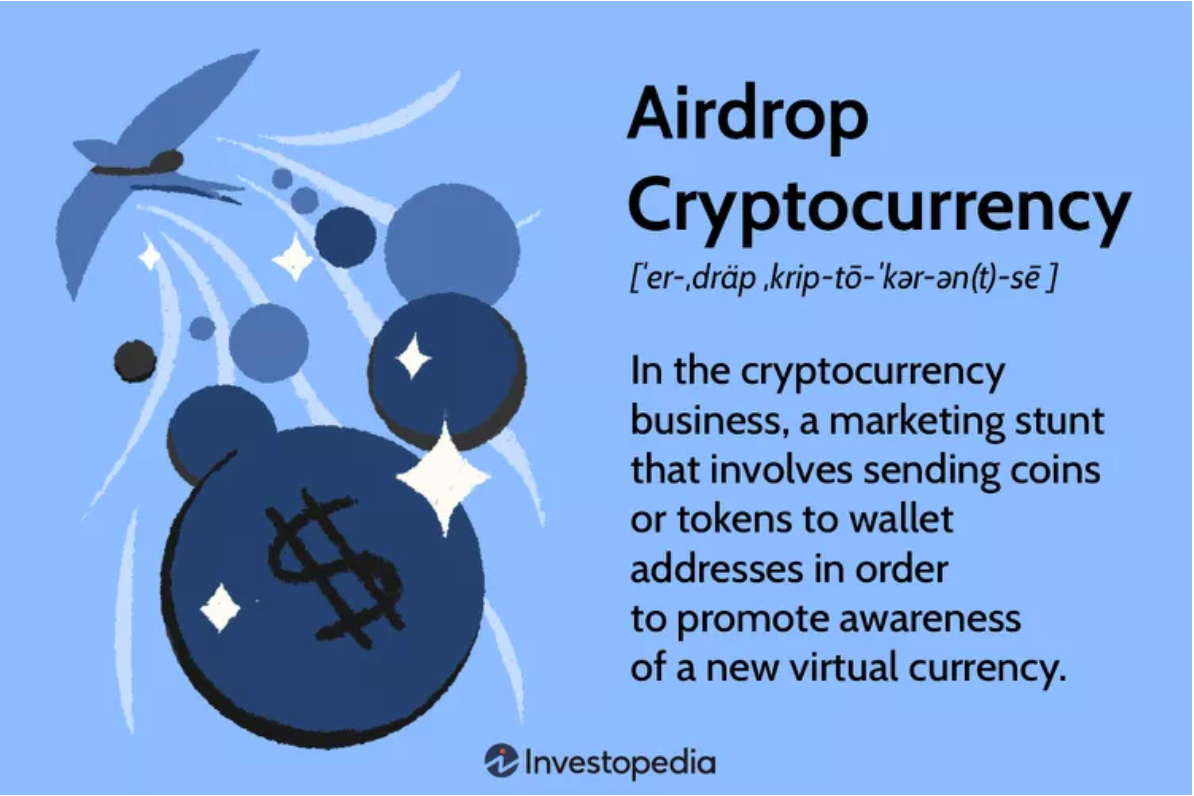
2014 is when it started taking shape. Auroracoin distributed coins to Icelandic residents as part of a push to bootstrap a new national cryptocurrency from scratch. Rough template, but recognisable. What's changed since is scale and sophistication. DeFi (decentralised finance) protocols now run retroactive distributions that can drop tokens worth thousands of pounds into wallets based entirely on on-chain activity users weren't tracking at the time.
The tokens in an airdrop are usually a new or recently issued asset. A slice of total supply gets earmarked for distribution, separate from what goes to investors, the founding team, or a treasury. How big that slice is matters. A project setting aside 1% of supply for an airdrop is saying something different about decentralisation than one setting aside 10%.
Why Do Crypto Projects Use Airdrops?
What a project wants from an airdrop usually reflects where it is in its development.
Marketing sits at the top of the list. Tokens in new wallets means awareness and conversation, plus a supply that isn't concentrated in one place. For an early-stage project, broad distribution on day one can matter more than where the price opens.
Community building is closely related but slightly different. Projects often want tokens held by many participants rather than concentrated in the hands of a few early investors. A wider token distribution creates a broader stakeholder base and can make the project feel less centralised.
Governance is another major use case. Projects built around DAOs (decentralised autonomous organisations) need voting power distributed across many participants. Airdropping governance tokens to people who have actually used the protocol tends to produce more engaged voters than simply selling them to whoever has money to spend.

There's also a price discovery element. When tokens are distributed to a wide audience before being listed on exchanges, the resulting mix of holders with different intentions helps establish an initial trading range. That early distribution can shape how the token is perceived in the market from day one.
Projects have also used airdrops as a decentralisation mechanism in a more formal sense. In certain jurisdictions, the regulatory classification of a token can depend partly on how concentrated its distribution is. A token held almost entirely by founders and investors looks different to regulators than one distributed across thousands of independent users. Airdrops have been used, not always convincingly, as part of the argument that a token's distribution is broad enough to matter.
Loyalty and reward round it out. Uniswap's September 2020 distribution of 400 UNI tokens to every historical user is probably the most cited example in DeFi history. Those tokens were worth roughly £900-£1000 at launch. At peak prices in 2021, that allocation was worth over £12,000 per wallet, going to users who had done nothing more than use the exchange before a specific date.
Different framing, same end goal: get tokens to wallets that will actually do something with them. Flooding addresses at random and hoping for the best is not the point.
What Types of Crypto Airdrops Exist?
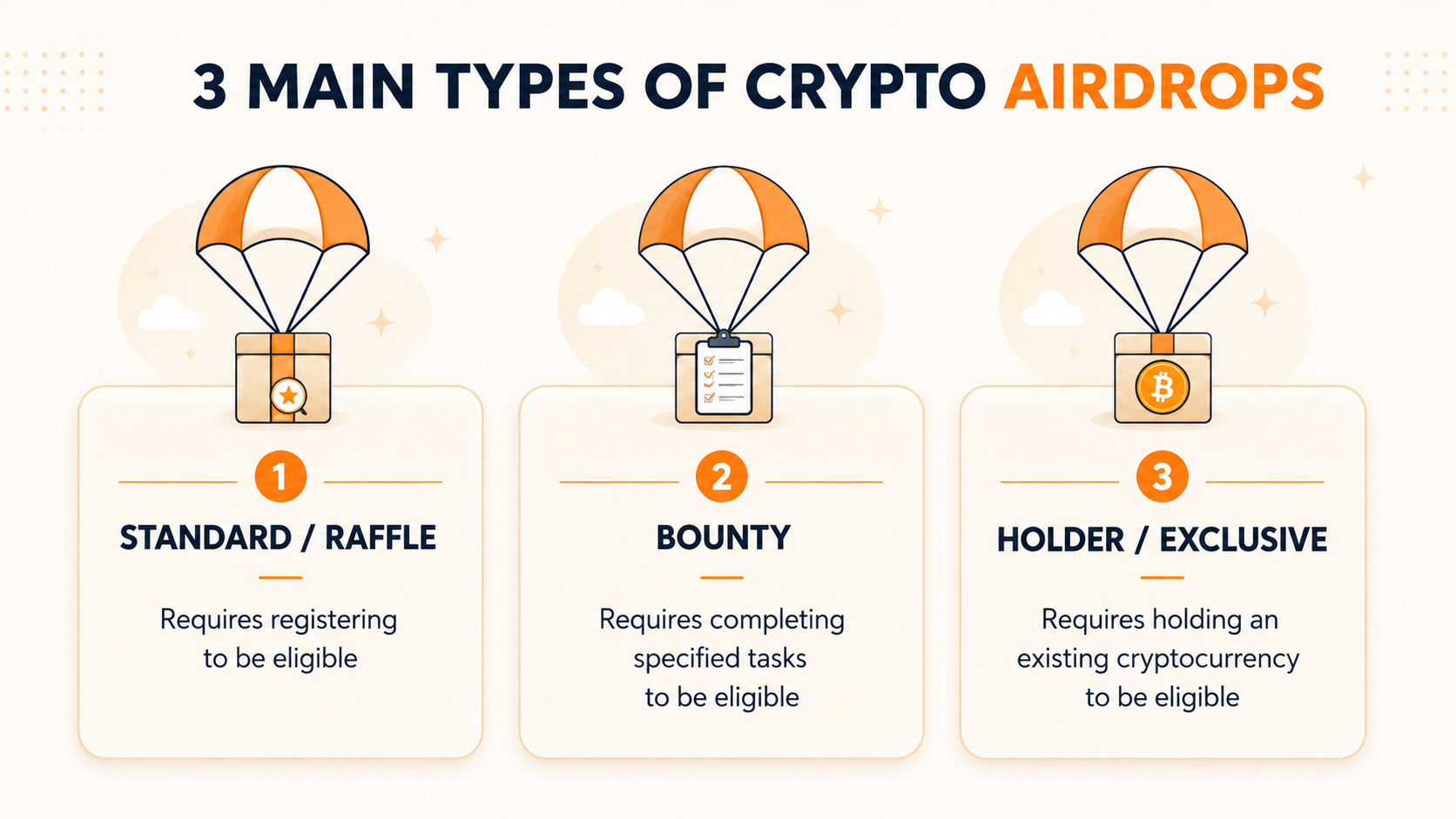
Airdrops come in several forms, each with different qualification criteria and different strategic purposes.
Standard airdrops
The simplest format. Users register interest, usually by submitting a wallet address or signing up on the project's website, and receive tokens in return.
There are no complex eligibility criteria and no task to complete beyond registration. Standard airdrops are common at launch and are often capped, either by total supply or by the number of participants. Timing can matter. Once the cap is reached, registration closes. The RabbitX decentralised exchange used this approach to reward new sign-ups in its early days.
Bounty airdrops
Unlike standard airdrops, bounty versions require you to earn the tokens. Follow some accounts, share a post, join a Telegram group, write a review, refer a friend. Complete the checklist, receive the tokens.
Everyone gets something out of it. One Rare, an NFT (non-fungible token) platform focused on food culture, used exactly this model: a seven-step checklist with $50,000 in tokens waiting at the end. Twitter follows, friend tags, watchlist additions. Each step a small marketing win for the project.
This type of airdrop functions more like a growth campaign than a giveaway. The recipient earns their tokens.
Holder and snapshot airdrops
Holder airdrops go to people who already own a specific token at a particular point in time. That moment is the snapshot: the date at which the project records wallet balances across the network.
If you held the required asset before the snapshot date, you qualify automatically. Buy the day after, and you don't. Projects use this to reward loyal holders or to distribute a new token to the existing community of a related project. Sudoswap used this method when launching its SUDO governance token, distributing the first batch to holders of OXMON from its sister application.
Exclusive or retroactive airdrops
Retroactive airdrops skip the announcement. The project works back through on-chain history, finds the wallets that were actually active in the protocol, and rewards them based on what they did.
Arbitrum's ARB launch in March 2023 is probably the clearest recent case. Months of bridge usage, transaction history, and interaction volume went into the eligibility calculation. Wallets that had been active before the snapshot got tokens scaled to how much they'd done, and no one told them it was being tracked.
Retroactive distributions tend to attract real users rather than people who signed up specifically to collect airdrop tokens. That is generally the intention.
Two other formats appear occasionally: hard fork airdrops, where users holding an original asset receive tokens in a new chain that splits from it, and raffle airdrops, where a fixed token pool is distributed by lottery when interest exceeds supply. Neither is as common as the four types of airdrops above.
How Does a Crypto Airdrop Work in Practice?
Every airdrop runs slightly differently, but the skeleton tends to be the same.
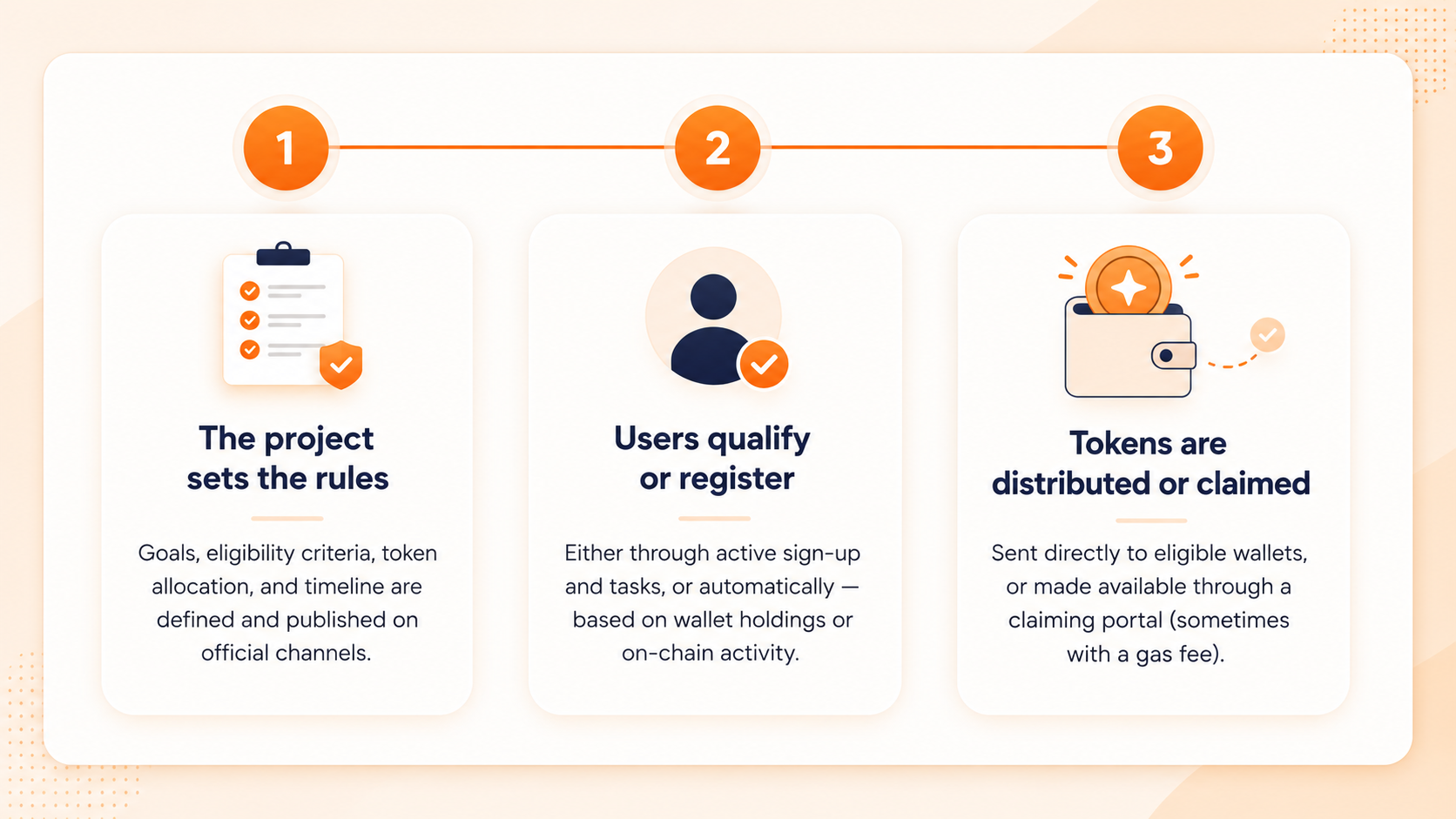
The project sets the rules
Before any distribution, the project defines what it's trying to achieve and builds the eligibility criteria around that goal. What behaviour does it want to reward? How widely should the tokens be distributed?
The rules cover who qualifies, what actions are required if any, when eligibility is assessed, and how many tokens are available. These are published on the project's official channels, sometimes in advance and sometimes only when the distribution is announced.
Users qualify or register
For standard and bounty airdrops, there's usually a registration period during which eligible users need to take action. For holder and retroactive airdrops, eligibility comes from existing wallet data. If you qualify, you're on the list.
Not all airdrops require active participation after the announcement. Many retroactive distributions send tokens directly to wallets, with nothing required from the recipient at all.
Some projects run what might be called forward-looking retroactive airdrops: they announce in advance that activity is being tracked, without specifying the exact eligibility criteria. Users who want to qualify can engage more with the protocol in the hope of meeting whatever threshold is eventually set. It's a different incentive structure from either a pure bounty or a true retroactive distribution.
Tokens are distributed or claimed
Token delivery splits two ways. Some airdrops just land in eligible wallets with nothing required. Others need a trip to a claiming portal, a wallet connection, and the user to manually trigger the transfer.
Claiming can carry a cost. On the Ethereum mainnet, every transaction requires a gas fee, the cost of processing activity on the network. On layer-2 networks such as Arbitrum or Base, which process transactions off the main chain at much lower cost, this is rarely a concern. Some projects cover claiming fees themselves to make sure eligible users aren't put off by the cost.
Some distributions also include lock-up conditions. Recipients may not be able to sell immediately after claiming, which is designed to reduce the sell pressure that often follows large token distributions.
What Makes Some Airdrops Valuable – and Others Forgettable?
Not all airdropped tokens are worth the same. Some lose most of their value within days. Others hold steady or appreciate.
Start with the project. If the token actually does something within the ecosystem, governance votes, staking rewards, fee reductions, holders have a reason to keep it. Tokens created purely as a launch incentive rarely build that kind of demand once the initial excitement fades.
Then there's the sell-off problem. Thousands of wallets receive tokens on the same day and a large portion of them sell at once. Vesting schedules, where tokens unlock in monthly tranches rather than all at once, take some of the pressure off that.
Cliff periods add another layer. A cliff is a point before which no tokens are released at all, followed by a gradual unlock schedule. A six-month cliff followed by 24 months of linear vesting means recipients wait half a year before receiving anything, then receive tokens slowly over two more years. From a price stability standpoint, that structure is far more considered than an immediate full unlock.
It's also worth noting that hype alone can temporarily inflate the value of an airdropped token. In the days after a distribution, prices sometimes spike before settling back. That window can be short.
The ratio of airdropped supply to total token supply is worth checking as well. A distribution representing a small percentage of total supply has less dilutive impact than one representing a large chunk.
People keep referencing the Uniswap UNI drop for a reason. Real protocol behind it, actual utility in the token, a distribution large enough to matter but not so large it swamped the supply. Most airdrops land one of those. Two is rare. All three is rarer still.
What Risks Should Users Watch Out For?
Free tokens get attention. And that's also what makes them a consistent target for airdrop scams.
Scams and fake airdrops
Scammers follow the money. Fake airdrop posts turn up across Telegram, Twitter, and on sites built to be indistinguishable from the real project's page until you check the URL.
Private keys and seed phrases should never come up. No legitimate airdrop asks for either. If a claiming process does, close the tab without a second thought.
Scam announcements are designed to look authentic, copying logos and impersonating official accounts. Fake claiming portals work by asking users to connect their wallet and approve a malicious contract. Once approved, the contract can drain the wallet's contents. The only reliable check is going directly to the project's verified website before interacting with anything.
There's also a category of airdrop that is technically real but structured to obscure its terms. Tokens arrive in the wallet, then conditions emerge afterwards: staking requirements, additional tasks, or linked assets needed before the full amount unlocks. Reading the distribution terms before claiming is worth the two minutes.
Wallet and security risks
A less obvious risk is the dust attack. A bad actor sends tiny amounts of a token to a wallet, so small they appear worthless. Because all transactions on a public blockchain are visible, those deposits can be used to trace the wallet's connections to other addresses. Interacting with those tokens later may trigger malicious contract activity.
The general principle: receiving tokens from an unknown source doesn't on its own create risk. Interacting with those tokens can.
Low-value or highly speculative tokens
Receiving tokens doesn't mean receiving value. Many airdropped assets lose most of their price in the days after distribution, often because a large proportion of recipients sell at once.
Sell-offs from recipients with no attachment to the project often create a sharp price drop within the first 48 to 72 hours. That pattern is common enough in the space to have a name: the airdrop dump. Awareness of it doesn't make the tokens worthless, but it's a reasonable expectation to have about price behaviour immediately after distribution.
It's also worth checking whether a token is listed on reputable exchanges with real trading volume. Some airdropped tokens only exist on low-liquidity platforms where selling at any practical price is difficult.
Tax and reporting implications
In the UK, HMRC (His Majesty's Revenue and Customs) treats airdropped tokens as miscellaneous income at the point of receipt. The taxable figure is whatever they were worth when they arrived in your wallet, not what you eventually sell them for.
When you later sell, any gain above that original value may be subject to capital gains tax. The precise treatment can depend on how the airdrop was structured and whether any conditions were attached to receiving the tokens.
It's worth understanding this before participating, not after. A tax adviser familiar with crypto assets is the right resource for anything beyond the basics.
How Can You Approach Airdrops More Carefully?
The risks above are not reasons to avoid airdrops. They're reasons to build a few straightforward habits before getting involved.
Verification comes first. Find the project's official site yourself and type the address directly – do not click a link from a DM or an account you don't recognise. A first announcement appearing only in a Telegram group you didn't ask to join is already a red flag.
Check wallet compatibility before anything else. Some airdrops only work with certain wallet types, and missing that detail means the tokens go nowhere even if you tick every other eligibility box.
For any claiming process, find out what the gas fee will be before connecting. On some networks, this check takes thirty seconds and can save the cost of a transaction that returns less than it costs.
A separate claiming wallet is a practical measure many experienced users adopt. Keeping a wallet with minimal holdings specifically for interacting with new or unfamiliar contracts limits exposure if something goes wrong.
The table below covers the key things to check before participating in any airdrop.
Conclusion: What Should You Understand About Airdrops First?
Crypto airdrops aren't a lucky surprise. Behind each one is a deliberate distribution strategy: growing a community, rewarding people who showed up early, or getting governance tokens to wallets that will actually use them.
Before joining any of them, three questions are worth asking. What's the project actually trying to achieve with this? What type of distribution is it, and do you qualify? And what could go wrong – scams, tax obligations, a token that drops in value the week after launch?
None of them are guaranteed to be meaningful. Uniswap's UNI drop in 2020 was significant for people who qualified, but it was also unusual. A protocol with genuine usage, a token that had actual utility, a distribution not built around hype alone. Most don't clear all three. That's also worth remembering the next time a new airdrop gets announced and the numbers sound large. The structure matters more than the headline figure.
Disclaimer: The content provided in this article is for educational and informational purposes only and should not be considered financial or investment advice. Interacting with blockchain, crypto assets, and Web3 applications involves risks, including the potential loss of funds. Venga encourages readers to conduct thorough research and understand the risks before engaging with any crypto assets or blockchain technologies. For more details, please refer to our terms of service.