Table of Contents
Portfolio diversification spreads exposure across investments that do not all respond in the same way, reducing dependence on one outcome. By spreading your wealth across multiple asset classes in a diversified portfolio you can help protect yourself should one or more of those asset classes not perform well. Although portfolio diversification can help you reduce risk, and can narrow the range of results, it cannot prevent market-wide losses or guarantee a return.
It's sort of like ordering a lot of different desserts at a restaurant. You increase your chances that at least one of the desserts will taste good and reduce the risk of a disappointment if something tastes bad. The more you order, the more likely you are to at least like one of your desserts. A diversified portfolio of desserts is a good idea, especially if you read the menu and don't know what any of the desserts are exactly because the names are in another language or the description isn't descriptive enough.
Diversification vs Asset Allocation
Asset allocation is the mix between broad asset classes and diversification is the spread within and across them. However, owning many securities can still leave one dominant risk. For example, stocks in the same market often move in the same direction. Also, when a major recession hits, most companies lose value at the same time. If your 20 different stocks all belong to the stock market, a crash pulls them all down together. You reduce risk associated with one company failing but still have the risk of the entire market failing.
The Role of Correlation
Correlation measures how two asset prices move in relation to each other. It is scored on a scale from +1.0 to -1.0. In positive correlation (+1.0) two assets move in the same direction. In negative correlation (-1.0) two assets move in opposite directions. In low correlation (~0) two assets move independently.
The price movement of one asset gives no clue about what the other asset will do. Take the example of correlation between a tech company and a physical asset like gold. During normal markets, they have low correlation. However, during market stress, investors often dump all their volatile assets at the same time, causing the tech company and gold to crash together.
It's sort of like skateboarding and biking. If a scateboarder and biker are both using a ramp, the skateboarder falling doesn't have anything to do with whether the biker falls off of his bike as well. But if the ramp is suddenly removed while they are moving toward it, they will both fall.
The Main Layers of a Diversified Portfolio
Here are the main layers of a diversified portfolio. Each targets distinct risk sources:1. Asset Class (Systemic Risk)
- Target: Broad market crashes.
- Fix: Mix equities, bonds, cash, and commodities.
2. Sector (Business Cycle Risk)
- Target: Tech or energy downturns.
- Fix: Spread across technology, healthcare, and utilities.
3. Geography (Sovereign Risk)
- Target: Local economic or political crises.
- Fix: Allocate to domestic, developed, and emerging markets.
4. Currency (Purchasing Power Risk)
- Target: Local currency devaluation.
- Fix: Hold global assets denominated in different currencies.
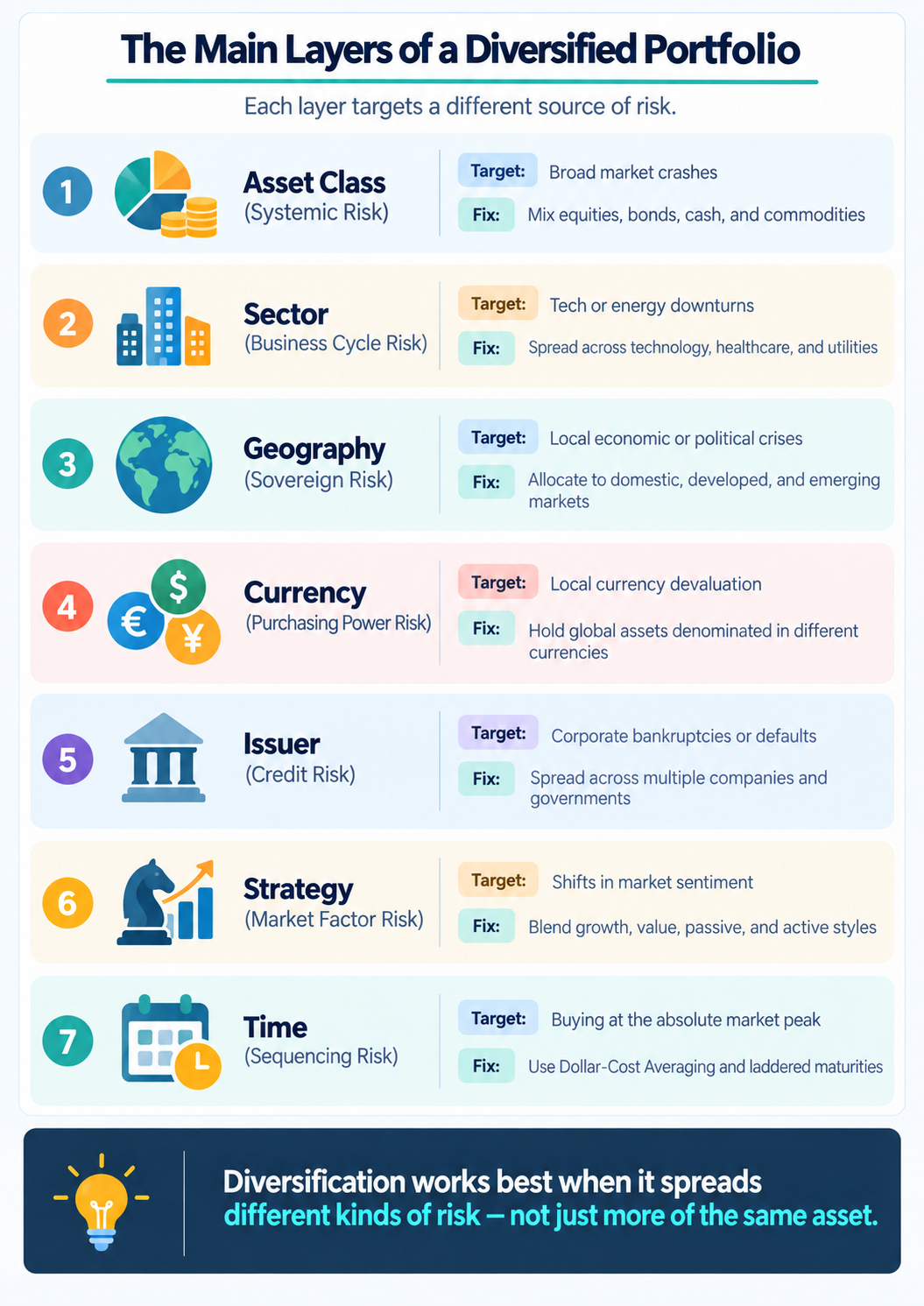
5. Issuer (Credit Risk)
- Target: Corporate bankruptcies or defaults.
- Fix: Spread across multiple companies and governments.
6. Strategy (Market Factor Risk)
- Target: Shifts in market sentiment.
- Fix: Blend growth, value, passive, and active styles.
- Target: Buying at the absolute market peak.
- Fix: Use Dollar-Cost Averaging and laddered maturities.
How Many Holdings Are Enough?
There is no magic number because what you own matters more than how many tickers you buy.
The answer depends on what each holding contains and how risks overlap.
- Broad Funds: A tiny handful of total-market index funds is enough because they already contain thousands of diversified global stocks.
- Individual Stocks: You need a wider, basket-sized selection of distinct names to effectively cancel out company-specific risk.
- Thematic ETFs & Overlap: Owning multiple tech funds provides zero safety because they share the same DNA. Similarly, mixing an S&P 500 fund with popular individual tech shares just duplicates risks you already own.
True safety comes from holding assets that behave differently from one another.
Home Bias, Currency and Geographic Diversification
A portfolio can be spread across companies but remain concentrated in one economy or currency. This means you are still at great risk if the economy or currency crashes. To build a truly diversified portfolio, you must look past where a stock trades and analyze where it actually conducts business.
- Trading Currency (The Listing): This is the currency used to buy and sell the stock on an exchange. For example, buying Nestlé on the Swiss exchange requires Swiss Francs (CHF).
- Underlying Economic & Currency Exposure (The Business): This is where the company makes its money. Nestlé is based in Switzerland, but it sells products globally.
- The Impact: If the U.S. Dollar strengthens or the Chinese economy slows down, Nestlé’s earnings will shift significantly, regardless of how the Swiss Franc is performing.
True geographic and currency diversification is driven by where a company’s customers are located, not where the company's headquarters or stock exchange are located.
A Practical Portfolio Example
Portfolio A concentrates risk in one company and one country/currency.
Portfolio B spreads exposure across asset classes, sectors, and geographies, so no single event (a stock drop, a rate move, a regional slump) affects more than a small amount at once.These are educational examples, not a real representation.
Why Several Funds May Still Overlap
This trips people up a lot: you buy three or four different funds thinking you've spread things out, and you end up owning the same handful of companies three or four times over.
- Top-holding duplication A "tech fund," a "growth fund," and an "innovation fund" can all be leaning on the exact same mega-cap names as their biggest positions, just in slightly different weightings.
- Common index exposure An S&P 500 fund and a Nasdaq 100 fund and even a "world" fund often converge on the same large-cap winners, because bigger companies dominate market-cap-weighted indexes no matter which one you pick.
- Regional concentration Something labeled "global" or "developed markets" can quietly be 60-70% US stocks, simply because the US makes up that much of most global benchmarks.
- Indirect crypto/tech exposure A fund can hold zero crypto by name and still be riding the crypto cycle through exchanges, chipmakers, or payment companies. Same idea with tech. A "balanced" or "diversified" fund can still be tech-heavy if the index underneath it is.
Just an illustration to show how overlap happens — not any real fund's actual holdings.
Can a Portfolio Be Overdiversified?
The point of portfolio diversification is to reduce risk, but sometimes extra holdings add little new exposure while increasing complexity, fees or difficulty rebalancing. However, concentration is not necessarily preferable, especially without considering the additional risk. It can be tricky to create a diversified portfolio that is diversified to just the right amount.
What Diversification Can and Cannot Reduce
Portfolio diversification is powerful, but it's not a cure-all and fix for everything. It only works on one specific type of risk.
What it reduces: company-specific riskThis is the risk tied to one company — a bad earnings report, a scandal, a failed product. Spread your money across enough companies and one blowing up barely dents the portfolio. This is the risk portfolio diversification is actually good at.
What it can't touch: risks that hit everything at once
- Market risk when the whole market drops, pretty much everything you own drops with it, no matter how spread out you are.
- Inflation risk rising prices erode purchasing power across cash, bonds, and most assets simultaneously. Diversifying among them doesn't create an exit.
- Interest-rate risk rate changes ripple through bonds, real estate, and borrowing-sensitive stocks all at once.
- Currency risk if you're holding foreign assets, currency swings affect that whole slice together, no matter how many different foreign holdings you have.
- Systemic risk a financial crisis or credit freeze doesn't discriminate by holding; it moves through the whole system.
The cost of dilution is that a diversified portfolio will not fully capture the best-performing holding. If you own 30 stocks and one of them triples, your portfolio doesn't triple — that gain gets reduced by the other 29.
Rebalancing Changes the Risk Mix
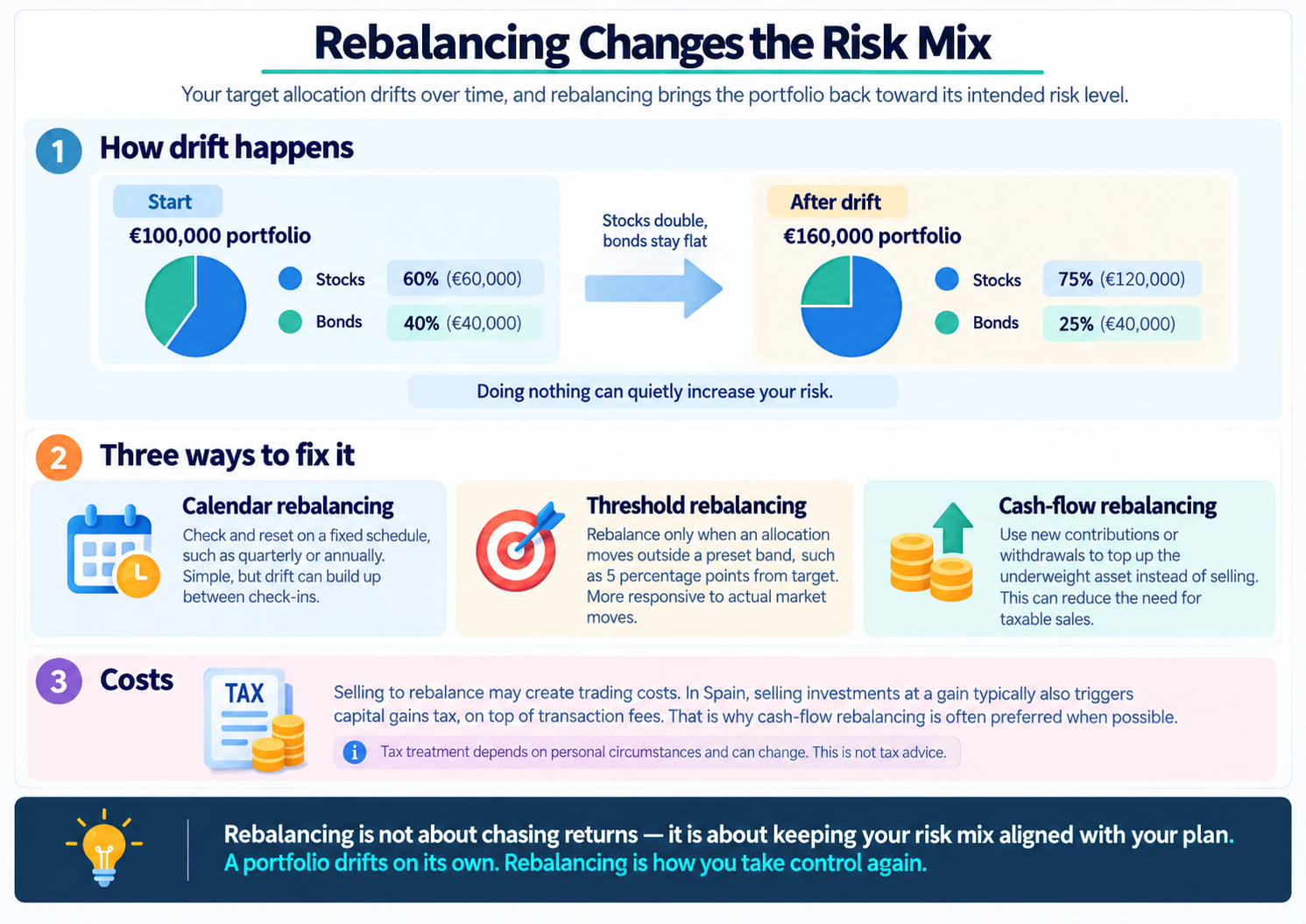
Here's the thing nobody tells you when you first build a portfolio: your target allocation doesn't stay put. It drifts on its own, just from normal price movement.
How drift happens
Say you start 60/40 stocks/bonds with €100,000. Stocks have a good run and double, bonds stay flat. Now you're sitting on €120,000 stocks and €40,000 bonds. That's 75/25, not 60/40. Nobody made a decision to take on more risk, but you did anyway, just by doing nothing.
Three ways to fix it
- Calendar rebalancing check and reset on a fixed schedule (quarterly, annually). Simple, but you might let drift build up between check-ins or rebalance when it wasn't really needed.
- Threshold rebalancing reset only when an allocation drifts past a set band (for example, 5 percentage points off target). More responsive to what's actually happening, less tied to the calendar.
- Cash-flow rebalancing instead of selling anything, direct new contributions (or withdrawals) toward whichever piece is underweight. This moves the mix back into line without triggering a taxable sale.
Costs
Selling to rebalance isn't free. Trading costs eat into returns, and in Spain, selling investments at a gain typically triggers capital gains tax, which is included on top of whatever you paid in transaction fees. That's part of why cash-flow rebalancing is often preferred when it's an option. It adjusts the mix without forcing a sale.
Tax treatment depends on your personal situation and can change, so this isn't tax advice. It's worth checking with a Spanish tax advisor before making rebalancing decisions with real money.
Where Crypto May Sit in an Investment Portfolio
Crypto is a distinct high-risk exposure whose correlation and volatility can change drastically and quickly. The size of crypto holdings in your portfolio depends on objectives, loss capacity and the rest of the portfolio. Loss capacity is the amount you can afford to lose on your investments before your lifestyle or long-term goals are harmed. Keep these things in mind when determining what percentage of your portfolio should be in crypto.
When Diversification Is Not Enough
A well-spread portfolio can still let you down in ways that have nothing to do with how many holdings you own.
- Emergency liquidity: if your money's tied up in a diversified mix of stocks, bonds, crypto, and property, that doesn't help much if you need cash next week. Diversification isn't a substitute for having an accessible emergency fund.
- Leverage: borrowing to invest amplifies losses regardless of how spread out the underlying assets are. A diversified portfolio bought with borrowed money can still wipe you out.
- Unsuitable horizon: a perfectly diversified portfolio built for a 20-year horizon can still be the wrong fit if you actually need the money in two years. Diversification manages risk within a timeframe, it doesn't fix a mismatched timeframe.
- Product failure: the fund manager, custodian, or platform itself can fail or mishandle things, independent of how diversified the holdings are. You're trusting more than just the assets.
- Correlated sell-offs: in a real crisis, assets that normally move independently can suddenly drop together. Diversification assumes things don't all fall at once, and that assumption can break exactly when you need it.
To actually understand a portfolio, you need more than the list of holdings. You need the overall allocation and how concentrated or spread it really is, how liquid each piece is, how much leverage (if any) is involved, whether the timeframe matches your actual goals, and who's holding the assets on your behalf. The holdings tell you what you own. These other things tell you what you're exposed to.
Conclusion: Diversification Works at the Portfolio Level
The number of products is less important than the underlying sources of risk and their interaction. Correlation, or how two asset prices move in relation to each other, concentration, or how much of your portfolio is in any individual thing, costs, or what you have to pay for any specific action, and portfolio rebalancing, or buying and selling assets to return to your target asset mix, are all important things to keep in mind when diversifying your protfolio. They can contribute to how much money you actually earn. A well diversified portfolio can help protect you from some risk, but is not a guarantee of certain returns.
Disclaimer: The content provided in this article is for educational and informational purposes only and should not be considered financial or investment advice. Interacting with blockchain, crypto assets, and Web3 applications involves risks, including the potential loss of funds. Venga encourages readers to conduct thorough research and understand the risks before engaging with any crypto assets or blockchain technologies. For more details, please refer to our terms of service.