
Table of Contents
If you are an investor interested in crypto strategies, you may want to consider new ways of increasing your holdings. One of the ways to gradually grow your asset amounts is to ensure a steady inflow of funds.
Maybe you are familiar with the dollar-cost averaging (DCA) approach that helps investors reduce risk and minimize the impact of emotions. It is based on investing a certain sum of money following a predetermined schedule, regardless of market ups and downs.
This article also focuses on creating a regular investing routine. However, we’ll discuss how to control different variables and therefore develop different cash flow and price exposure patterns. You’ll learn the pros and cons of investing €50 in BTC and buying a fixed 0.001 BTC monthly.
What Is the Main Difference Between the Two Approaches?
Let’s say you want to invest in Bitcoin on a regular basis. You may explore two options: either put a set amount of funds into an investment product or buy a fixed amount of an asset. The approaches differ in implications for cost and potential returns.
Approach 1. You invest €50 or any other cash sum into BTC every month. The amount of money spent does not change from one period to another. The amount of BTC you get is different each time, since the quotes are not stable.
Approach 2. You buy 0.001 BTC or any other set asset fraction every month. The amount of cryptocurrency you get is the same for every transaction. The euro cost changes, so you require a flexible monthly budget.
How Does Investing a Fixed €50 in BTC Work?
If an investor follows the first strategy and allocates the same 50 euros at each time interval, they don’t have to watch the price of digital assets. It does not matter whether the price grows or declines. That’s the dollar-cost averaging mechanism. The DCA allows buying more of an asset when prices are low and less when prices are high. You effectively average the cost.
For example, in June 2026, the average Bitcoin price was around €51,000. So, investors had an opportunity to get approximately 0.00097 BTC every time they made an installment. In September, the asset price went up to around €73,000. The fraction the investors got if they purchased Bitcoin was 0.00067 BTC, which is lower than before.
Since the investor first bought cryptocurrency cheaper and then at a higher price, the average cost per unit of BTC averaged down over time. Plus, the DCA removes emotional decision-making, the need to manage trades, and the stress typical for market timing.
What Changes If You Buy a Fixed 0.001 BTC Every Time?
Now let’s examine the opposite mechanics. With the second strategy, an investor commits to buying a strict quantity of cryptocurrency. Every purchase adds exactly 0.001 BTC to the portfolio. What changes is the sum of money an investor contributes, as it is directly dependent on fluctuations in quotes.
The target is the asset quantity, so you will have to accept that checking prices on the actual day of purchase might be unpleasant. When the digital asset price is low or goes down, you will spend less money. When the price rises, you’ll have to spend more euros.
For example, when the BTC cost on average €51,000 in June and July 2026, an investor needed €51 to get a fixed 0.001. In September, they already required €73 to acquire the same crypto portion. That’s before fees.
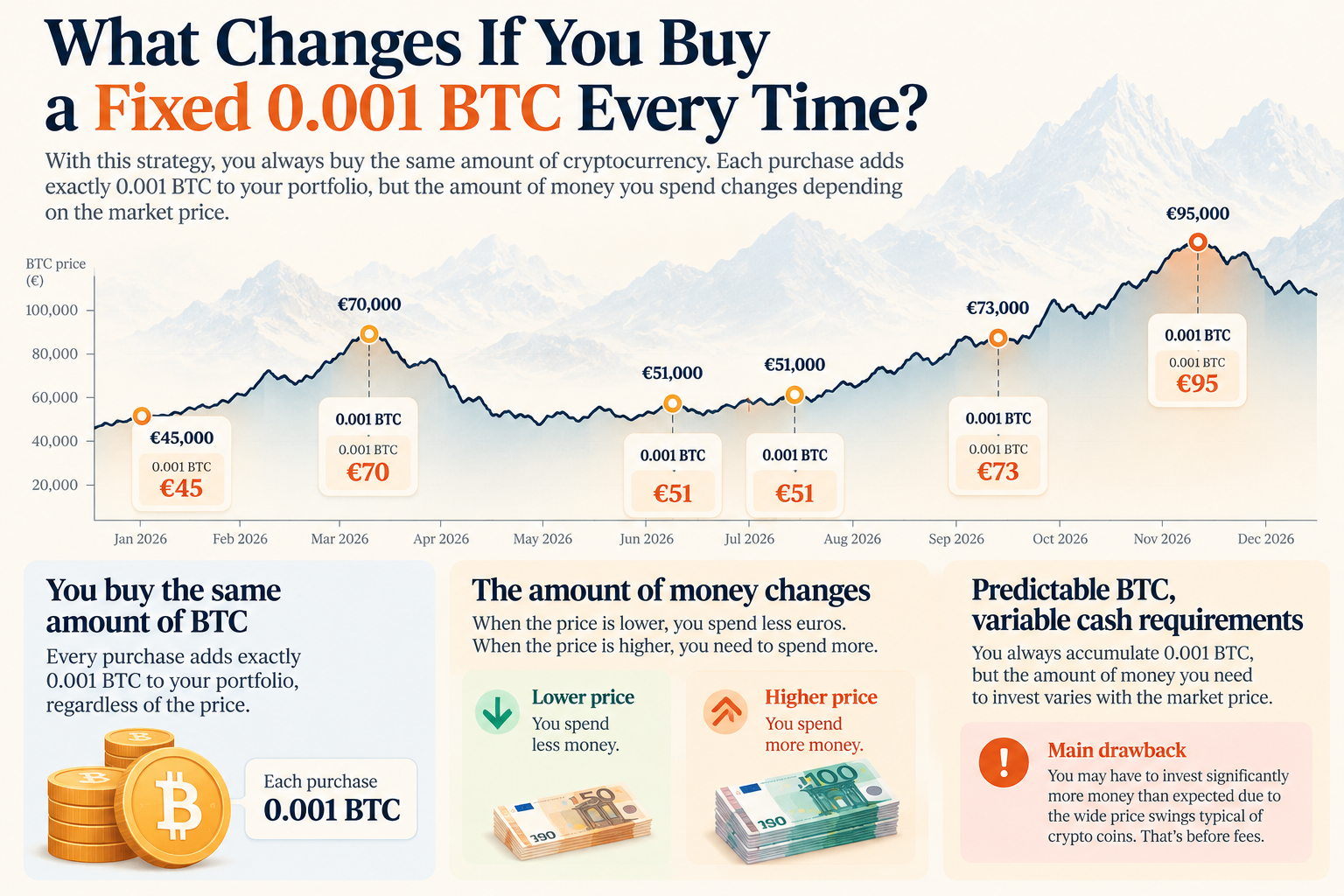
BTC accumulation becomes predictable while cash requirements are variable. The main drawback is that sometimes you will have to invest significantly more money than expected due to the wide price swings typical of crypto coins.
Is Buying 0.001 BTC Every Month Still Dollar-Cost Averaging?
No. Although this is a form of periodic investing, it lacks the core mathematical mechanism that gives the DCA method its name and provides its benefits. According to Investor.gov, dollar-cost averaging implies investing cash in equal portions at regular intervals. By doing so, an investor manages risk thanks to a consistent pattern of adding new money over a long time. Mathematically, this skews your average purchase price downward.
If an investor buys a fixed amount of Bitcoin every month, they lose the discount advantage of the DCA. They cannot control the sum of euros they spend, as it’s dependent on whether Bitcoin is cheap or expensive. The average cost per coin becomes the simple arithmetic average of the market prices. And this is fine, because the strategy is goal-oriented.
What Happens to Both Strategies When Bitcoin Rises or Falls?
The main distinguishing features of cryptocurrencies as an investment product are their high volatility, sensitivity to news, sudden surges, and sharp corrections. Therefore, you shouldn’t expect the same level of stability as with savings accounts or conservative assets. That’s why you need to understand what will happen to your money if market conditions and investor sentiment change dramatically, causing the crypto price to skyrocket or plummet.
- With the first strategy, when BTC is cheaper, €50 buys more of an asset, and when BTC is rising in value, the same €50 buys less.
- With the second one, buying a fixed 0.001 BTC requires fewer euros when the coin price falls, and the same fixed-BTC purchase becomes more expensive when it rises.
Which Strategy Is More Predictable?
The logic is as follows: fixed fiat = variable BTC; fixed BTC = variable fiat. The level of predictability of a strategy depends on what you actually want to predict.
If you need a stable and recurring cash commitment to stay calm and disciplined, for example, if you set a fixed amount from your salary every month, then the DCA is a suitable approach for you. It will be easier to distribute your monthly investment budget between assets. But you don’t know how much Bitcoin you’ll end up receiving.
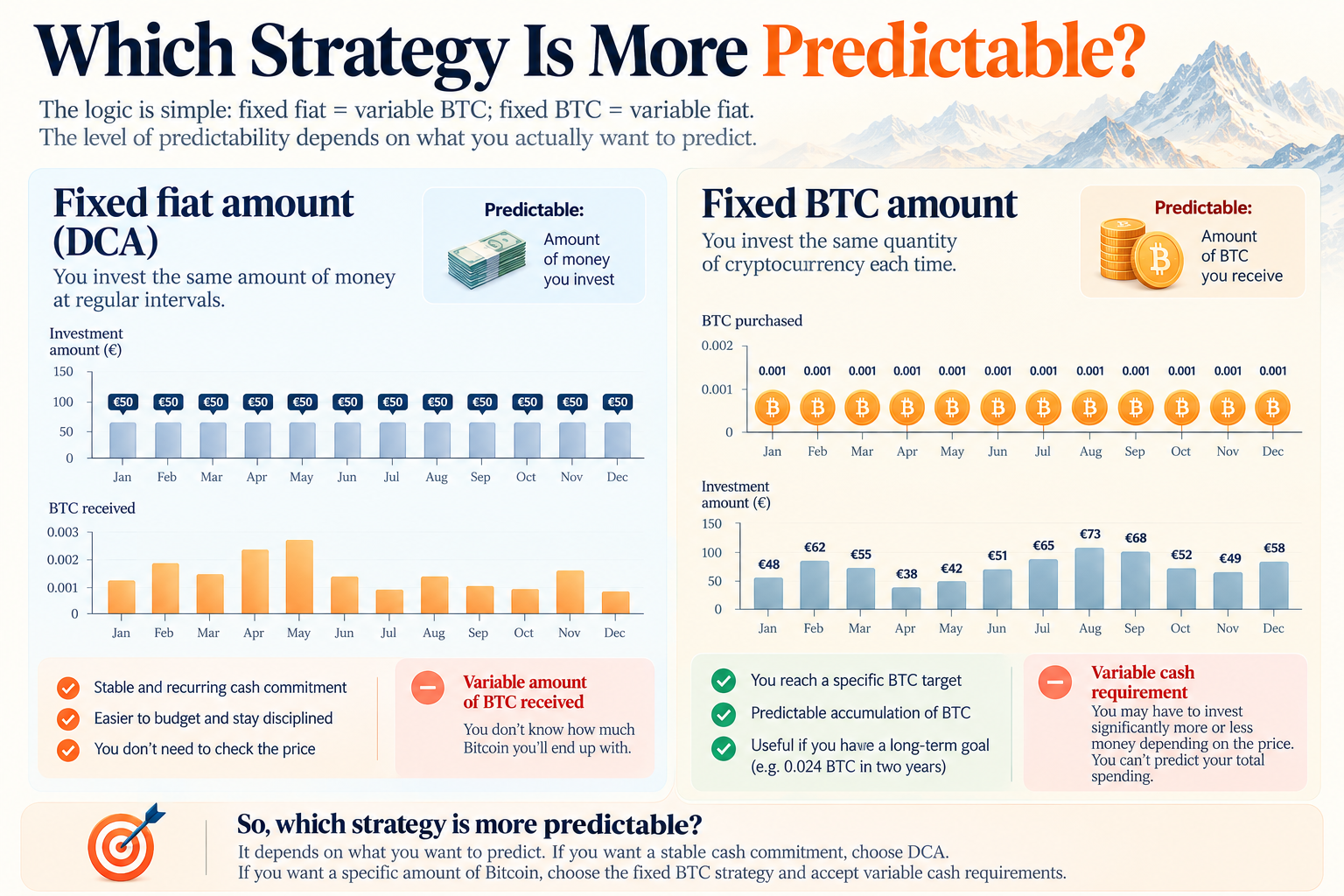
If you prioritize reaching a specific target, for example, you would like to have 0.024 Bitcoin in two years, then select the fixed 0.001 BTC strategy. The trade-off is accepting whatever budget fluctuations are necessary to get there. There won’t be an option to predict how much cash you will spend over the next two years.
How Do Fees and Minimum Orders Affect Regular Purchases?
The strategies described above share another common feature that stems from the regularity of investments. Since you’re not investing a lump sum all at once but making small purchases, you’ll consistently pay transaction fees, no matter which strategy you choose. You may also be affected by platform restrictions on minimum purchase amounts, if any, as well as taxes or fluctuations in the national currency exchange rate.
After all the expenses are deducted, your €50 order won’t result in €50 worth of BTC being added to the portfolio. And with a 0.001 BTC order, you won’t pay exactly €51, even though the crypto was traded at €51,000. Fees increase the amount of fiat required.
Practical Calculation: €50 vs. 0.001 BTC Over Six Months
Using the historical month-end closing prices for the BTC-EUR trading pair for the six months up to September 2026, we can perform a calculation to see how the two strategies played out.
Does Either Approach Guarantee a Better Investment Outcome?
No. When investing a fixed amount in fiat currency, the average purchase price may be lower under some price scenarios and higher under others. The exact same situation applies when investing a fixed number of coins.
When Can a Fixed Amount or Fixed Quantity Become Impractical?
Both approaches have limitations. A fixed euro contribution can become very small relative to fees or the crypto equivalent. With a fixed BTC target, a quantity that initially seems affordable may later become harder to maintain. What’s more, neither method solves the broader question of whether BTC is suitable for the investor.
The difference lies in what determines your fiat installment and the pace at which you accumulate assets. This could be the extreme volatility of crypto or your preferences. A fixed-cash-amount strategy limits your financial risk by protecting you from price spikes. It helps you take advantage of market corrections. Conversely, a fixed-asset-amount option shifts all market risk onto you but guarantees a simple path to a specific crypto balance.
Disclaimer: The content provided in this article is for educational and informational purposes only and should not be considered financial or investment advice. Interacting with blockchain, crypto assets, and Web3 applications involves risks, including the potential loss of funds. Venga encourages readers to conduct thorough research and understand the risks before engaging with any crypto assets or blockchain technologies. For more details, please refer to our terms of service.