

Table of Contents
You deposit €1,000. Set leverage to 10x and the trade you open is worth €10,000. That extra €9,000 of buying power is leverage.
Profit gets calculated on the €10,000, but so does any loss. If the coin drops a few percent, most of your margin can disappear, and the platform may then close the trade for you. That forced close is liquidation, and the chance of it arriving sooner than expected is what people mean by leverage risk.
Plenty of traders found this out on 10 October 2025. Over 24 hours, more than $19 billion of leveraged crypto positions got liquidated, a bigger one-day total than anything before it. Roughly 1.62 million accounts were hit, and about 87% of the liquidated positions were long, meaning they'd bet on prices going up.
This guide walks through how leveraged trading actually works, using simple euro maths, so the numbers make sense before any real money is involved.
Leverage, Margin and Position Size
Four terms come up over and over below, and they get muddled a lot. Plain definitions first.
- Leverage ratio. How many times bigger your position is than your own money. At 10x, for example, €1,000 of your money is backing a €10,000 trade.
- Notional exposure. In the example above, it's €10,000. Profits, losses and most fees are calculated on this number, not on your deposit.
- Initial margin. The money you post to open the trade. So with 10x leverage, you'd put up a tenth of the position's value.
- Maintenance margin. Once the trade is open, the platform sets a lower floor that your account has to stay above. Fall below it and the platform can start closing you out.
One important caveat: providers don't all calculate these the same way. Some use tiered margin that rises with position size, some quote margin as a percentage and others as a ratio. The product's own documentation is the only reliable reference.
Leverage in Spot Margin, Futures and CFDs
Spot margin, futures and contracts for difference (CFDs) can all give you crypto leverage. How they do it varies quite a lot, as the table shows.
Access and protections depend on three things: the provider, the instrument and where you live. For example, a retail CFD from a firm regulated in Spain and a perpetual contract on an offshore exchange might both follow Bitcoin. The rules protecting you on each one are completely different.
A Simple 1x, 5x and 10x Comparison
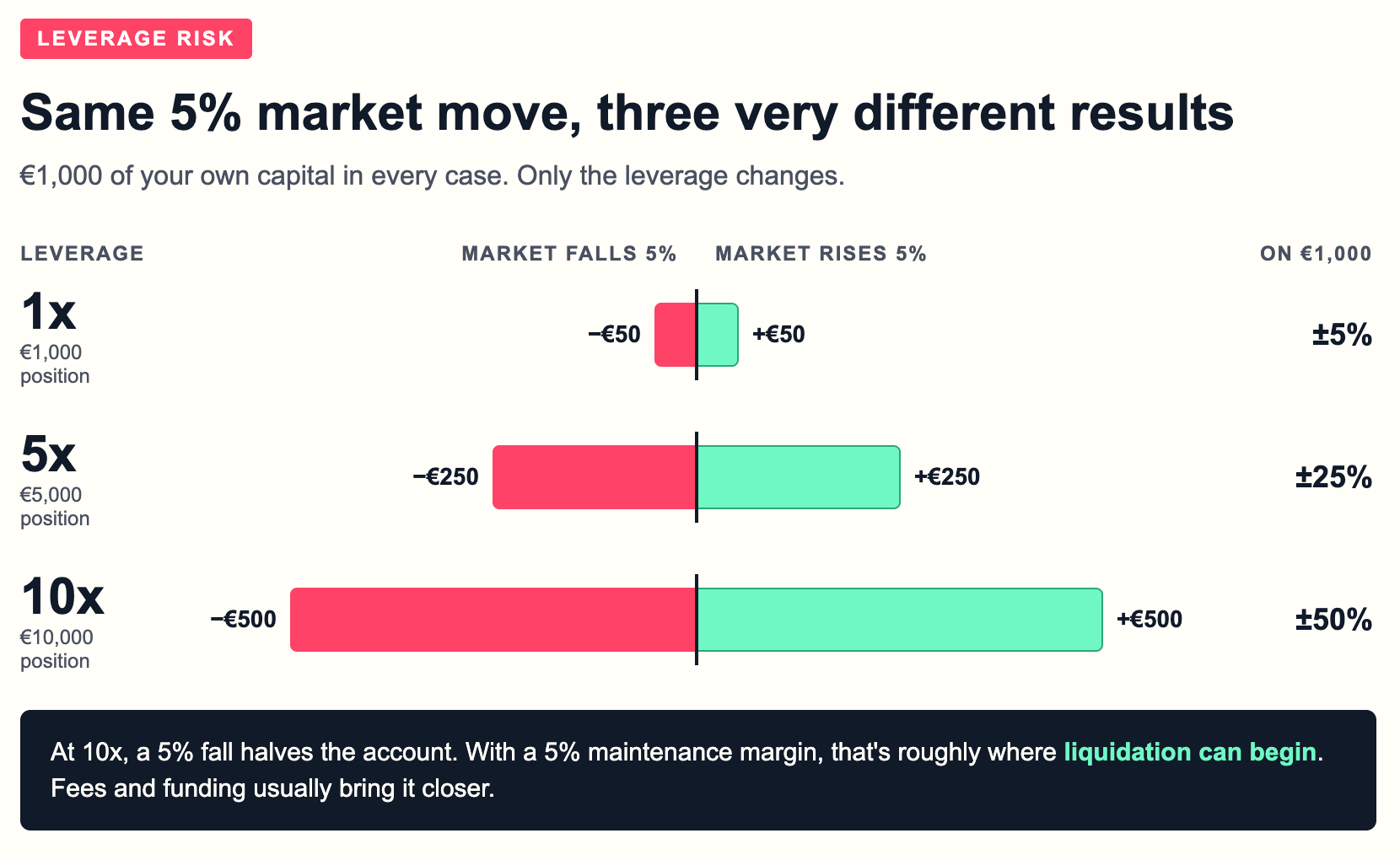
Here's the same €1,000 of capital at three levels of leverage, with the market moving 5% either way. Fees are ignored for now.
At 10x, a 5% dip halves the account. If the platform's maintenance margin sits at 5% of the position, as it does on some venues, that same dip puts the trade right at the liquidation line.
Real liquidation mechanics are messier than this table. Fees, funding, mark price calculations and tiered margin all shift the exact point, usually closer rather than further away.
Why Percentage Losses on Capital Accelerate
The relationship is simple multiplication. Take the market move, multiply by the leverage ratio, and you get the approximate change on your capital before costs.
A 2% move at 20x is a 40% hit. A 10% move at 10x wipes out the full margin.
Leverage doesn't make Bitcoin more volatile. What changes is how hard each price swing lands on your account.
A 5% daily swing in Bitcoin is pretty routine, and plenty of people who hold it outright wouldn't even open the app. Put the same swing on a 10x position and it can be enough to end the trade.
How Liquidation Works
In plain terms, liquidation means the platform shuts your position for you. It happens when losses have eaten so far into your margin that what's left can't meet the maintenance requirement.
Most venues watch a mark price rather than the last traded price. The mark price is built mainly from an index of spot prices across several exchanges, so a single odd trade on one venue doesn't trigger a wave of closures. Binance uses mark price to calculate both unrealised losses and liquidation levels.
Once your margin crosses that line, software called a liquidation engine starts closing the position. There's no phone call and usually no grace period.
Rules differ by venue. Some examples, current at the time of writing:
- Kraken's EEA (European Economic Area) derivatives can partially liquidate a position until equity is back above maintenance margin, or fully liquidate if it falls further. Kraken states plainly that it doesn't offer margin calls or warnings.
- Robinhood's EU perpetual futures set maintenance margin at 10% of position value, with a full close-out at 5% and a 0.05% liquidation fee.
- Binance first tries to reduce the position with a single large order and stops if the remaining margin is sufficient.
Every threshold here belongs to that specific product, and none of them carries over automatically to another venue.
Stop-Loss vs Liquidation
In leveraged trading, a stop-loss is your exit. You pick the price, and when the market reaches it, an order goes in to close the trade.
Liquidation is the platform's exit. It fires when your margin runs out, whether you've planned for it or not.
A stop set well above the liquidation price is a buffer, but not a guarantee. In a fast move, price can gap straight past a stop level. The order then fills at whatever the market offers, which may be much lower, or on the way to the liquidation level itself.
Neither price can be worked out from the leverage ratio alone. Fees, funding, tiered margin and mark price all move the real liquidation point.
Why the Liquidation Price Is Not the Only Leverage Risk
The liquidation price on the screen is an estimate. Kraken's own documentation says it "should not be taken as static". Several things quietly move it closer.
Funding payments. Perpetual futures have no expiry date, so a periodic payment between longs and shorts keeps the contract near the spot price. Binance settles funding every eight hours by default and can switch to hourly in volatile markets. Kraken's EEA perpetuals settle hourly. Each payment is calculated on the full position size, not your deposit.
- Trading fees. Opening and closing both cost money, and they're charged on notional value too.
- Spread and slippage. In thin or fast markets, orders fill away from the displayed price.
- Price gaps. Crypto trades around the clock, but liquidity doesn't. A sudden drop can skip whole price levels.
- Collateral value. If your margin is held in crypto, a falling price shrinks the margin itself.
- Platform rules. Tier changes, leverage caps and contract adjustments can all shift requirements mid-trade.
Each one trims the margin a little. Together, they can bring liquidation forward.
What Can Happen During and After Liquidation
What follows a liquidation depends entirely on the product's rules. Below are the main ones you'll come across, though a given venue might use only two or three.
Partial liquidation
Some platforms close only part of the position to restore margin. You keep a smaller trade, and a smaller balance.
Liquidation fees
Most venues charge a fee on liquidated positions. On Binance, a "Liquidation Clearance Fee" comes out of whatever margin remains.
Insurance funds
If a position closes at a worse price than the trader's margin can cover, some exchanges use an insurance fund to absorb the shortfall. During the October 2025 crash, Binance drew around $188 million from one of its insurance funds.
Auto-deleveraging (ADL)
When an insurance fund can't cover losses, some venues close profitable positions on the other side of the market to balance the books. So yes, even traders who were right can be closed out.
Negative balances
Regulated EU retail CFDs include negative balance protection, and Kraken says its EEA derivatives accounts can't go negative. Other products may treat a shortfall as a debt.
Cross Margin vs Isolated Margin
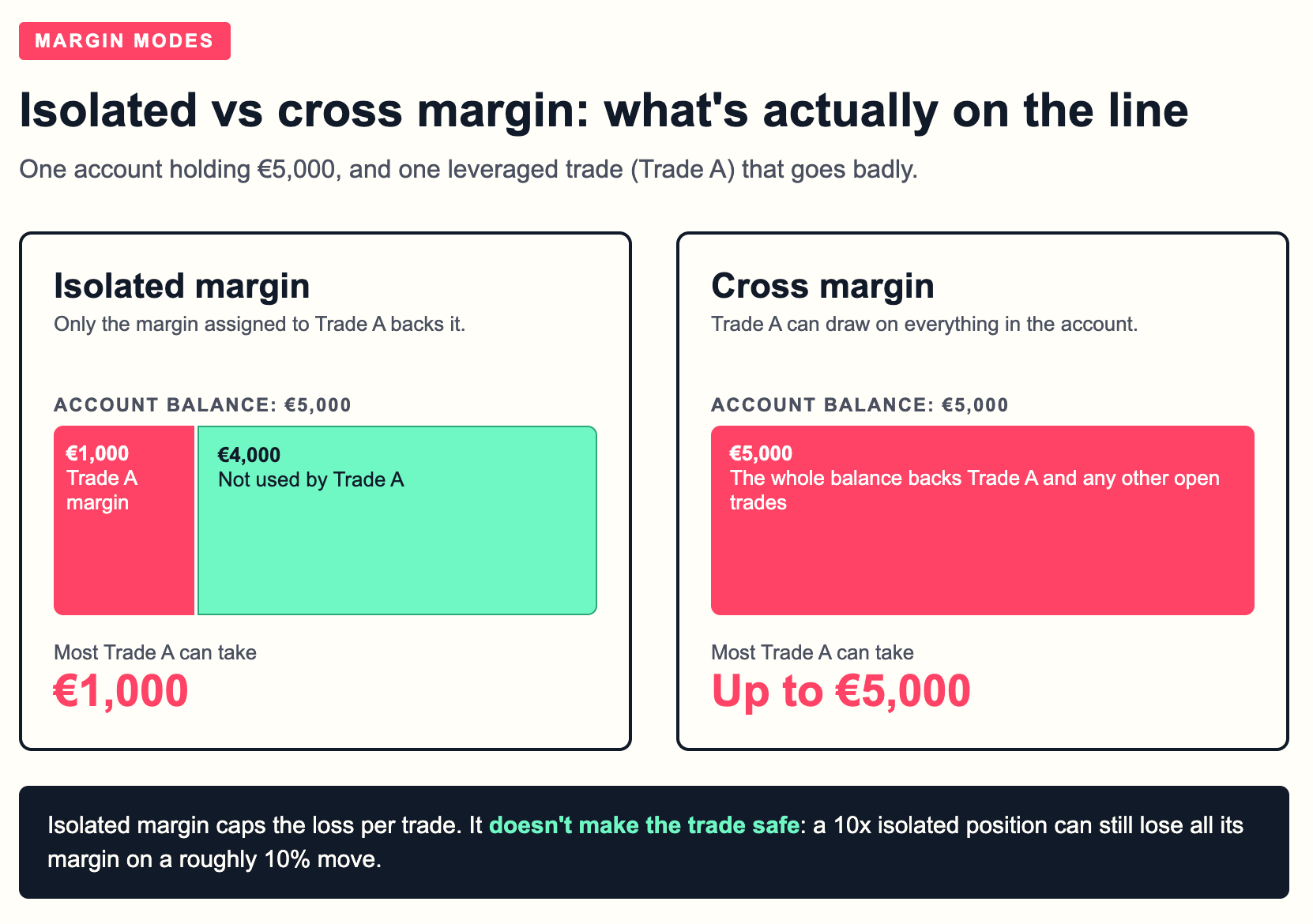
The margin mode decides how much of your money is actually on the line for each trade.
Isolated margin limits the damage a single position can do. It doesn't remove the leverage risk inside that position. A 10x isolated trade can still lose all of its margin on a roughly 10% move, and often before that point.
Cross margin can survive swings that would liquidate an isolated trade. The flip side is that a losing trade quietly draws on the rest of the account while it does.
Collateral Risk and Changing Effective Leverage
Effective leverage is your position size divided by the margin you actually have right now. It can drift upward even if you never touch the trade.
Losses shrink margin. Funding payments and fees do too. And if the collateral itself is crypto, its price can fall at the same moment the trade goes wrong.
Here's a hypothetical: A trader posts 0.02 BTC as collateral, worth €2,000 with Bitcoin at €100,000, and opens a €10,000 long on Bitcoin. That's 5x.
Bitcoin falls 10%. The position loses €1,000. The collateral is now worth €1,800. Total equity drops to €800 against a position worth €9,000.
Without any action from the trader, effective leverage has jumped from 5x to about 11x.
At a 15% fall, equity is €200 and effective leverage passes 40x. This is sometimes called wrong-way risk: the collateral and the position lose value together.
Stablecoin collateral isn't automatically immune. In October 2025, the synthetic dollar USDe briefly traded at around $0.65 on Binance, pulling down the margin value of anyone using it.
Worked Scenario: A Volatile Move and Forced Exit
Here is one hypothetical trade, followed from opening to liquidation. Every figure is an assumption for illustration, not a live product's formula.
Assumptions: Bitcoin at €100,000. €2,000 initial margin at 10x. Maintenance margin 5% of position value. 0.05% trading fee. Funding at 0.01% every eight hours for three days. A 0.5% liquidation fee.
A 5.7% fall in Bitcoin cost this trader about €1,262, or 63% of the deposit. Costs moved the liquidation point before the market even did anything.
For comparison, a stop-loss at €97,000 that filled cleanly would have cost about €638. The difference is the value of a planned exit, assuming the market lets it execute.
Leverage Rules for Retail Clients in Spain and the EU
Now to the rules. Back in 2018, ESMA (European Securities and Markets Authority) put a ceiling on the leverage EU brokers could offer retail clients on CFDs. Those product intervention measures were temporary, so national regulators later copied them into their own rulebooks.
For crypto, the ceiling is 2:1. Put another way, a retail trader has to post at least half the position's value as initial margin.
The same rules require a margin close-out once account funds fall to 50% of the initial margin posted, negative balance protection per account, and a risk warning showing the share of retail accounts that lose money.
Spain's version arrived in 2019 from the CNMV (Comisión Nacional del Mercado de Valores), the country's securities regulator.
A 2023 resolution added something more unusual. Since August that year, firms have been barred from advertising CFDs to retail clients in Spain, with narrow exceptions such as information a client asks for directly. Foreign firms selling into Spain are covered by the ban too.
Perpetual contracts came up in February 2026. On the 24th, ESMA published a public statement warning firms that selling a product as "perpetual futures" doesn't keep it out of the CFD rules. In ESMA's words, the commercial name "is irrelevant".
How that plays out is still developing. At the time of writing, some EU-licensed venues still list crypto perpetuals at up to 10x for EEA clients.
The bigger distinction is between regulated and offshore. A CFD from an EU-authorised firm comes with these protections. A perpetual contract on an exchange outside the EU framework may offer 50x crypto leverage or more, with none of them.
Why Leverage Risk Is Especially Demanding for Beginners
Leveraged trading moves faster than holding spot. A normal day for a Bitcoin holder can decide a leveraged position in minutes.
- The path matters too. A price can end the week where it started and still liquidate you on the way, because the engine only cares about the lowest point your margin reached.
- Then there's monitoring. Crypto markets run through the night and over weekends, and a position can be liquidated at 3am on a Sunday as easily as at lunchtime.
- The mechanics take some learning, too. Order types, margin modes and funding schedules all have to be right under time pressure.
And watching a position swing by 30% in an afternoon is stressful. Stress tends to produce rushed decisions, like adding margin to a losing trade or removing a stop at the wrong moment.
Experience helps with the mechanics. It doesn't remove the underlying leverage risk. Professional traders get liquidated as well.
When Leverage Does Not Fit the Situation
Some situations make leveraged trading a poor fit, whatever the market is doing.
- If losing the full margin would cause real financial difficulty, the risk is already too big. The same goes for money set aside for rent, bills or other living costs.
- If the liquidation rules for a product aren't clear, including how fees, funding and mark price work, the real risk can't be measured.
- Trading without a tested plan for entry, exit and position size leaves decisions to the moment. And a leveraged position that can't be monitored is running on hope.
Lower leverage reduces the pace of losses. It doesn't remove market risk. A 2x position still loses 20% on a 10% fall.
Conclusion: Exposure Matters More Than the Deposit
The deposit is what you put in. The exposure is what's actually at risk. Leverage risk lives in the gap between those two numbers, and the market only ever sees the bigger one.
Margin sets how much room there is before liquidation. Fees, funding, collateral values and platform rules all shrink that room over time, often faster than expected.
Understanding crypto leverage comes down to knowing the real notional size, the real liquidation terms and the protections that apply where you live. Those details live in each product's disclosures and in your local regulator's rules, and they're worth reading before considering any leveraged instrument.
Disclaimer: The content provided in this article is for educational and informational purposes only and should not be considered financial or investment advice. Interacting with blockchain, crypto assets, and Web3 applications involves risks, including the potential loss of funds. Venga encourages readers to conduct thorough research and understand the risks before engaging with any crypto assets or blockchain technologies. For more details, please refer to our terms of service.