
Table of Contents
Every investment comes with a pitch. Some are loud, some are polished, and plenty are perfectly honest. None of them are a risk assessment.
If you want to know how to assess investment risk properly, five questions do most of the work. What could cause a loss? How big could that loss get? When can you actually get your money back? Who owes you, or holds the assets for you? And which dated, independent documents back all of this up?
Marketing can introduce a product. Answering those questions takes the paperwork behind it.
Separate the Product From the Promise
Investment marketing claims tend to lean on a small set of comforting words. "Stable." "Protected." "Passive income." "Institutional-grade." "Low risk." In crypto, add "fully backed" and "real yield."
None of these words is a red flag on its own. Plenty of well-run funds describe themselves this way, and often they're right to. Each word works better as an opening line, with the detail still to come.
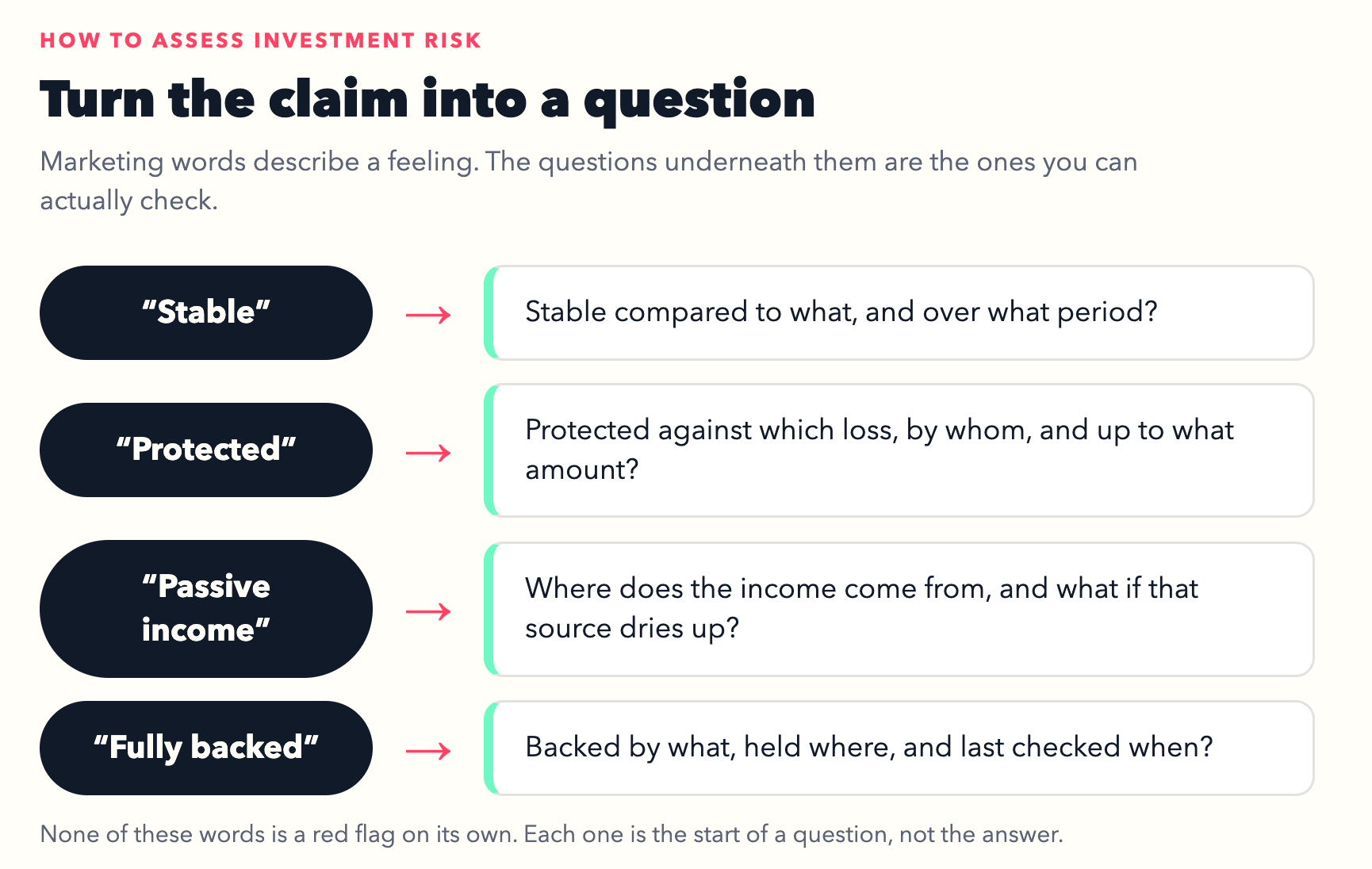
Asking this doesn't assume bad faith. It turns an adjective into something you can check, which is the whole point of an investment risk assessment.
Start With the Loss Mechanism
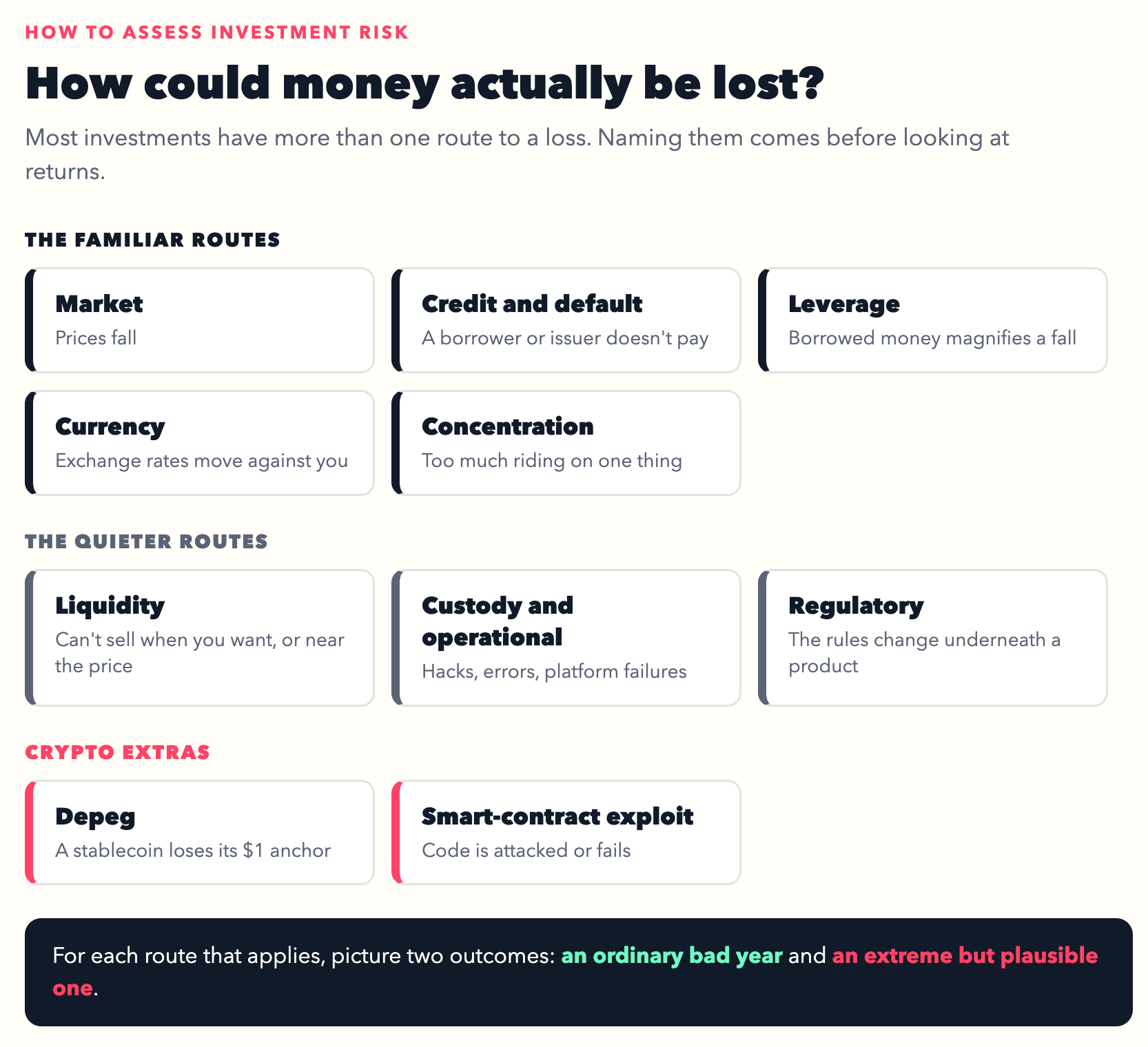
Learning how to assess investment risk starts with one plain question: how, specifically, could money be lost? There's usually more than one route.
Market risk is the most familiar investment risk: prices fall. Credit and default risk is about a borrower or issuer failing to pay. Leverage and currency can magnify either. Concentration means too much riding on one company, sector or token.
Then there are the quieter paths. Liquidity risk is being unable to sell when you want to. Custody and operational risk covers hacks, errors and platform failures. Regulatory risk is the rules changing underneath a product. Crypto adds its own entries, such as a stablecoin losing its peg or a smart contract being exploited.
For each relevant path, it helps to picture two outcomes. First, an ordinary bad year: prices down 15%, income lower than hoped. Second, an extreme but plausible one.
Take Terra's UST, which was built to hold $1 and managed it for a good while. On 9 May 2022 it was trading at around 60 cents. A week later, what was left was a small fraction of that. Holders who'd been told it was stable found out what the mechanism behind the word actually was.
Match Product Risk With Horizon, Liquidity Needs and Loss Capacity
The same investment product risk can mean very different things to different people. A 20% fall is a nuisance if the money isn't needed for ten years. It's a real problem if that money is next spring's house deposit.
Two personal factors shape this. Time horizon is when the money will be needed. Loss capacity is how much of a fall could be absorbed without changing plans.
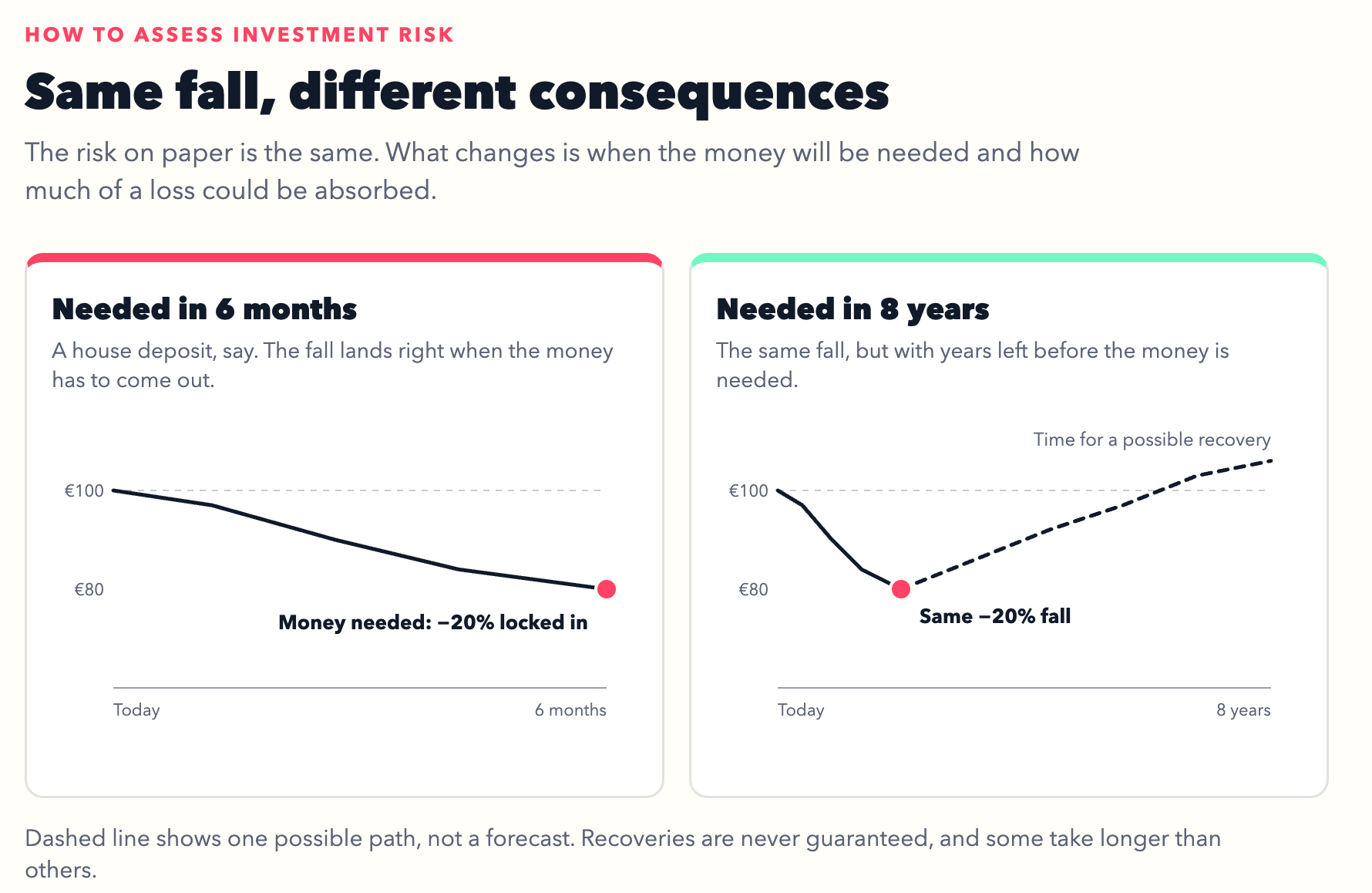
Risk and return are linked, but the link only helps if you can wait for the return to show up. A product that tends to recover over five years offers little comfort to someone who has to sell in five months. This isn't about labelling any product as right or wrong for a type of investor. It's about noticing that the risk on paper and the risk in your own situation can differ.
Understand What You Legally Own
"Buying" an investment can mean owning quite different things.
A share is part-ownership of a company. A fund unit is a slice of a pooled portfolio, usually held by a separate depositary. A bond or note is a debt claim: you're owed money by an issuer, and you rely on them to pay. Some crypto exchange-traded products (ETPs) work this way too, as notes backed by crypto rather than direct ownership of the coins. A derivative is a contract whose value depends on something else, and on the other party honouring it.
Crypto adds more layers. Tokens in your own wallet are held directly. Tokens on a platform may be held for you as a beneficial interest, or may only give you a contractual claim against the platform. The terms decide which. Once tokens are lent out or staked through a third party, ownership can quietly turn into an IOU.
The legal documents tell you which one you have: the prospectus, the key information document (KID), the terms and conditions or, for crypto-assets, the white paper required under MiCA (the EU's Markets in Crypto-Assets Regulation). Until you've read the relevant section for the specific product, it's best not to assume either ownership or protection.
Check Liquidity and Exit Conditions
Liquidity is about how, when and at what cost you can leave.
Some funds deal daily, others weekly or monthly. Exchange-traded products only trade when their exchange is open. Some products have lock-ups, notice periods or redemption gates, which let a manager limit withdrawals when too many people want out at once.
Then there's the price. A bid-ask spread is the gap between buying and selling prices. Market depth is how much can be sold before the price moves against you. In a thin market, a large sale can land well below the price on screen.
There's a big difference between being able to request an exit and being able to exit near the displayed price.
That gap is liquidity risk in practice. Crypto may trade 24/7, but that's cold comfort when the platform holding your coins decides nobody's leaving. Celsius customers found this out on 12 June 2022 (about 1.7 million of them), and the lender was in bankruptcy court by mid-July.
Read the Risk Indicator With Its Assumptions
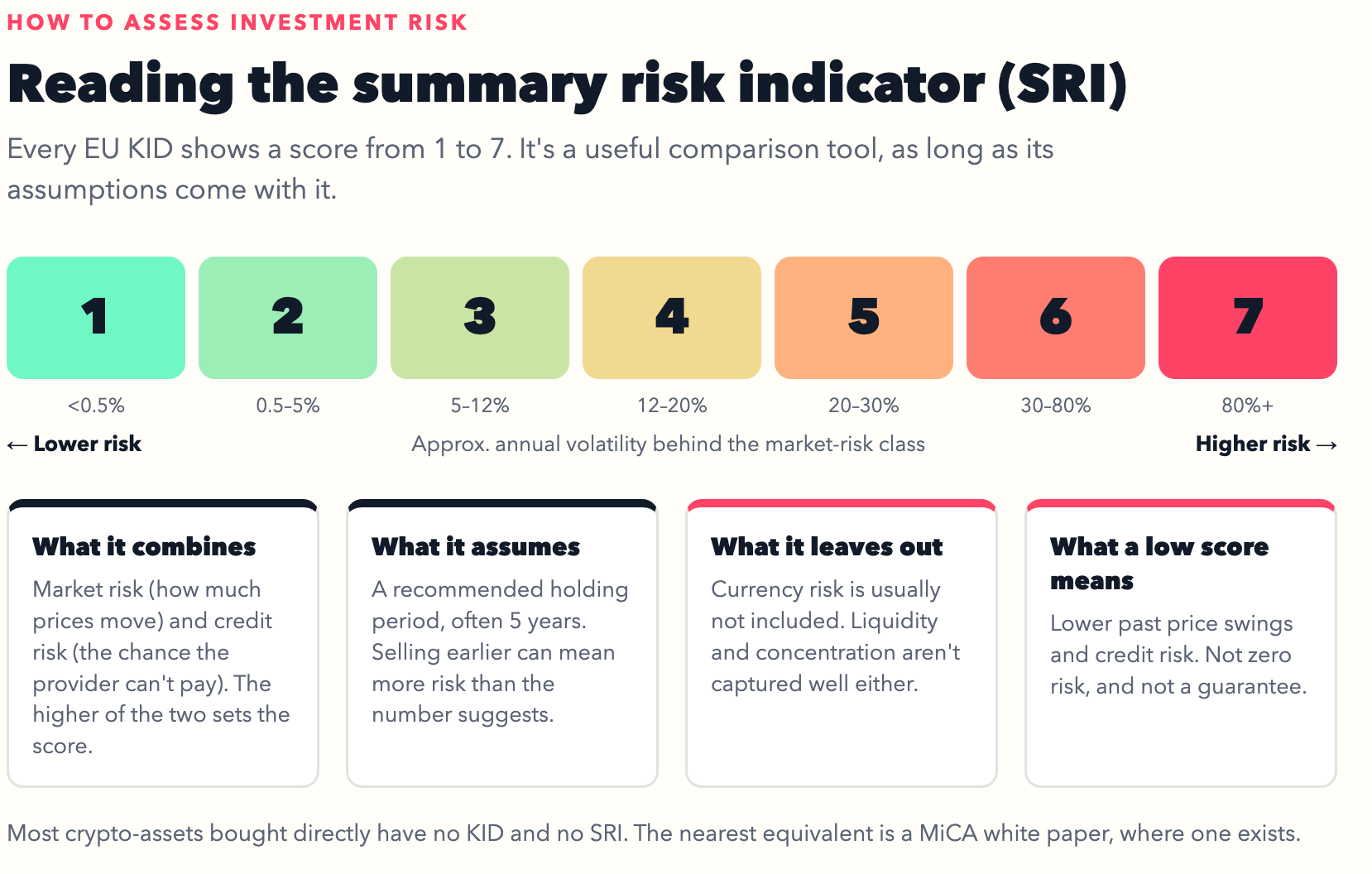
Most packaged investments sold to retail investors in the EU have to publish a KID. That's thanks to the PRIIPs (Packaged Retail and Insurance-based Investment Products) Regulation, and since the start of 2023 it's applied to UCITS funds too (the format most European funds use). On the first page there's a little row of boxes numbered 1 to 7. That's the summary risk indicator, or SRI.
The SRI combines two things: how much the price has tended to move (market risk) and how likely the provider is to be unable to pay (credit risk). The higher of the two sets the score.
The SRI always comes with a holding-period assumption. A typical KID says something like: "The risk indicator assumes you keep the product for 5 years. The actual risk can vary significantly if you cash in at an early stage."
A low score doesn't mean no risk. The indicator is a tool for comparing investment product risk across products, and KIDs themselves point out what it leaves out. Currency risk, for example, is usually "not considered in the indicator". Liquidity and concentration aren't captured well either.
What if there's no KID? Crypto ETPs sold to EU retail investors usually have one. One bitcoin exchange-traded note on the market, for example, is rated 6 out of 7 rather than 7. Most crypto-assets bought directly don't have a KID at all. The nearest equivalent is the MiCA white paper, where one exists, which describes the asset and its risks but has no standardised risk indicator.
Review Performance Scenarios and Stress Assumptions
KIDs also show four performance scenarios: favourable, moderate, unfavourable and stress. Under the current rules, the first three are illustrations based on the best, average and worst performance of the product or a suitable benchmark over the last ten years. The stress scenario shows what might happen in extreme market conditions.
What KID performance scenarios look like: an illustrative example (€10,000 invested)
These are useful for getting a sense of the range of risk and return outcomes. They aren't forecasts, and KIDs say so directly: "Markets could develop very differently in the future."
A few things are worth checking. What holding period are the scenarios based on? Do the figures include all costs, or only the product's own? Is the history the product's own, or a benchmark's? And when was the KID produced? A KID from 18 months ago reflects the market of 18 months ago.
How Fees, Leverage and Currency Can Magnify Risk
Costs, borrowing and currency are rarely the main investment risk on their own. What they do is make a loss bigger.
To see how this stacks up, picture €10,000 put into something priced in US dollars, which then drops 10% in a year. Annual costs are 1.5% of the amount invested. Leverage, where used, is 2× with borrowing at 5% a year. Currency effect is the dollar falling 5% against the euro.
The asset only fell 10%. The investor lost 37%.
Currency can work the other way, of course, and a rising dollar would have softened the fall. The point is that it adds a second moving part. In 2025, the euro rose roughly 14% against the dollar, which cut about 12% off the euro value of a dollar holding that didn't move at all.
Leverage changes the balance of risk and return in both directions, so it deserves particular care. EU regulators found that 74–89% of retail accounts trading contracts for difference (CFDs), a common leveraged product, lost money. That's why leverage on crypto CFDs for retail clients is capped at 2:1.
Verify the Provider, Custody and Counterparties
A logo on a website proves very little. Checking the official registers costs nothing and usually takes a couple of minutes.
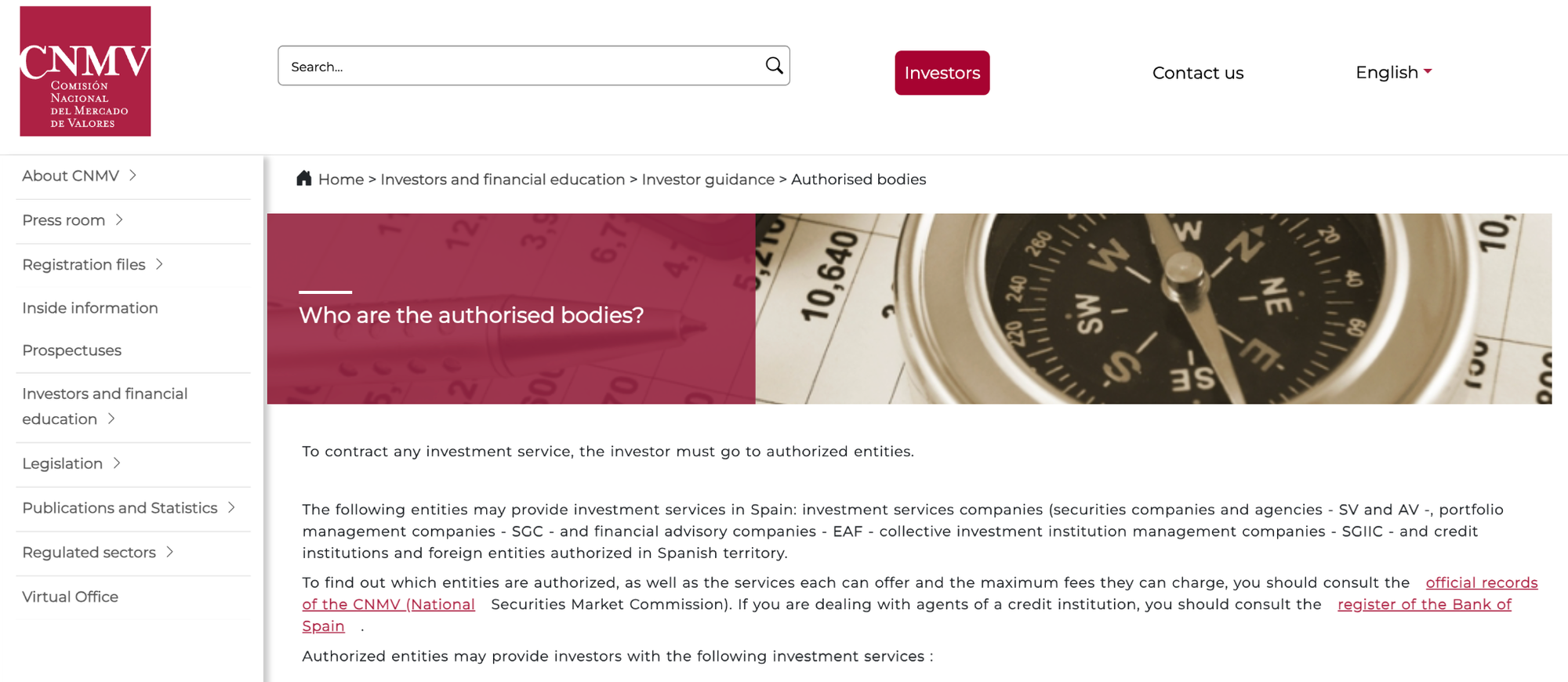
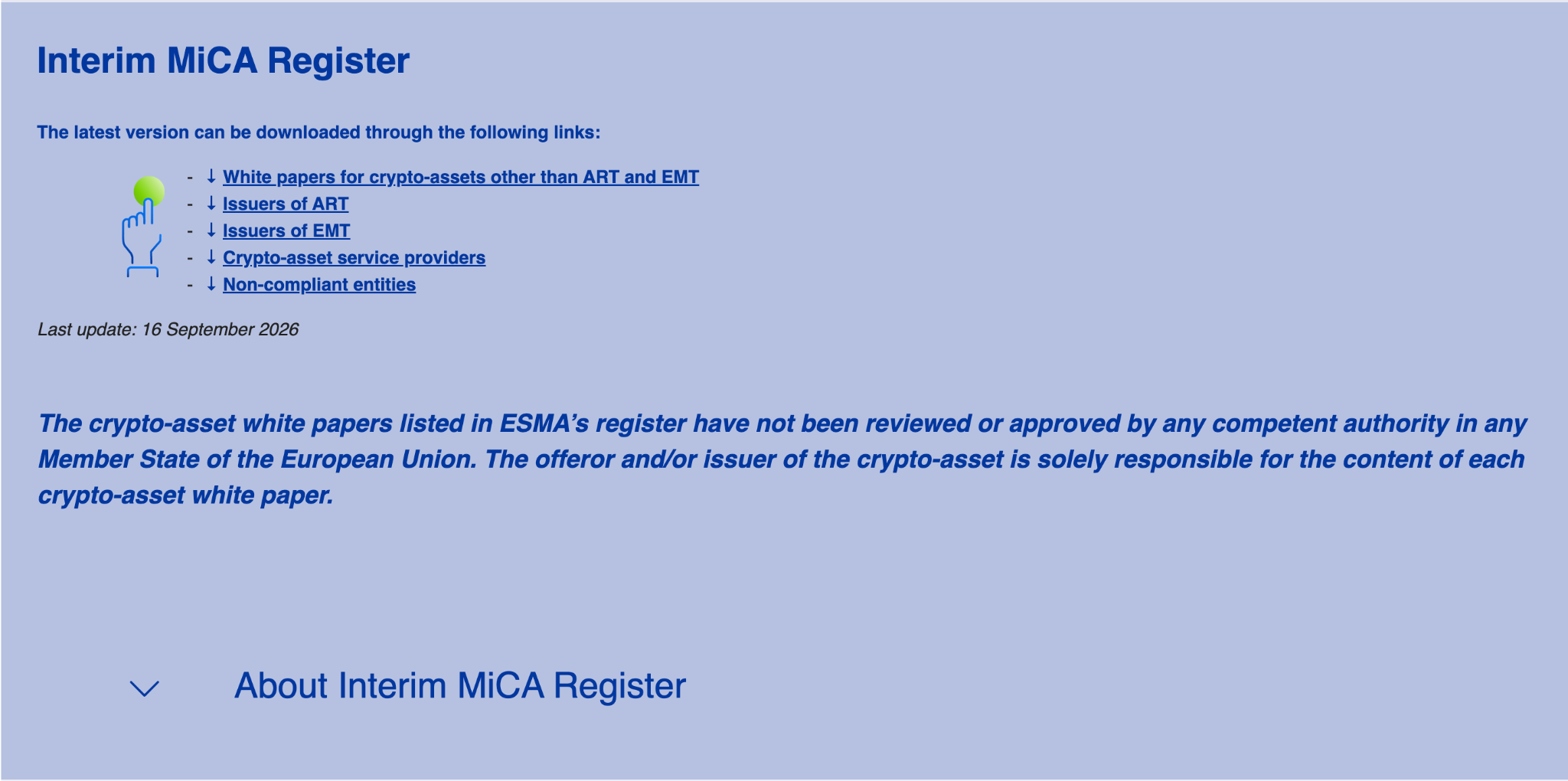
In Spain, that means the CNMV (Comisión Nacional del Mercado de Valores), whose website has a search for authorised firms and a separate page of warnings about firms that aren't. For crypto, there's a second stop. ESMA, the EU's markets watchdog, runs an interim MiCA register, which is really a handful of downloadable lists: approved crypto-asset service providers (CASPs), filed white papers, and firms that have been flagged as non-compliant. Spain's transition period ended on 1 July 2026, so crypto platforms serving Spanish clients now need MiCA authorisation.
Registration deals with one investment risk: handing money to a firm that isn't allowed to take it. Counterparty risk is the other side. Who is the legal entity you contract with? Who holds the assets, and are they kept separate from the provider's own? Who pays you if things go wrong? Are there conflicts, such as a platform lending out client assets to earn its own returns?
Spain has two guarantee schemes. The FGD covers bank deposits, plus securities held with banks as a separate guarantee. FOGAIN covers investments held with member investment firms. Each guarantee goes up to €100,000 per person. FOGAIN is clear about its limits. It doesn't cover market losses, and it doesn't cover the failure of an issuer.
Compare Claims With Disclosures and Numbers
This is where the pitch and the paperwork meet, and where an investment risk assessment gets concrete. The table below pairs common investment marketing claims with where to check them.
A marketing claim that holds up across every column is a strong claim. One that goes quiet in a column is telling you where to look harder. Good risk disclosure fills the gaps. Weak risk disclosure leaves them open.
A Worked Product-Risk Scenario
Here's a hypothetical product: "Earn 8% stable income on US dollar stablecoins."
Tracing each layer shows how investment product risk builds up. Picture €10,000 converted into a dollar stablecoin at an exchange rate of 1.17, with a 1% spread on the way in and out. Deposits need 30 days' notice to withdraw.
- Price. Even the big, well-established stablecoins can wobble. USDC dipped below 87 cents over one weekend in March 2023, after Circle revealed that $3.3 billion of its reserves were stuck at the collapsed Silicon Valley Bank. It recovered, but not everyone holds through the gap.
- Issuer. Under MiCA, holders of e-money tokens have a right to redeem at par with the issuer. That right depends on the issuer's reserves and on the token actually being authorised in the EU.
- Platform. The 8% has to come from somewhere, usually lending to traders or other borrowers. EU rules restrict interest on e-money tokens, so it's fair to ask which entity pays the 8%, from what activity, and under which authorisation. That entity is the counterparty risk.
- Liquidity. Thirty days' notice means thirty days of exposure after deciding to leave.
- Currency and fees. Say the euro strengthens over the year, from 1.17 dollars to 1.25. Take off the spreads and the "8%" turns into about €9,910. In euros, that's a small loss of around 1%.
Now add time. If the money is needed in three months and the same currency move happens, the result is closer to −6.5%, with notice periods making the timing tighter. Over five years, currency swings have more time to even out, but issuer and platform exposure run for five years too. Nothing here makes the product suitable or unsuitable. It shows how the same product can lead to different conclusions depending on the investor's timeline.
Red Flags and Important Exceptions
Some warning signs come up again and again in regulator guidance:
- Urgency: "offer closes tonight", "only 20 places left"
- Guaranteed high returns, or returns with "no risk"
- A vague or missing legal entity, or one based far from its customers
- No verifiable documents, or documents that don't match the marketing
- Pressure to skip independent research, keep it quiet, or trust that "everyone is buying"
Crypto adds its own. A "guaranteed APY" (annual percentage yield) on a volatile token is one. A platform missing from the ESMA register is another. MiCA requires crypto marketing to be fair, clear and not misleading, and consistent with the white paper, so a gap between the two is worth noticing.
Now the exception. A regulated provider and clear risk disclosure do reduce some risks. They make fraud harder, set rules on custody, and give you somewhere to complain. What they don't do is guarantee performance. A fully authorised product can still fall in value, and many do.
When Professional Help May Be Appropriate
Knowing how to assess investment risk yourself goes a long way. Some situations are still worth a second opinion. Complex structures, leverage, large amounts relative to total savings, documents that stay unclear after a careful read, and tax questions all come into that category.
In Spain, investment advisers and firms offering advice should appear on the CNMV's register. Tax treatment of investments, crypto included, depends on personal circumstances and Spanish rules, and it can change. A registered adviser or tax professional can look at the specifics in a way no general guide can.
Conclusion: A Risk Claim Is Only as Strong as Its Conditions

"Low risk" is a conclusion. The useful part is the reasoning behind it.
A proper investment risk assessment pulls the threads together: how money could be lost, what you legally own, how and when you can get out, who stands between you and your assets, what costs and currency do to the result, and when you'll actually need the money. A risk indicator helps. A marketing adjective starts the conversation.
Neither one finishes it, and that's true of investment marketing claims generally. Knowing how to assess investment risk mostly comes down to asking what has to be true for the claim to hold, and then checking whether it is.
Disclaimer: The content provided in this article is for educational and informational purposes only and should not be considered financial or investment advice. Interacting with blockchain, crypto assets, and Web3 applications involves risks, including the potential loss of funds. Venga encourages readers to conduct thorough research and understand the risks before engaging with any crypto assets or blockchain technologies. For more details, please refer to our terms of service.