Table of Contents
When MiCA (the Markets in Crypto Assets rulebook) was first introduced in 2020, the entire crypto community celebrated the possibility that MiCA would bring clarity to the regulatory issues plaguing the crypto world.
MiCA is now officially referred to as (EU) 2023/1114 and it legally became effective on 29 June 2023. There have been many key dates throughout the process of developing the MiCA regulations. After June 2023, there have been several significant dates in the evolution of MiCA.
Existing crypto-asset service providers will be able to utilise a national transitional regime for a certain amount of time, dependent upon their location of operation. The EU wide cap on the length of the national transitional regime is 1 July, 2026. As of today, this date has passed.
In this article, you will see how this applies and which dates have influenced the MiCA implementation thus far.
Why Does MiCA Have Several Different Implementation Dates?
MiCA is not just one book of rules covering many types of cryptocurrency and related products. Rather, MiCA is made up of three sections. The first section relates to stablecoin type tokens. The second section deals with other cryptocurrencies, such as utility tokens.
The third section addresses the service providers who buy, hold, and transfer those items. Since each group required varying amounts of preparation time, the EU staggered the start date. Only three terms are necessary to understand the remainder:
- Entry into force: MiCA formally becomes EU law. It's on the books.
- Application date: specific obligations actually start binding specific market players.
- Transitional deadline: the last day an existing business can keep going under its old setup while it moves over.
The classic mix-up? Thinking "in force" means "comply today". It doesn't. That gap causes most of the confusion.
MiCA Implementation Dates at a Glance.
29 June 2023: MiCA Enters Into Force
MiCA was published in the Official Journal of the European Union on 9 June, 2023. Just 21 days later, on 29 June, MiCA formally became law. Was this the moment when crypto regulation was implemented uniformly across Europe? Almost.
It was the moment when the MiCA rulebook was placed on the books. At that point, exchanges, wallets, and token-issuing companies did not have to implement MiCA rules because it wasn't yet enforceable.
For example, if you owned Bitcoin back then, nothing happened with your app. That's typical for this stage of enforcement — most significant changes happen at a later time.
30 June 2024: The ART and EMT Rules Start Applying
The first time the EU took real action regarding the regulatory status of cryptoassets was with regard to these two titles.
- Title III applies to "Alternative Retail Tokens" (ART) which are tokens referencing a particular asset basket, whether it is an array of different types of cryptocurrencies, commodities, or other assets.
- Title IV applies to E-Money Tokens (EMTs), also known as stablecoins which are pegged to a single fiat currency.
The reason for issuing regulations concerning stablecoins first is because they act very similarly to the fiat we use every day. When a stablecoin's peg becomes unstable, the effects could be felt by ordinary citizens quickly.
As a result, the EU prioritised protecting consumers in this space before others. From this date forward issuers would need to have their products approved through the appropriate process, maintain sufficient reserves and produce compliant white papers.
30 December 2024: Most of MiCA Becomes Applicable
This is one of the biggest dates in the history of MiCA. In fact, when people say MiCA went live, they are usually referring to December 30, 2024. Beginning January 1st, 2026, the remaining framework will be in place, with all licensing and conduct standards for CASP's to follow their own provisions.
- Licensing and conduct rules for crypto-asset service providers (CASPs)
- Rules on white papers and marketing for other crypto assets
- Market abuse rules, such as bans on insider dealing and manipulation
New firms now need a MiCA licence before offering crypto asset services in the EU. No license, no launch. This MiCA date brings about passporting rights to licensed firms.
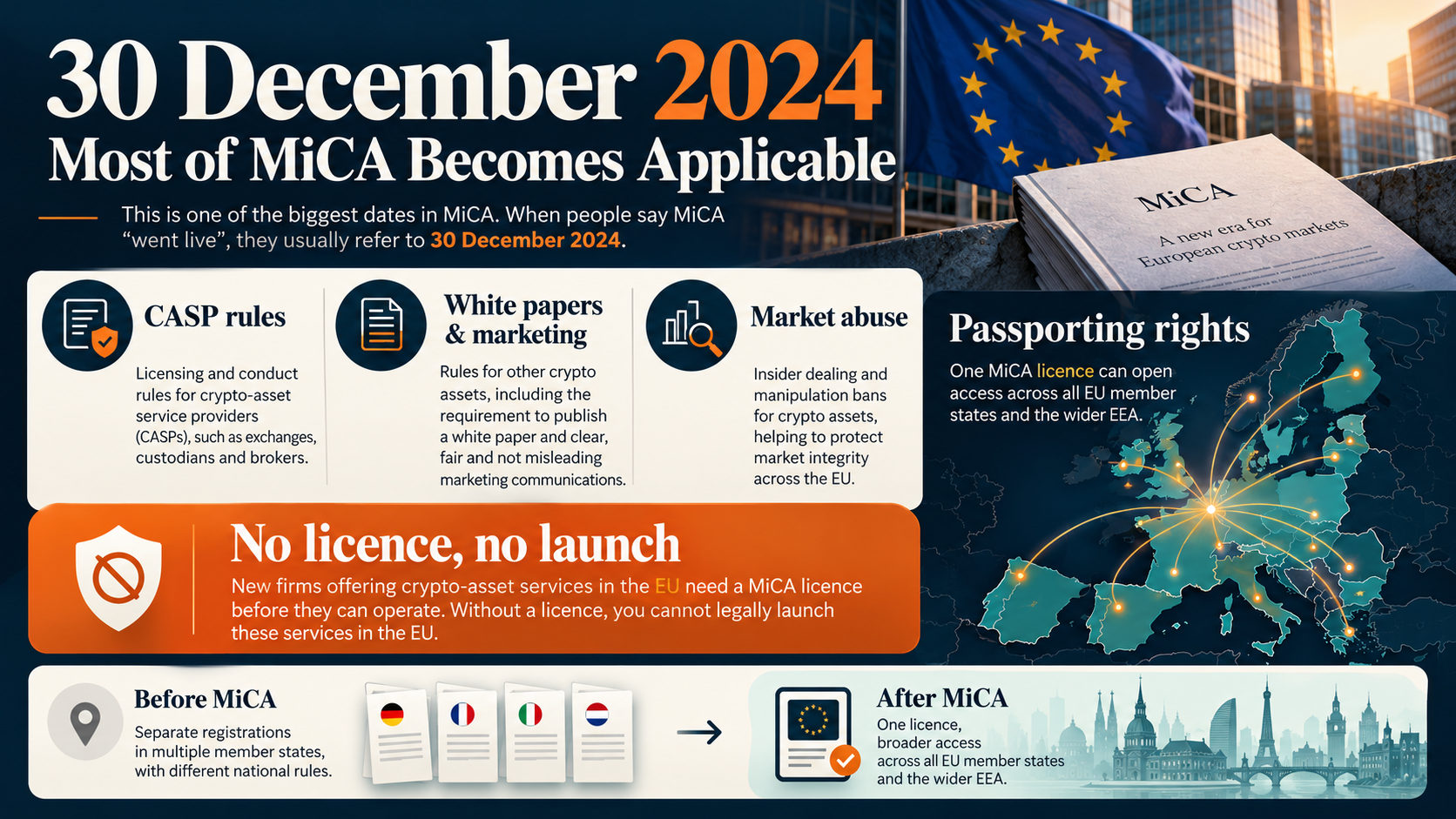
One licence allows the firm access to all member states of the European Union and beyond into the European Economic Area (EEA). Prior to MiCA, a firm may have been required to register separately in each member state.
Why Did Early 2025 Still Matter for Stablecoins?
The stablecoin rules had been in effect since June 2024. Yet plenty of EU platforms still listed stablecoins from unauthorised issuers at year-end. So on 17 January 2025, ESMA published a statement with the European Commission's Q&A.
The message: trading non-compliant ARTs and EMTs could count as offering them to the public. That breaches MiCA. National authorities were told to ensure CASP compliance as soon as possible and no later than the end of Q1 2025.
In practice, ESMA expected platforms to restrict new purchases by the end of January 2025. "Sell-only" access could run until the end of March, so users could exit or convert. That's why some well-known stablecoins quietly vanished from EU order books around then.
Why Did CASP Transitional Deadlines Differ Across EU Countries?
Thanks to Article 143(3), CASPs that were lawfully providing services under national law before 30 December 2024 keep going. They could continue until 1 July 2026, or until they were granted or refused MiCA authorisation, whichever came first.
The catch? Each Member State could shorten that window or skip it entirely. They had to tell the Commission and ESMA by 30 June 2024. The result was a patchwork. ESMA's published list showed grace periods ranging from roughly 5 to 18 months.
Germany and Ireland went with 12 months. France took the full 18. Why shorten it? Countries whose old national rules were lighter than MiCA often chose shorter windows.
Less time under weaker rules means less risk for users. Some countries added filing cutoffs too. Miss the application date, lose the grace period. One more limit: firms relying
1 July 2026: The Maximum CASP Transitional Period Ends
The EU-wide grandfathering window is closed everywhere. ESMA flagged it early. In April 2026, it confirmed there would be no extensions. On 23 June 2026, it set out exactly what unauthorised firms had to do.
For non-compliant entities, the expectations were clear:
- Stop onboarding new EU clients
- Stop marketing and soliciting EU users
- Limit services to selling, transferring or closing existing positions
- Keep custody only as long as an orderly exit requires
That's consumer protection doing its job. Users got time to sell or move their crypto assets, rather than waking up to a frozen account. Firms outside the EU got a reminder too. They can't serve EU clients, except under the narrow reverse-solicitation exemption.
So what does this mean for you? Check the register. ESMA keeps an interim MiCA register of authorised CASPs. Industry trackers counted around 320 names on it in early August 2026. That number keeps moving, so check the live list.
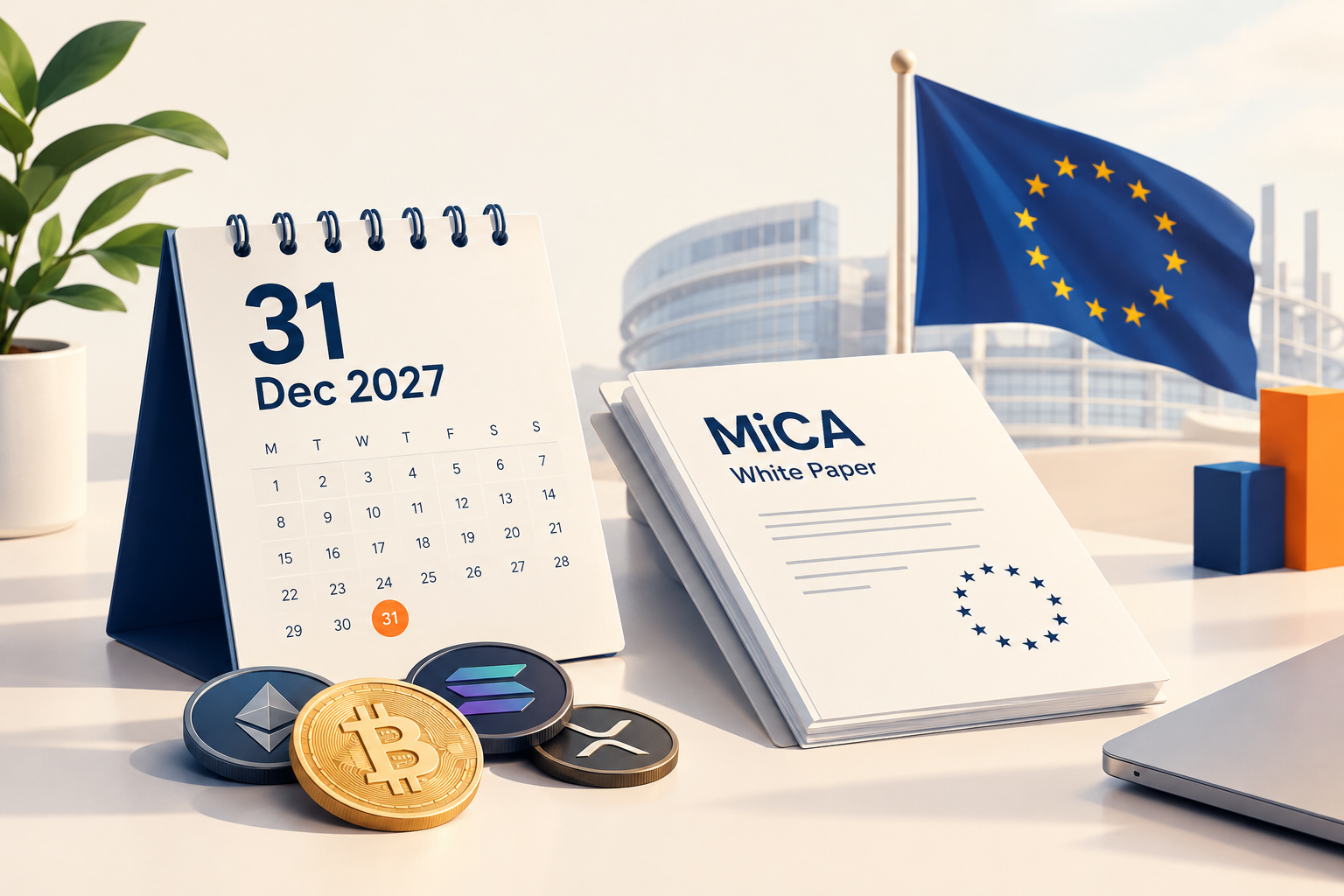
31 December 2027: Why Does MiCA Still Have a Future Deadline?
December is not MiCA part two. Article 143(2) covers crypto assets other than ARTs and EMTs that were already admitted to trading before 30 December 2024. Think older, established tokens.
For these legacy tokens, trading platform operators must make sure a compliant white paper is drawn up, notified and published by 31 December 2027. ESMA confirmed this in Q&A 2654 in autumn 2025.
Their marketing, however, has had to follow MiCA since 30 December 2024.
What this date does not do:
- It doesn't extend CASP grandfathering to 2027.
- It doesn't push back any other deadline.
- It doesn't cover tokens listed after 30 December 2024. Those need one already.
Small twist: if a legacy token isn't on any trading platform, it may never get a MiCA white paper at all.
Practical Example: How the Dates Affected a Crypto Platform Operating Before MiCA
In order to demonstrate our hypothetical situation, let's use an example with the fictional BitBag Exchange as our trading platform. This is a trading platform registered as a national platform in an EU member state since 2021 providing both the trade/exchange and custodial functions.
Below is a step-by-step of how these timelines have progressed.
- June 2023 – MiCA legislation comes into force. Although BitBag is a nationally registered exchange (and thus continues to operate), their compliance team begins conducting a gap analysis. However, nothing will change for users at this time.
- 30 June, 2024 - A Euro-denominated stablecoin and a US-Dollar denominated stablecoin are listed by BitBag. At this point, it is the regime regarding the issuers of stablecoins that matters. They check if each of the stablecoin issuers was legally authorised under MiCA.
- 30 December, 2024 – The broader CASP regulations become applicable. Since BitBag provided client service lawfully prior to the cutoff, they reviewed their home country's transitionary provisions. Let us assume the home country has a 12-month transitionary provision.
- Early 2025 - The ESMA stablecoin statement is released. As such, BitBag immediately restricts the sale of the non-compliant stablecoin and subsequently delists it by the end of March 2025.
- 2025/26 - BitBag files for MiCA authorisation. During this time, BitBag can continue to serve clients, however, only in those jurisdictions where their national transitional provision still applies. No passport exists.
- 01-Jul-26 - Either BitBag possesses the correct MiCA authorisations, or it winds down all regulated services that it has no legal foundation to perform.
Which MiCA Dates Still Matter After July 2026?
If you want to know which of the various MiCA dates are most important, you should realise that there is a sequence of legislative milestones related to MiCA rather than a fixed launch date. Therefore, when trying to determine what is relevant for your cryptocurrency business model, you will need to take into account what segment(s) of the cryptocurrency space you are operating within.
The important dates for stablecoin issuance are different from those dealing with legacy crypto assets already admitted to trading. The table below will give you a breakdown of the important dates that matter for different sectors in crypto.
By securing their final licence, companies are finally unlocking the true benefits of passporting across the continent. The MiCA framework is fully active, and the European market is now playing by a unified, safer set of standards.
Disclaimer: The content provided in this article is for educational and informational purposes only and should not be considered financial or investment advice. Interacting with blockchain, crypto assets, and Web3 applications involves risks, including the potential loss of funds. Venga encourages readers to conduct thorough research and understand the risks before engaging with any crypto assets or blockchain technologies. For more details, please refer to our terms of service.