
Table of Contents
Once every 210,000 blocks, Bitcoin starts paying its miners half as much new BTC as before. That's the Bitcoin halving. Maybe you typed “what is halving in crypto” into Google and ended up here. It's a slightly odd name, honestly. The only thing that gets cut in half is a payment.
The most recent one fell on a Saturday, 20 April 2024, at block 840,000. Up to that block, finding one earned a miner 6.25 BTC. From then on it earned 3.125.
The effect on supply can be worked out with a calculator. The effect on price is much harder to pin down, and most of the talk around each halving sits somewhere in that gap.
What Exactly Happens During a Bitcoin Halving?
Every block starts the same way, with the miner who found it paying themselves. Bitcoin people call it the coinbase transaction (yes, the name is confusing). Part of that payment is brand-new BTC, known as the block subsidy. The rest is whatever fees users attached to their transactions.
The halving only goes after the subsidy. Bitcoin splits its history into 210,000-block stretches. With every new stretch, the payout that started at 50 BTC gets cut in half once more. Block 839,999 was still in the fourth stretch, so it paid 6.25 BTC. One block later the fifth had begun, and the payout dropped to 3.125 BTC.
Nobody has to sign anything off. A miner who tries to pay themselves the old amount gets their block thrown out by everyone else on the network, and the electricity they burned finding it goes to waste.
How Much Does a Halving Reduce New Bitcoin Issuance?
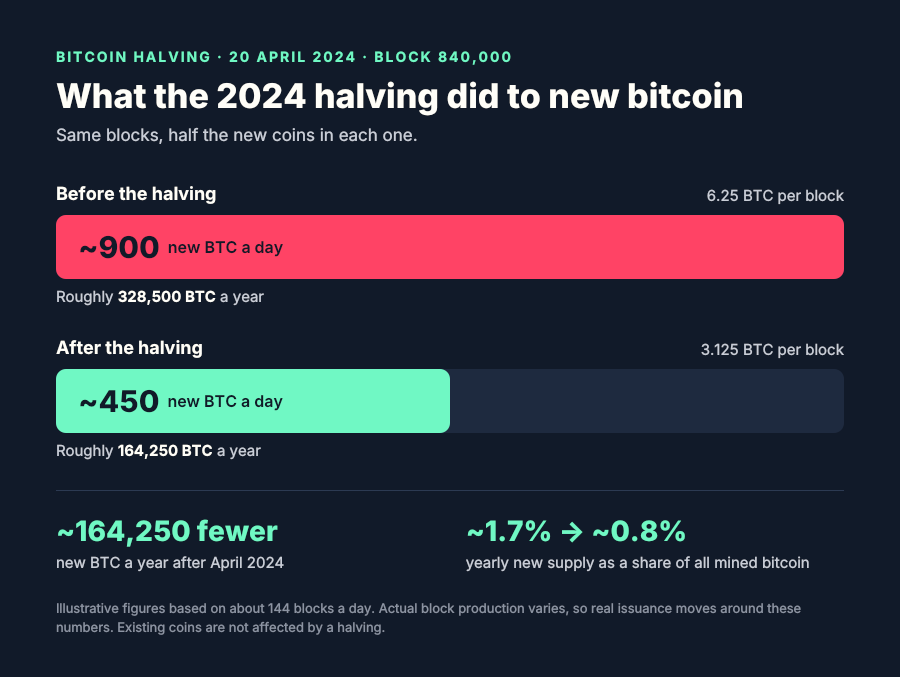
A new block turns up every 10 minutes or so, on average. That's about 144 a day, and the whole calculation hangs on it. Here's what the 2024 halving event did to daily issuance:
- Before: 6.25 BTC a block, so about 900 new BTC a day
- After: 3.125 BTC a block, so about 450 new BTC a day
Multiply by 365 and you go from about 328,500 new coins a year to about 164,250. That's 164,250 fewer coins a year, give or take.
Treat those as ballpark figures. Some days the network churns out 150 blocks. Other days it only manages the 130s, and the real total wobbles around 450 as a result.
Why Doesn't Halving Cut Bitcoin's Existing Supply in Half?
Some newcomers assume a halving removes half of the bitcoin already in existence. Your coins don't go anywhere. If you had 0.5 BTC in a wallet on 19 April 2024, you still had 0.5 BTC on the 21st.
It helps to think in terms of stock and flow. The stock is everything mined so far, and the flow is what gets added over a set period, such as a day or a year. A halving changes the flow only. Our tokenomics guide covers a related distinction, the one between circulating supply and max supply.
Bitcoin's stock is already large next to its flow. The 20 millionth coin came out of block 939,999 in March 2026. Fewer than a million are left to mine, and it'll take until roughly 2140 to dig them all out.
Worth knowing: Do the sums and the shrinking effect shows up fast. Before April 2024, around 328,500 new coins a year were landing on a pile of about 19.7 million. Call it 1.7%. Today it's about 164,250 on roughly 20.1 million, nearer 0.8%. Once 2028 rolls round it's roughly 82,000, which is about 0.4%. Each halving still chops the flow in two. It just moves the overall supply by less every time.
What Does Halving Change for Miners?
Most mining costs are paid in euros or dollars, for electricity, hardware and buildings, and none of them change on halving day. Only the subsidy does.
Let's invent a mine. It makes 10 BTC a month from the subsidy and spends €300,000 a month on power. We'll put bitcoin at €60,000, purely for the maths, which means the subsidy was bringing in €600,000 before the halving. After it, the mine gets 5 coins, worth €300,000 if the price hasn't budged. The power bill now swallows the whole subsidy, and fees have to cover hardware, staff and everything else.
Operators with older, less efficient machines usually feel this first, and some switch them off. Bitcoin does have a release valve here. Every 2,016 blocks, about once a fortnight, the network looks at how fast blocks have been coming and makes mining easier or harder. If enough machines go dark, the ones left running get an easier puzzle. That's roughly what happened after April 2024. Hashrate sagged for a few weeks, then kept climbing and set fresh records in 2025.
Fees can be erratic. Halving day in 2024 had an odd twist. Block 840,000 coincided with the launch of Runes, a new way to create tokens on Bitcoin, and people paid about $2.4 million in fees to get in early. The subsidy in that same block was worth roughly $200,000. The frenzy didn't last. In August 2026, Glassnode put fees at a measly 0.69% of what miners earned.
Satoshi Nakamoto's original whitepaper expected fees to take over eventually, noting that once enough coins exist, "the incentive can transition entirely to transaction fees". Whether fees alone can pay for the level of security Bitcoin has today is still debated, and the last fractions of subsidy aren't expected until around 2140.
Why Does a Predictable Event Create Such a Strong Market Narrative?
Everything about the halving can be calculated in advance, down to the block number, which in theory gives markets years to price it in. Online countdown trackers already shows an estimated date and time for the next halving in April 2028.
Even so, each halving event brings a familiar run of headlines about a coming "supply shock". The story is easy to repeat: fewer new bitcoin each day, while nobody can say how much demand there will be.
Models have made that story more persuasive. Back in March 2019, a pseudonymous analyst called PlanB put out the stock-to-flow model. It tied Bitcoin's price to its shrinking issuance, and plenty of fans took it as a sign of $100,000 or more by the end of 2021. Bitcoin topped out near $69,000 that November. Stories like that are why we think separating a product from the story around it pays off.

Does Lower New Supply Mean Bitcoin's Price Must Rise?
Not necessarily. Fewer new coins can help the price, but only if buyers stick around, and the halving has no say over that.
Look at what happened after April 2024. Miners kept adding about 450 BTC a day the whole time. Bitcoin's record came on 6 October 2025, at around $126,000. Four months later it had slid to somewhere between $60,000 and $70,000. Same issuance, very different prices.
Swings like that come from the demand side. Rates matter. So does the amount of spare cash in the system, plus ETF money coming and going, new rules, leverage and plain old mood. In January 2022, IMF research found Bitcoin moving more in step with US stocks since the pandemic. Its correlation with the S&P 500 was just 0.01 in 2017–19. By 2020–21 it had jumped to 0.36.
Worth knowing: Miners make roughly 450 BTC a day. On a normal day, exchanges swap tens of thousands. So when the price jumps or drops on a Tuesday afternoon, it's the trading doing it, not the new coins.
What Can Previous Halvings Actually Tell Us?
Bitcoin has gone through four halvings so far, each one cutting the subsidy in half again.
Bitcoin halving schedule
(We've used 144 blocks a day here. Real days vary.)
The market looked different each time. When the first halving hit in November 2012, you could pick up a whole bitcoin for about $12, and most people bought theirs on Mt Gox. The 2020 one arrived just two months after the March crash, with the US Federal Reserve having already slashed rates to near zero. And by April 2024, US spot Bitcoin ETFs had been trading for three months.
Prices did rise in the year or so after each previous halving, and that's the basis of the "halving cycle" idea. Four events, each under its own set of conditions, is a small sample, though, and it can't show whether the halving caused those rises or whether the pattern will hold. Our guide to trying to time a Bitcoin purchase around cycles goes into why that kind of timing tends to be unreliable.
When Is the Next Bitcoin Halving?
Next up is block 1,050,000. That's when the subsidy drops from 3.125 BTC to 1.5625 BTC, and new supply falls to something like 225 BTC a day.
If blocks keep coming at their recent pace, you're looking at April 2028. There's no point circling a date yet, though. In October 2026 the forecasts were already spread between 7 and 17 April, and they'll keep moving until the block turns up.
Worth knowing: Blocks, not dates, set the timing. If a wave of new machines switches on before the next difficulty reset, blocks speed up a little and the halving date edges earlier. When miners pull the plug, it slips back.
What Really Matters About the Bitcoin Halving?
The supply side is the easy bit. Anyone can check the numbers for themselves: around 900 new BTC a day before April 2024, about 450 now, and roughly 225 once 2028 comes round.
What the market makes of that is far messier. Demand, macro conditions and sentiment move independently of block height, and in the two years after the last halving they pushed the price to a record before taking roughly half of it away again.
The Bitcoin halving reliably changes Bitcoin's new supply, then, but it doesn't reliably tell anyone what the price will do next.
Disclaimer: The content provided in this article is for educational and informational purposes only and should not be considered financial or investment advice. Interacting with blockchain, crypto assets, and Web3 applications involves risks, including the potential loss of funds. Venga encourages readers to conduct thorough research and understand the risks before engaging with any crypto assets or blockchain technologies. For more details, please refer to our terms of service.