
Table of Contents
Listing a crypto-asset on an EU trading platform is not simply a matter of technical integration, liquidity or commercial demand. The token first needs an appropriate legal classification, and MiCA imposes conditions on both admission to trading and the platform that accepts the asset. It's sort of like before you get a driver's license, you first have to pass a test. Before you list your token, you first have to satisfy legal conditions.
What Has to Be Determined Before a Token Can Be Listed?
The first question is what the token legally represents, not what its issuer calls it. Its rights, economic features, value reference and structure can determine whether it is an ordinary MiCA crypto-asset, an Asset-referenced token (ART), an E-money token (EMT), a financial instrument or potentially outside MiCA's scope. Here's a table describing each of the classifications and what has to be determined before listing:
Why Does a Token's Legal Classification Change the Listing Rules?
A token’s legal classification completely changes its listing rules because the European Union regulates different types of digital assets under entirely separate frameworks.
If a crypto token is legally classified as a financial instrument (like a digital stock or bond), the EU's main crypto regulation, MiCA, does not apply to it at all. Instead, that token must follow traditional, highly strict financial laws like MiFID II.
Even within MiCA itself, tokens are separated into different categories with their own distinct rules:
- Asset-Referenced Tokens (ARTs): Tokens pegged to multiple currencies or commodities have their own dedicated, strict regime.
- Electronic Money Tokens (EMTs): Tokens pegged to a single official currency face separate rules similar to traditional electronic money.
- Other Crypto-Assets: General utility tokens or cryptocurrencies follow the standard, baseline MiCA rules.
Essentially, regulators do not treat all tokens the same. The legal category decides which rulebook a crypto exchange must follow before listing the asset.
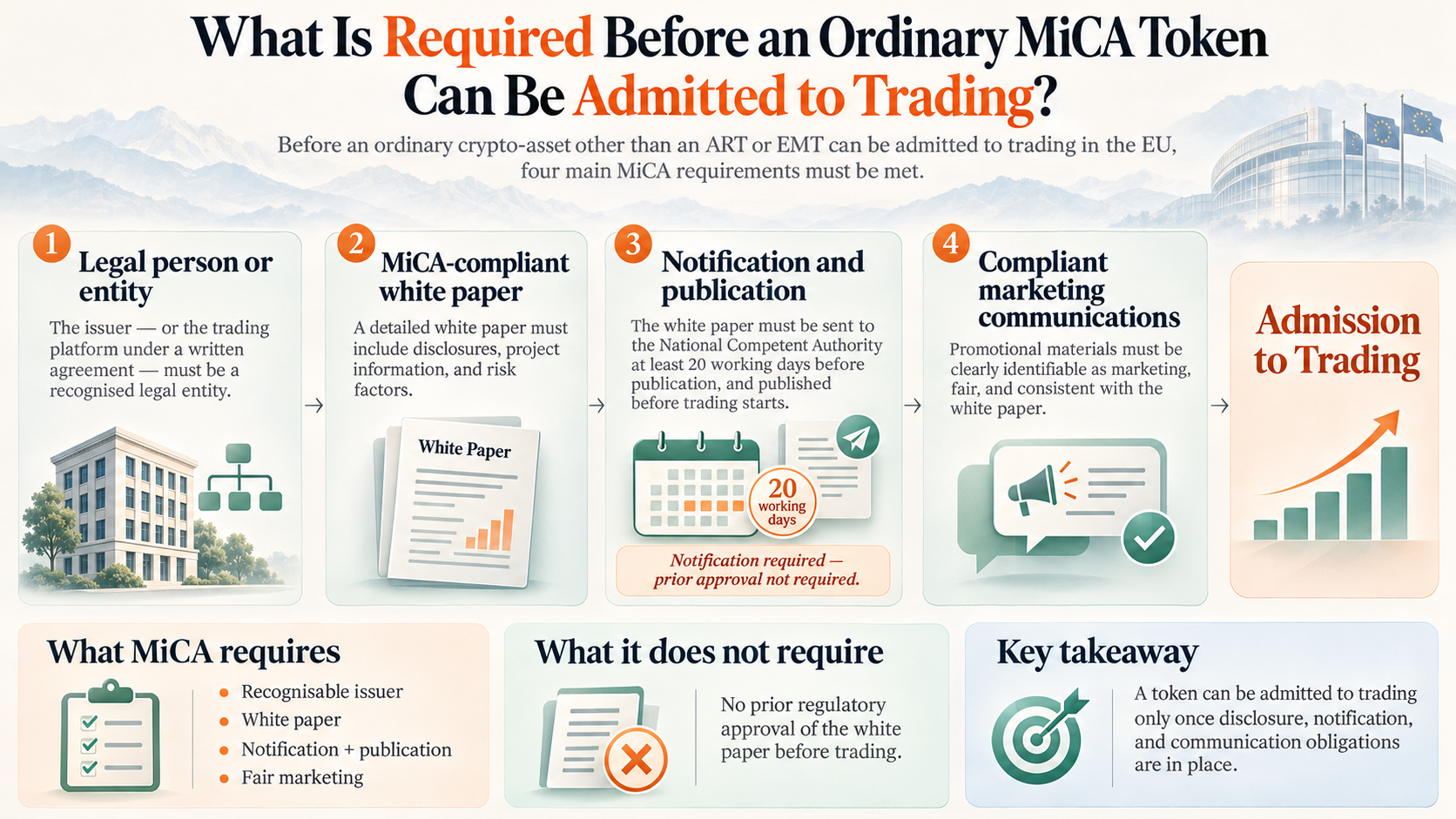
What Is Required Before an Ordinary MiCA Token Can Be Admitted to Trading?
Before an ordinary crypto-asset (other than an asset-referenced token or e-money token) can be admitted to trading in the European Union, a project must meet four main requirements under the Markets in Crypto-Assets Regulation (MiCA):
- A legal person or entity: The issuer (or the trading platform via a written agreement) must be a recognized legal entity rather than an anonymous or unorganized group.
- A MiCA-compliant white paper: The team must draw up a detailed crypto-asset white paper containing required disclosures, project info, and risk factors.
- Notification and publication: The white paper must be sent to the National Competent Authority at least 20 working days before it is published, and then formally published before trading starts (no prior regulatory approval is required, just notification).
- Compliant marketing communications: Any promotional materials tied to the public offer or listing must be clearly identifiable as marketing, fair, and consistent with the white paper.
Why Do ARTs and EMTs Follow a Different Route?
Stable-value tokens cannot simply use the general Title II listing process. An ART generally needs an appropriately authorised EU issuer or eligible credit institution, while an EMT offered or admitted to trading generally needs an issuer authorised as a credit institution or electronic money institution, subject to the specific MiCA exceptions.
What Must the Trading Platform Assess Before Listing a Token?
A MiCA trading-platform operator must have transparent admission rules and assess whether the crypto-asset is suitable for trading. This includes factors such as the reliability of its technical solution and potential links to illicit or fraudulent activity, alongside the issuer's and development team's experience, track record, and reputation.
Can Privacy Features Prevent a Token From Being Listed?
Yes, privacy features can absolutely prevent a token from being listed.
Under the EU’s Markets in Crypto-Assets (MiCA) regulation, crypto exchanges are strictly forbidden from listing tokens with inbuilt anonymisation functions.
The only exception is if the exchange can fully identify the token holders and trace their entire transaction history. Because true privacy coins (like Monero) inherently mask this information, exchanges are forced to delist or ban them to remain compliant.
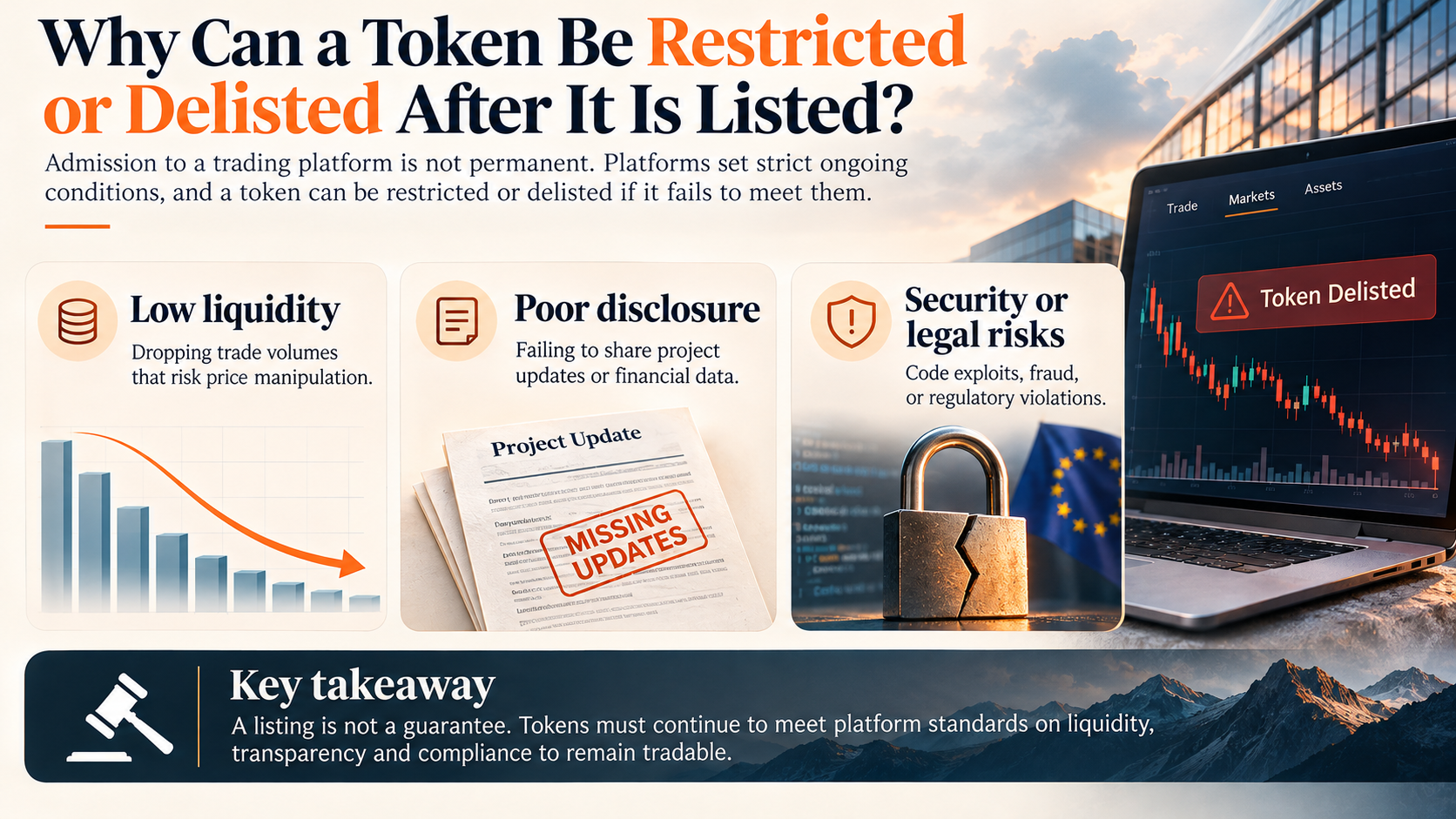
Why Can a Token Be Restricted or Delisted After It Is Listed?
Admission to a trading platform is not permanent. Just because a token gets listed does not mean it stays there forever.
Platforms set strict ongoing conditions, and a token will be restricted or delisted if it fails to meet them. Trading is typically suspended or removed due to:
- Low liquidity: Dropping trade volumes that risk price manipulation.
- Poor disclosure: Failing to share project updates or financial data.
- Security or legal risks: Code exploits, fraud, or regulatory violations.
Practical Example: One Token, Three Possible Legal Routes
Token X is fictional. The same token lands on a different listing path depending on its economic features.
Scenario A: access to a digital service (MiCA Title II)
- The person seeking admission to trading drafts a white paper, notifies it to the competent authority, and publishes it. The authority does not approve it.
- Offer exemptions do not apply if communications mention seeking admission to trading.
- The platform must be an authorised crypto-asset service provider and should check the white paper before listing.
- Listing impact: Relatively light. The work is the white paper, the notification, and the platform’s admission checks.
Scenario B: value held against EUR (potentially an EMT)
- Only the issuer can seek admission to trading, and it must be a credit institution or an e-money institution with a notified, published white paper.
- Third parties can seek admission only with the issuer’s written consent.
- EMTs are deemed electronic money, so redemption rights apply.
- Listing impact: The issuer must now be a regulated institution. A tracked basket of currencies or assets would point to an ART instead.
Scenario C: rights like a share or bond (potential financial instrument)
- ESMA’s guidelines look at the actual rights, not the label or the technology. A transferable security needs no payment function, must be a class of securities, and must be negotiable on the capital market.
- Financial instruments fall outside MiCA and under MiFID II.
- Listing impact: The MiCA white paper route no longer applies. The token would likely need a MiFID II trading venue and prospectus rules (from my general knowledge). National law also matters, because some countries do not allow tokenised securities.
Does Listing Mean a Token Has Been Approved by a Regulator?
No, listing or trading a crypto-asset does not mean it has been approved by a regulator.
No Prior Approval: Article 8 of MiCA explicitly states that regulators shall not require prior approval of white papers or associated marketing communications for ordinary tokens.
Listing friction exists because a token is a technical asset, a set of economic rights, and a potential regulated product all at once. The legal treatment of those rights determines which path to trading is an option.
Disclaimer: The content provided in this article is for educational and informational purposes only and should not be considered financial or investment advice. Interacting with blockchain, crypto assets, and Web3 applications involves risks, including the potential loss of funds. Venga encourages readers to conduct thorough research and understand the risks before engaging with any crypto assets or blockchain technologies. For more details, please refer to our terms of service.