
Table of Contents
A regulated crypto platform must do much more than protect users’ login details.
The base line should have several layers of security in place, including limiting employee access to sensitive information, securely encrypting data and private keys, continuously monitoring its systems for threats, regularly checking for vulnerabilities, carefully managing system updates, preparing for security incidents, and ensuring that third-party technology providers meet strict security standards.
Well, what about 2FA? Two-factor authentication (2FA) and strong passwords only secure the front door. The true gate-keeping work happens behind the scenes, ensuring the platform's internal plumbing can withstand attacks, operational failures, and vendor breaches without putting user funds or personal data at risk.
What Does “Minimum Security” Actually Mean?
Unlike the word, Minimum Security means more than simply protecting users’ accounts, it is a legally binding baseline established by European financial regulation.
For crypto-asset service providers (CASPs), security requirements operate under a dual framework:
- MiCA (Markets in Crypto-Assets): During the authorisation phase, MiCA requires platforms to document and demonstrate the reliability of their Information and Communication Technology (ICT) systems, governance structures, and security arrangements before handling customer assets.
- DORA (Digital Operational Resilience Act): Once authorised, CASPs fall under DORA’s comprehensive digital operational resilience regime. DORA shifts the focus from basic preventive security to operational survival: ensuring a platform can withstand, absorb, and quickly recover from severe cyber threats, hardware failures, or network disruptions.
It is worth taking into account that the regulatory technical standards (RTS) under DORA outline specific, non-negotiable requirements across areas like user access management, cryptographic key protection, audit logging, network segregation, and day-to-day ICT operations.
Here is how those baseline controls break down in practice, what they protect against, and where they actually meet with the user:
Why Is Account Security Only One Layer of Protection?
Putting a bank-vault-grade biometric lock on your front door is fantastic until you realize the back windows don't have latches.
While strong customer authentication (SCA) dramatically reduces the risk of account takeovers, it only protects the front door. True platform security relies on what is happening behind the scenes: internal staff access, infrastructure, APIs, databases, and administrative accounts.
If a platform misconfigures an API endpoint or leaves an internal server exposed, the strongest password in the world won’t save the day. A secure platform defends the entire perimeter.
How Should Access and Privileged Accounts Be Controlled?
Nobody at a crypto platform needs the keys to every single room.
Regulated platforms must stick to the principle of least privilege: both physical and digital access are strictly limited to legitimate, approved job functions.
The support specialist troubleshooting your ticket has zero business peeking into private database clusters or treasury infrastructure.
A tight access policy comes down to three non-negotiables:
- Strict assignment: Every single access right must be formally requested, justified, and logged.
- Routine cleanup: Permissions should be audited regularly and revoked the minute an employee switches roles or leaves the company.
- Red-carpet security for admin accounts: Anyone touching core databases or critical systems needs extra friction, think hardware security keys, short session timeouts, and multi-person approvals so no single person can unilaterally move needles (or funds).
How Should Data and Cryptographic Keys Be Protected?
A regulated crypto platform should treat encryption as an ongoing security process, not just a marketing promise.
Under DORA technical standards, crypto platforms can't just flip an encryption switch and call it a day. Data protection must cover two distinct fronts:
- Data in transit and at rest: Every scrap of sensitive info, from your passport scan to your euro deposits must be strongly encrypted while traveling across networks and while sitting inside databases.
If an intruder manages to intercept traffic or steal a hard drive, they should end up with nothing more useful than unreadable digital confetti.
- Full lifecycle key management: Cryptographic keys (the master tools that sign transactions and decrypt sensitive records) are the crown jewels. A compliant platform must actively manage them from cradle to grave: generating them in secure hardware (like HSMs), strictly limiting access, rotating them on a disciplined schedule, and destroying retired keys cleanly.
Because at the end of the day, top-tier encryption algorithms are practically unbreakable. It’s almost always sloppy key storage that lets the cat out of the bag.
How Should a Platform Detect Vulnerabilities and Suspicious Activity?
A security setup that only blocks recognized threats is always one step behind. Rather than simply deflecting attacks that are already well-known, a platform needs controls built to actively sniff out problems, hidden weaknesses, and unusual behavior across its entire infrastructure.
Effective detection brings together several continuous layers working at the same time:
- Detailed system logging and real-time monitoring of all network activity
- Automated anomaly detection that flags unusual spikes or suspicious access patterns instantly
- Routine vulnerability assessments and penetration tests to catch software flaws early
- Active cyber threat awareness to spot emerging attack methods before they reach the platform
Why Are Updates and System Changes a Security Issue?
Fixing a vulnerability shouldn't accidentally create a fresh one. While patches and configuration updates remove security holes, rushing them out can crash systems or open new blind spots.
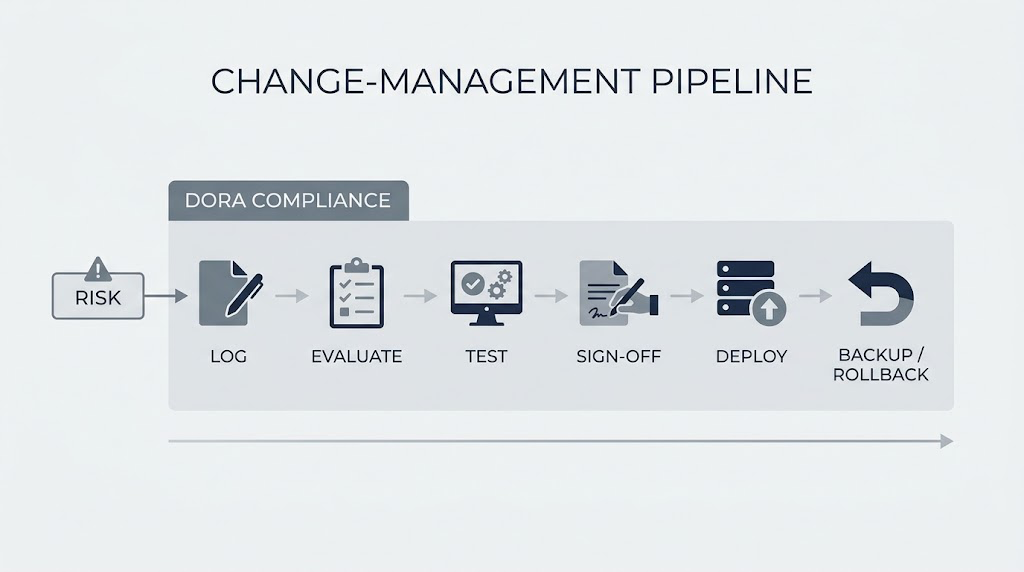
Because of this risk, DORA requires platforms to follow a strict change-management pipeline. Every single modification must be formally logged, evaluated, and thoroughly tested before getting final sign-off.
Only then is it deployed, verified on the live system, and backed by a quick rollback plan just in case.
What Should Happen When a Security or ICT Incident Occurs?
When something goes wrong, a platform shouldn't be guessing what to do next. It needs a clear game plan ready to go: spot the issue fast, track what happened, stop the damage, and get the right team on it immediately.
Getting the app back online is only the first step. The team also needs to find the root cause and fix it for good because simply restarting a broken system just leaves the door open for it to happen again.
Why Are Backups and Recovery Part of the Security Baseline?
Even the best defenses can be tested by hardware crashes, power cuts, or severe outages, which is why recovery is just as vital as prevention.
A platform needs tested backup plans ready at all times. If something catastrophic knocks the core servers out, the team should be able to restore transaction records, account balances, and system settings quickly, keeping downtime short and making sure user data remains intact.
What If the Platform Uses Cloud or Other External Providers?
Modern crypto platforms rarely build every server or tool from scratch. They routinely rely on external providers for cloud hosting, data processing, customer communications, and specialized cybersecurity tools.
Under DORA, using outside help doesn't mean passing the buck. The core rule is crystal clear: outsourcing technology does not outsource regulatory responsibility.
If a cloud provider goes down or leaks data, the platform cannot simply point fingers and shrug. That is why it must actively manage these third-party risks:
- Assessing critical dependencies: Knowing exactly which outside tools the platform cannot survive without, and avoiding dangerous single points of failure.
- Contractual safeguards: Demanding clear, legally binding standards for data security, uptime guarantees, and audit rights.
- Continuity and exit plans: Having a concrete fallback strategy if a key vendor suddenly changes terms, suffers an outage, or shuts down.
Practical Example: Suspicious Access to a Critical System
To see how these controls work together, imagine an alert goes off at 2:00 AM on a platform’s withdrawal server. Here is how layered security handles it in real time:
- Access limits block the damage: An admin credential is used off-hours, but strict permission limits prevent it from touching funds or overriding multi-signature approvals.
- Monitoring sounds the alarm: Automated surveillance flags the unusual login time and location, alerting the on-call security team instantly.
- Logs trace the footprint: Immutable audit trails show engineers every command attempted, confirming zero funds left the platform.
- Incident response locks it down: The team freezes the compromised account, cuts active sessions, and isolates the server.
- Credentials get wiped: Keys are rotated, the machine is cleaned, and fresh patches are applied.
- Recovery checks clear the green light: Engineers verify data integrity and account balances before quietly resuming normal withdrawals.
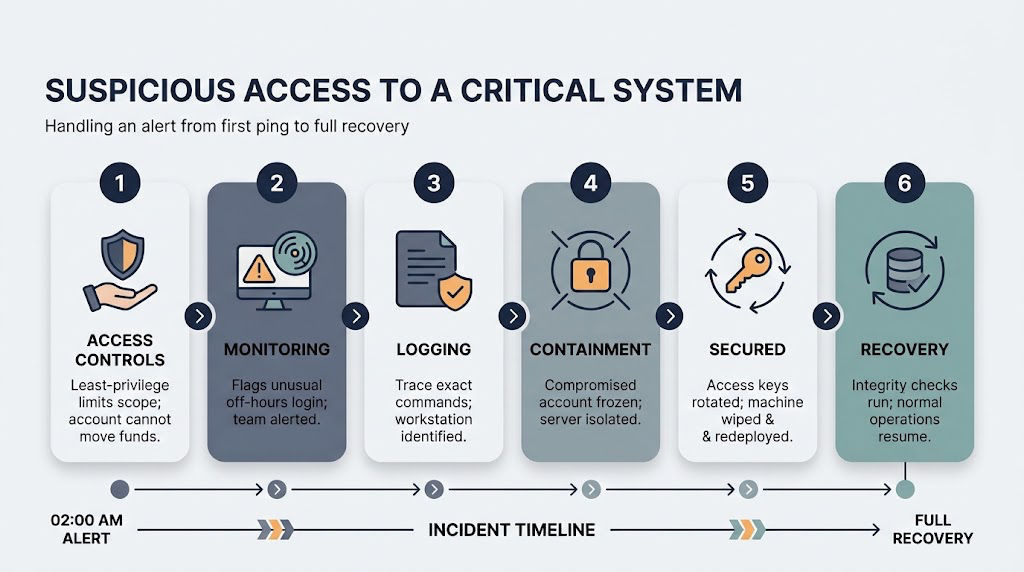
When every layer does its job, an attack becomes a quiet routine check rather than a crisis.
What Do Security Controls Not Guarantee?
Even the strictest regulations cannot promise a 100% hack-proof world.
Meeting strict security standards does not guarantee that a platform will never suffer an outage, lose data, or get caught up in a crash at an external cloud provider. In tech, absolute zero risk does not exist.
You also won't ever see every single lock and bolt a platform uses behind the scenes. That is by design: publishing the exact blueprint of internal infrastructure just gives bad actors a handy map to study.
Ultimately, a credible security baseline is not a marketing label, a shiny certificate, or a single impenetrable wall, it is a combination of preventive controls, continuous monitoring and tested response processes.
Disclaimer: The content provided in this article is for educational and informational purposes only and should not be considered financial or investment advice. Interacting with blockchain, crypto assets, and Web3 applications involves risks, including the potential loss of funds. Venga encourages readers to conduct thorough research and understand the risks before engaging with any crypto assets or blockchain technologies. For more details, please refer to our terms of service.