
Table of Contents
Withdraw crypto from an EU exchange today and the form will often ask who owns the destination wallet. That extra step comes from the crypto Travel Rule.
Under the rule, your platform needs details on two people. One is whoever sends the transfer, known as the originator. The other is whoever receives it, the beneficiary. It keeps those details on record and, where another provider sits at the receiving end, passes them on.
The EU's Travel Rule requirements sit in Regulation (EU) 2023/1113. It was published in June 2023, but nothing changed for users until 30 December 2024, when it started to apply. The Markets in Crypto-Assets Regulation (MiCA) started applying to crypto firms that same day.
Banks got there first. The Financial Action Task Force (FATF), a Paris-based anti-money laundering body, applied it to wire transfers back in 2001. In June 2019 it stretched the idea to cover crypto. FATF guidance isn't law, though. Each country writes its own version, and the EU's is stricter in places.
When Does the Crypto Travel Rule Apply in the EU?
For the rule to apply, a regulated firm has to be handling the transfer somewhere along the way. Which coin you send, or which blockchain it runs on, makes no difference.
The trigger is a CASP (crypto-asset service provider), the type of firm authorised under MiCA, the EU's wider crypto rulebook. If an app in the EU holds your coins for you, it’s almost certainly one.
Article 2 sets the geography. If any provider touching the transfer, including a go-between, has its registered office in the EU, the transfer is caught. Transfers between two platforms are covered. So are transfers between a platform and a self-hosted address, meaning a wallet whose keys you hold yourself.
There's one big exception. A person-to-person transfer from one self-hosted wallet to another, with no provider involved, falls outside this Regulation. Not every blockchain transaction triggers the EU Travel Rule.
Travel Rule scenarios at a glance
"EU CASP" means a provider with its registered office in the EU.
What Information Accompanies a Crypto Transfer?
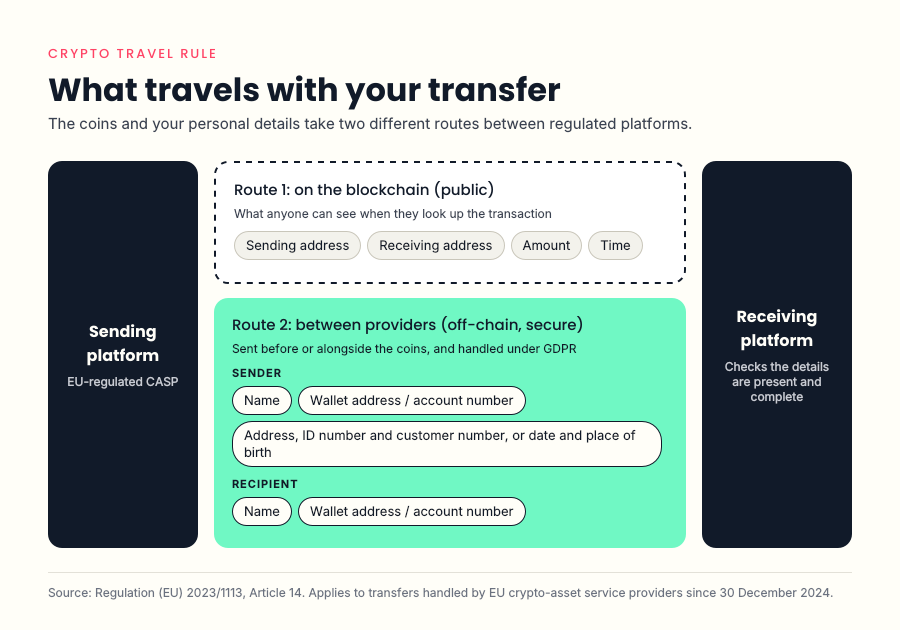
Article 14 sets out two Travel Rule lists, one for the originator and one for the beneficiary.
Sender's details
- Name
- Distributed-ledger address (the wallet address) and crypto-asset account number, where one is used
- Either their address with country, official ID document number and customer number, or their date and place of birth
Recipient's details
- Name
- Distributed-ledger address and crypto-asset account number, where one is used
Your own details are already on file from when you opened the account, so the recipient's name is usually the part you end up typing in.
What Happens When You Send Crypto From One Platform to Another?
The most common case is a move between two EU exchanges.
The sending exchange sends the Travel Rule information first, or alongside the coins. It can't follow on later. Many providers exchange it in a shared data format called IVMS101, over messaging systems built for the job.
It works a bit like a parcel whose delivery note goes by a separate courier. The coins travel on the blockchain. The Travel Rule data travels between the two firms.
The receiving exchange then checks that the Travel Rule information has arrived and is complete. If a field is missing, it applies its own procedures before crediting the funds (see the section on delays).
What Changes When You Transfer to or From a Self-Hosted Wallet?

Self-custody isn't prohibited. Keep your coins on a hardware wallet for ten years if you like; the Travel Rule has nothing to say about it. Venga's guide to custodial and non-custodial wallets covers that choice in more detail.
What changes is the platform's side of the paperwork. Under Article 14(5), a CASP sending to a self-hosted address must obtain and hold the Travel Rule information, and make sure the transfer can be individually identified. Article 16(2) applies the same duty to incoming transfers.
There's no second provider to receive the data, so the platform keeps it on file itself. On many withdrawal forms, it shows up as a yes/no question about whether the wallet is yours. If it belongs to someone else, the form will want their name as well.
What Does the €1,000 Threshold Mean for Self-Hosted Wallets?
€1,000 is one of the most misread numbers in this area. It isn't a general EU threshold below which the crypto Travel Rule switches off.
Worth knowing: FATF's version allows a lighter touch for small transfers, with less information needed below USD/EUR 1,000, and that's likely where the myth started. The EU didn't copy that for transfers between providers. A €20 transfer between two EU exchanges carries the same data as a €20,000 one.
The €1,000 figure only applies when one side of the transfer is a self-hosted address. Above that amount, the platform must take adequate measures to assess whether the address is owned or controlled by its customer.
Platforms run the check in different ways. With a signed message, your wallet produces a digital signature the platform can verify, and no coins move at all. A test transfer works differently. You send a tiny amount the platform picks from that address. Ticking a box that says "this is my wallet" is generally not enough by itself.
Below €1,000, the platform still collects and keeps the Travel Rule details. It just isn’t legally required to run the ownership check.
Is Your Personal Information Written on the Blockchain?
No. Article 14(4) is clear. Travel Rule information can travel separately from the transfer of crypto-assets, rather than being attached to it or written into it.
On-chain, nothing new appears. Anyone looking up the transaction sees two addresses, an amount and a timestamp, the same as before 2024. Names, ID numbers and dates of birth stay off-chain.
Why this matters: That data is personal, so GDPR (the General Data Protection Regulation) applies to every EU firm that handles Travel Rule data. It's the same law that already covers the ID you uploaded when you opened your account.
Why Can a Transfer Be Delayed or Require More Information?
Receiving platforms, and intermediary platforms that pass a transfer along, must have procedures for detecting missing or incomplete Travel Rule information.
When something is missing, Article 17 lets the receiving provider decide, on a risk basis, how to respond. Often it pauses the transfer and asks for whatever’s missing, and the funds stay put until the details arrive. Otherwise, it can refuse it or send the crypto-assets back.
The European Banking Authority (EBA) has published guidance on how providers make that call. The EBA's Travel Rule guidelines started applying on the same day as the Regulation.
For users, a Travel Rule hold usually means a field was empty or didn’t match.
What If the Other Crypto Provider Is Outside the EU?
An EU platform keeps its obligations when the provider on the other side is established outside the Union. It still has to identify that counterparty and send the Travel Rule information, even where the other country has applied the FATF standard differently.
Differences like that are common, and FATF checks on them every year. Its July 2026 review of how countries apply the standard found progress on adoption, but almost half of the countries with Travel Rule laws hadn’t taken any supervisory or enforcement action.
Send to a platform in one of those countries and you might face an extra question, or wait a little longer for the funds to land. One technical point. An address at a non-EU exchange doesn't count as self-hosted under Article 3(20), so the €1,000 ownership check doesn't apply to it.
Practical Example: Exchange → Own Wallet → Another Exchange
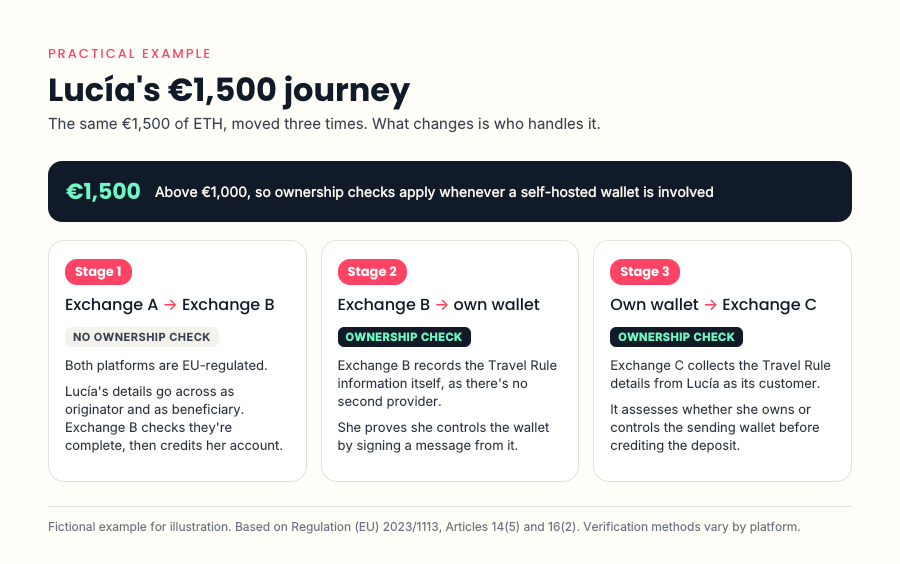
Lucía lives in Madrid. She holds €1,500 of ETH (Ether) and moves it three times in a year.
Stage 1: EU Exchange to Another EU Exchange
Lucía moves the ETH from Exchange A to an account in her name at Exchange B, both regulated in the EU. Her Travel Rule details go across as originator and as beneficiary. Exchange B checks they're complete and credits her account.
Stage 2: EU Exchange to Her Own Wallet
She then withdraws the ETH from Exchange B to her own hardware wallet. Exchange B records the Travel Rule information for the withdrawal. As €1,500 is over the threshold, it also asks her to prove she controls the address, and she signs a message from the device.
Stage 3: Own Wallet to Another EU Exchange
Six months later she sends the ETH to Exchange C, also in the EU. Exchange C collects the Travel Rule details from Lucía as its customer. The deposit comes from a self-hosted address and exceeds €1,000, so Exchange C also assesses whether she owns or controls that wallet.
What Does the Crypto Travel Rule Not Mean for Users?
Three common assumptions don't hold up:
- It doesn't ban self-hosted wallets.
- It doesn't put names or ID numbers on the blockchain.
- It doesn't set a €1,000 maximum for crypto transfers.
A complete set of Travel Rule information won't guarantee a transfer is approved, either. Transfers still go through sanctions screening, plus the platform's own anti-money laundering (AML) checks. A transfer can be stopped there even with every field filled in.
The practical point is this. The Travel Rule is attached to regulated service providers. When one is involved, the information moves with your crypto. When a transfer runs between two people's own wallets, this rule doesn't reach it.
Disclaimer: The content provided in this article is for educational and informational purposes only and should not be considered financial or investment advice. Interacting with blockchain, crypto assets, and Web3 applications involves risks, including the potential loss of funds. Venga encourages readers to conduct thorough research and understand the risks before engaging with any crypto assets or blockchain technologies. For more details, please refer to our terms of service.