Table of Contents
When buying crypto, most people do not think that the geographical location would affect how their assets are treated.
Across the EU, a single, unified framework sets clear standards upfront for custody, disclosures, and platform operations, while in the U.S., investor protection is largely shaped through state-by-state licensing and federal court enforcement.
We will look at a breakdown of how both approaches work and what kind of protection you actually get on each side of the Atlantic.
EU vs. U.S. Crypto User Protection: How the Frameworks Differ
The EU operates under a single, harmonised crypto framework built primarily around the Markets in Crypto-Assets Regulation (MiCA). This is reinforced by specialized legislation like DORA (the Digital Operational Resilience Act), which sets strict IT security and cyber standards, and the recast Transfer of Funds Regulation (TFR), which traces crypto transactions for anti-money laundering compliance.
By contrast, user protection in the U.S. does not come from a single crypto rulebook. Instead, the rights and safeguards you receive depend heavily on four moving pieces:
- The type of crypto-asset: Whether a token is treated as a security, commodity, or payment tool.
- The Activity: What you are doing: spot buying, staking, lending, or trading derivatives.
- The Provider: How the platform is chartered, registered, or licensed to hold assets.
- The Jurisdiction: Whether oversight falls under federal regulators (like the SEC and CFTC) or state rules (like New York's BitLicense).
Why Is the EU–U.S. Comparison Not One-to-One?
Comparing EU and U.S. crypto protections is not simply a matter of comparing two regulatory frameworks with different requirements. The EU takes a more unified, comprehensive approach, while the U.S. relies on a combination of federal agencies, state regulators, and local laws.
In the EU, the approach was architectural. Lawmakers sat down to build a tailored system from scratch. Through MiCA, the EU established a single set of harmonised rules defining specific categories of crypto-assets (such as asset-referenced tokens, e-money tokens, and utility tokens) alongside clear obligations for Crypto-Asset Service Providers (CASPs).
Once an entity complies with MiCA in one EU Member State, those exact same rights and operational baselines carry across all 27 borders.
The U.S. took the opposite route. Instead of one comprehensive crypto law, protection is distributed across existing securities, commodities, banking, anti-money laundering, and state-level regimes.
While federal lawmakers continue working on bespoke crypto legislation, U.S. safeguards still depend on which legacy financial laws apply, which state you live in, and how court decisions shake out.
How Does Regulation of Crypto Providers Differ?
Opening a crypto business in the EU is not a free-for-all. Any platform offering regulated crypto-asset services to retail users generally needs a formal authorization under MiCA(as a licensed Crypto-Asset Service Provider, or CASP) or another permitted regulatory status under existing financial laws, such as being an authorized credit institution or investment firm.
To keep everything transparent, everyday users can verify legitimate platforms directly on the public ESMA register. Maintained by the European Securities and Markets Authority, this registry lists authorized CASPs alongside the exact services they are legally permitted to provide, their home country, and an active blacklist of non-compliant entities.

Even so, once authorized, EU CASPs cannot simply run their business as they please. They are bound by strict, harmonised rules across three core areas:
- Conduct requirements: They must act honestly, fairly, and professionally, keeping marketing materials clear and non-misleading while making pricing, fee schedules, and execution policies plain to see.
- Organisational requirements: Platforms must enforce strong conflict-of-interest policies, maintain robust internal governance, establish structured complaints-handling procedures, and hold dedicated prudential capital buffers.
- Service-specific requirements: Tailored rules apply depending on what the firm actually does—whether operating a trading exchange, executing orders on behalf of clients, providing custody, or offering portfolio advice.
In contrast, the U.S. has no single regulator or unified public register for all crypto providers. Depending on the services they offer, platforms may need to obtain state money transmitter licences, secure state trust charters, or register with federal agencies such as the SEC, CFTC, or FinCEN. As a result, the operational and conduct requirements they must meet can differ considerably depending on their activities and regulatory status.
What Information Should Users Receive Before Buying or Using a Service?
Once you have made the decision to get into crypto, before you tap "buy" or transfer funds onto an exchange?
You should understand what you are buying, who is handling your transaction, and what risks are involved.
Exactly for this reason, disclosure rules exist to ensure buyers are not making blind bets based on promotional hype or opaque fine print.
However, the obligations on platforms and issuers differ markedly across jurisdictions, so rules that apply in one jurisdiction does not automatically apply to another.
The EU: Standardized, Mandatory Transparency
Under MiCA, transparency is not optional, The EU sets a clear baseline of upfront disclosure requirements that CASPs and token offerors must meet before serving retail customers:
- Fair, clear, and non-misleading information: All communications including marketing pitches and platform copy must be honest, balanced, and free from misleading claims or promises of guaranteed returns.
- Transparent pricing and fee policies: CASPs are legally required to make their fee schedules, pricing methodologies, and order execution policies easily accessible so users know the real cost of a trade upfront.
- Mandatory risk warnings: Platforms and issuers must prominently display warnings stating that crypto-assets can lose value rapidly, are volatile, and typically fall outside traditional deposit guarantee or investor compensation safety nets.
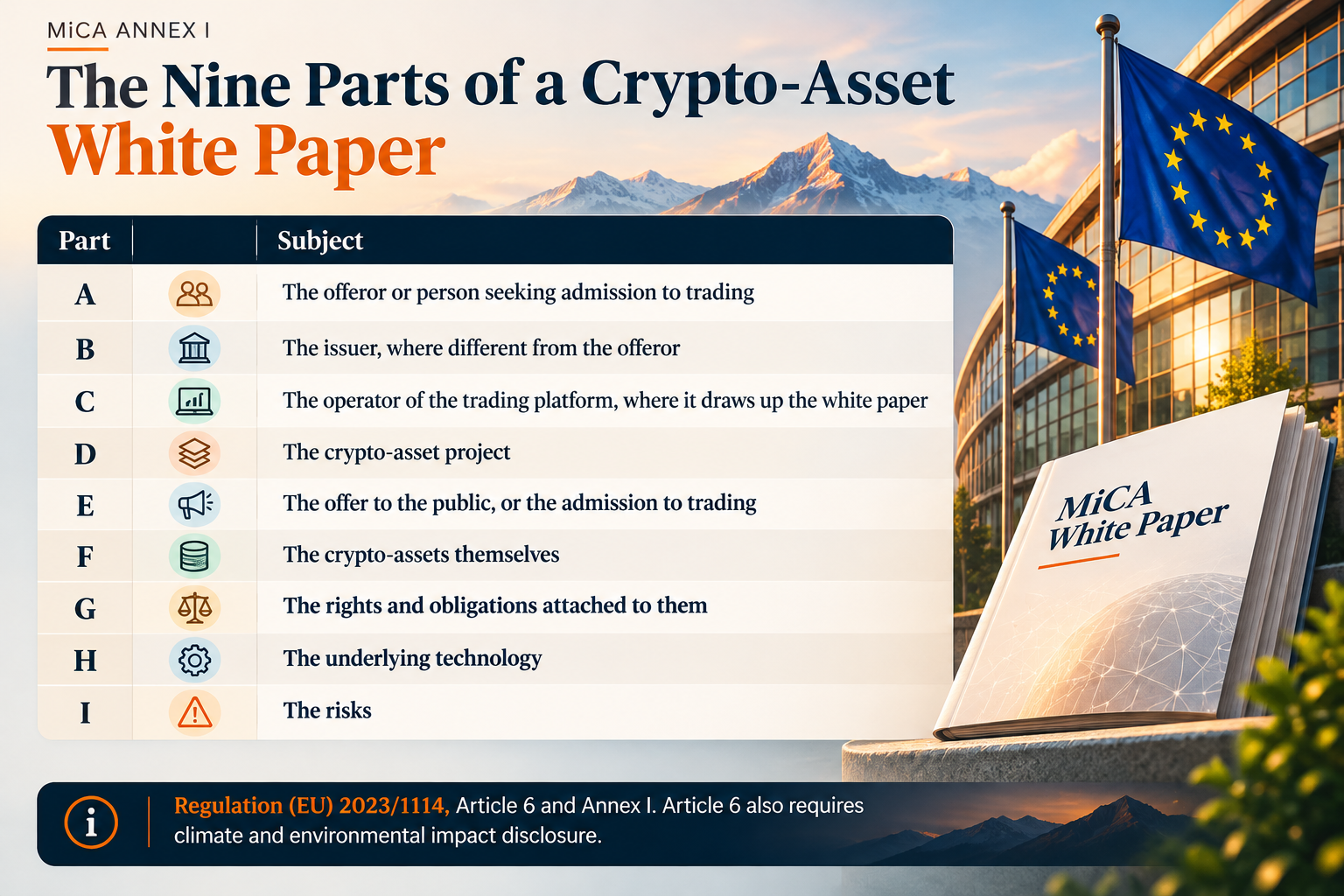
- Standardized white papers: When a token is offered to the public or listed on an EU exchange, issuers or platforms must publish an official, regulated crypto-asset white paper. Functioning much like a streamlined prospectus, it must detail the issuer's identity, the underlying blockchain technology, rights and obligations attached to the token, environmental impact, and specific project risks.
The U.S.: Disclosure Follows Asset Classification
In the United States, the disclosure you receive depends on a key legal distinction: how the asset and the transaction are classified.
- When securities laws apply: If a token offering or yield program is seen as an "investment contract" or security under federal law, disclosure requirements enforced by the SEC can be exhaustive. Issuers must provide detailed registration statements or formal offering circulars covering audited financial histories, management compensation, governance risks, and material conflicts of interest.
- When commodities or spot markets apply: If a crypto-asset is treated as a commodity (such as Bitcoin) trading on a spot exchange, it does not trigger securities registration. Spot crypto exchanges operate primarily under state-level consumer protection and money transmitter regimes, where mandatory disclosure centers on execution terms, fee schedules, and basic commercial risks rather than standardized technical token prospectuses.
In summary, consider the table below.
How Do Rules for Holding Customer Crypto Differ?
Under the EU’s MiCA framework, Crypto-Asset Service Providers (CASPs) offering custody have to play by strict, non-negotiable rules:
- Clear custody agreements: Platforms must establish a formal, transparent agreement with each client outlining rights, duties, and how assets are handled.
- Segregation of client assets: Customer funds must be kept strictly separated from the platform’s own balance sheet, ensuring users aren't left stranded as general creditors if the company goes down.
- Accurate position records: Platforms are required to maintain real-time, matching records of what every user owns down to the exact decimal point.
- Direct custodian liability: If client crypto is lost due to a hack, operational failure, or negligence attributable to the platform, the custodian is held legally accountable to compensate for those losses.
How Do the EU and U.S. Regulate Stablecoins?
The EU moved first and already has active rules on the ground. Since 30 June 2024, MiCA’s regimes for E-Money Tokens (single-currency pegs) and Asset-Referenced Tokens (multi-asset pegs) have been fully in force.
In the EU, you can't just launch a stablecoin and hope for the best. Issuers need an official license, must hold matching 1:1 cash reserves in safe accounts, and have to let users cash out at face value anytime. All while continuous regulatory supervision.
Across the Atlantic, the U.S. passed the GENIUS Act in July 2025 to create federal rules for payment stablecoins. But there’s a big gap between signing a bill and having everything running: regulators are still working out the finer licensing details.
In simple terms, Europe’s rules are already part of daily life, while the U.S. is still tuning the engine.
How Are Market Manipulation and Misconduct Addressed?
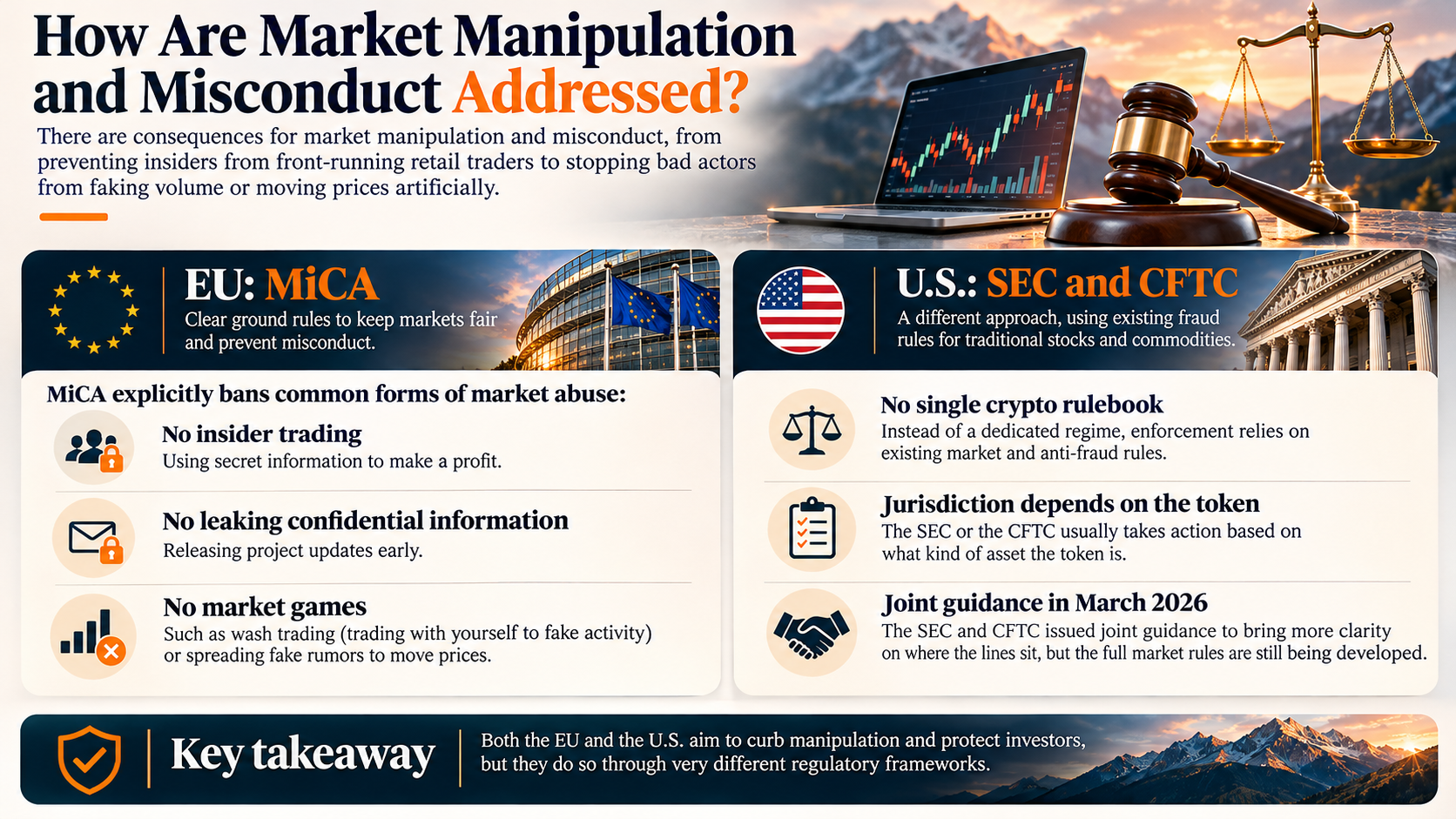
As with everything else, there are consequences for market manipulation and misconduct : This runs from preventing insiders from front-running retail traders and stopping bad actors from faking volume or moving prices artificially.
Just like with stablecoins, the EU and the U.S. tackle this challenge through two very different setups.
In the EU, MiCA lays down clear ground rules so markets stay fair. It bans the classic shady tricks:
- No insider trading (using secret info to make a profit),
- No leaking confidential project updates early,
- No market games like wash trading (trading with yourself to fake activity) or spreading fake rumors to move prices.
The U.S. handles this differently. Instead of one unified crypto rulebook, regulators use existing fraud rules meant for traditional stocks and commodities.
Whether the SEC or the CFTC takes action usually depends on what kind of asset the token actually is. Both agencies teamed up in March 2026 to offer clearer guidance on where those lines sit, but the full market rules are still being worked out.
What Happens When a Platform Has a Technology Failure?
Under DORA, the E.U regulates technology outages. Authorized Crypto-Asset Service Providers (CASPs) must follow the same operational resilience standards as traditional banks.
A platform cannot simply treat a crash as bad luck; it must operate a legally binding framework covering:
- ICT risk management: Identifying system vulnerabilities and maintaining strict defenses.
- Incident management: Logging disruptions and reporting major outages to regulators on strict deadlines.
- Testing and recovery: Regularly stress-testing systems and maintaining tested backups to restore operations quickly.
- Third-party technology risk: Monitoring and holding outside vendors (like cloud hosts) to high operational standards.
Are Crypto Assets Protected by Deposit Insurance or Compensation Schemes?
Holding crypto on a regulated app doesn’t mean it works like money in a bank account.
A lot of people assume that if a platform has a license, government deposit insurance automatically protects them if things go south. It doesn’t.
In both the US and Europe, traditional safety nets like FDIC insurance or EU bank guarantee schemes are built for regular cash in a bank, not crypto.
In the EU, having a MiCA license means the platform follows strict rules, but it does not give your tokens government-backed deposit protection.
If you use a traditional bank or broker that happens to offer crypto, always read the fine print, that safety net usually only covers the actual cash sitting in your account, not the crypto tokens you buy with it.
Practical Example: The Same Crypto Purchase in the EU and the U.S.
To see how these two systems feel in practice, imagine an investor named Alex buying and holding the exact same cryptocurrency (let us say Bitcoin) through a regulated platform in Europe, and doing the identical trade in the United States.
The checkout screen might look similar, but the legal checklist behind it is completely different.
The Workflow for Alex in E.U
Under the EU’s Markets in Crypto-Assets (MiCA) framework, Alex follows one unified checklist across all 27 member states:
- Verify the platform on the official register: Alex searches the central ESMA public register to confirm the platform is an authorized Crypto-Asset Service Provider (CASP) with valid permissions to hold custody and execute trades.
- Review the mandatory token white paper: Before buying, Alex can access a legally required, standardized white paper that details the token’s underlying tech, project risks, and environmental footprint.
- Inspect clear fees and risk disclosures: The platform is required to display all trading, deposit, and withdrawal fees upfront alongside clear risk warnings before Alex confirms the trade.
- Rely on statutory custody segregation: Alex’s tokens are separated from the exchange’s balance sheet by law, and the platform bears direct legal liability if assets are lost due to a platform hack or operational failure.
- Use a free, formal complaint path: If an execution fails or assets go missing, the platform must provide a structured, zero-cost dispute resolution process subject to review by national regulators.
The Workflow for Alex in the U.S.
Here is no single central register or uniform crypto code. Alex must navigate several overlapping layers to understand the terms of the trade:
- Classify the asset and transaction: Alex must determine how the asset is categorized (for instance, as a digital commodity under CFTC purview or an investment contract/security under SEC oversight, guided by their joint framework).
- Identify the exact operating entity: Major U.S. platforms operate through several corporate entities. Alex must check the user agreement to verify which specific affiliate such as a trust company or money services business is executing the order and holding the tokens.
- Check state and federal licensing: Because there is no single federal CASP license, Alex must verify whether the platform is authorized in their home state, such as holding a New York BitLicense or individual state money transmitter licenses.
- Scrutinize the provider’s private custody terms: With no single federal custody statute covering all platforms, Alex must check the platform’s private user agreement to see if client assets are segregated, how bankruptcy risk is handled, and what private insurance (if any) exists.
- Handle disputes through private arbitration: If something goes wrong, recourse is typically governed by standard customer support channels and the platform's mandatory binding arbitration terms, rather than a statutory regulatory dispute portal.

Does Stronger Regulation Mean Lower Investment Risk?
The simple answer is No! Stronger regulation sets rules for market conduct, but it cannot eliminate market risk.
Both the EU and U.S. frameworks enforce provider licensing, mandatory disclosures, custody standards, and market-abuse rules. However, none of these controls prevent crypto prices from crashing, nor do they guarantee that an issuer or platform will never fail.
It is vital to separate regulatory protection from investment protection:
- Regulatory protection ensures the entity holding your money behaves honestly, maintains segregated accounts, and discloses known risks.
- Investment protection implies your capital is safe from losses which no framework provides.
Ultimately, regulators in both jurisdictions can govern who provides a crypto service and how that service is delivered, but neither system guarantees the value, stability, or financial performance of the asset itself.
Disclaimer: The content provided in this article is for educational and informational purposes only and should not be considered financial or investment advice. Interacting with blockchain, crypto assets, and Web3 applications involves risks, including the potential loss of funds. Venga encourages readers to conduct thorough research and understand the risks before engaging with any crypto assets or blockchain technologies. For more details, please refer to our terms of service.