
Table of Contents
On most perpetual futures screens, next to the price, you'll spot a tiny percentage with a timer counting down beside it. That's the funding rate. Of everything on the page, it's probably the bit newcomers ask about most.
A funding rate creates periodic transfers between long positions and short positions, and its job is to keep the perpetual contract trading close to the spot price of the asset.
For the trader, funding is a carrying cost or a receipt. On most venues it isn't a fee paid to the platform, and it isn't a reliable forecast of where the price goes next.
Worth knowing: On Binance, Bybit, OKX, and Hyperliquid, funding is peer-to-peer. It moves between traders holding opposite positions, and the exchange takes no cut of the funding payment. Trading fees are charged separately.
Why Perpetual Futures Need a Funding Mechanism
A traditional futures contract has an expiry date. On that date it settles against the underlying market, so its price gets pulled towards spot as expiry approaches. Anyone who wants to keep their exposure has to close the old contract and open the next one, a process called rolling.
A perpetual contract simply removes the expiry. You can hold it for an hour or for a year without rolling anything. BitMEX brought the format to a wide audience with its bitcoin perpetual in May 2026, and perpetuals have since become the most popular way to trade crypto futures.
Without a settlement date, though, nothing forces the perpetual back towards spot. Funding fills that gap. Think of it as a rubber band: the further the contract drifts from spot, the harder the payments pull traders towards the side that closes the gap.
Dated Futures vs Perpetual Futures
One caveat. Funding narrows the gap between a perpetual and spot, but it doesn't erase it. Perpetuals can trade at a premium or a discount for long stretches, especially when markets move fast.
Funding Timestamps and Eligibility
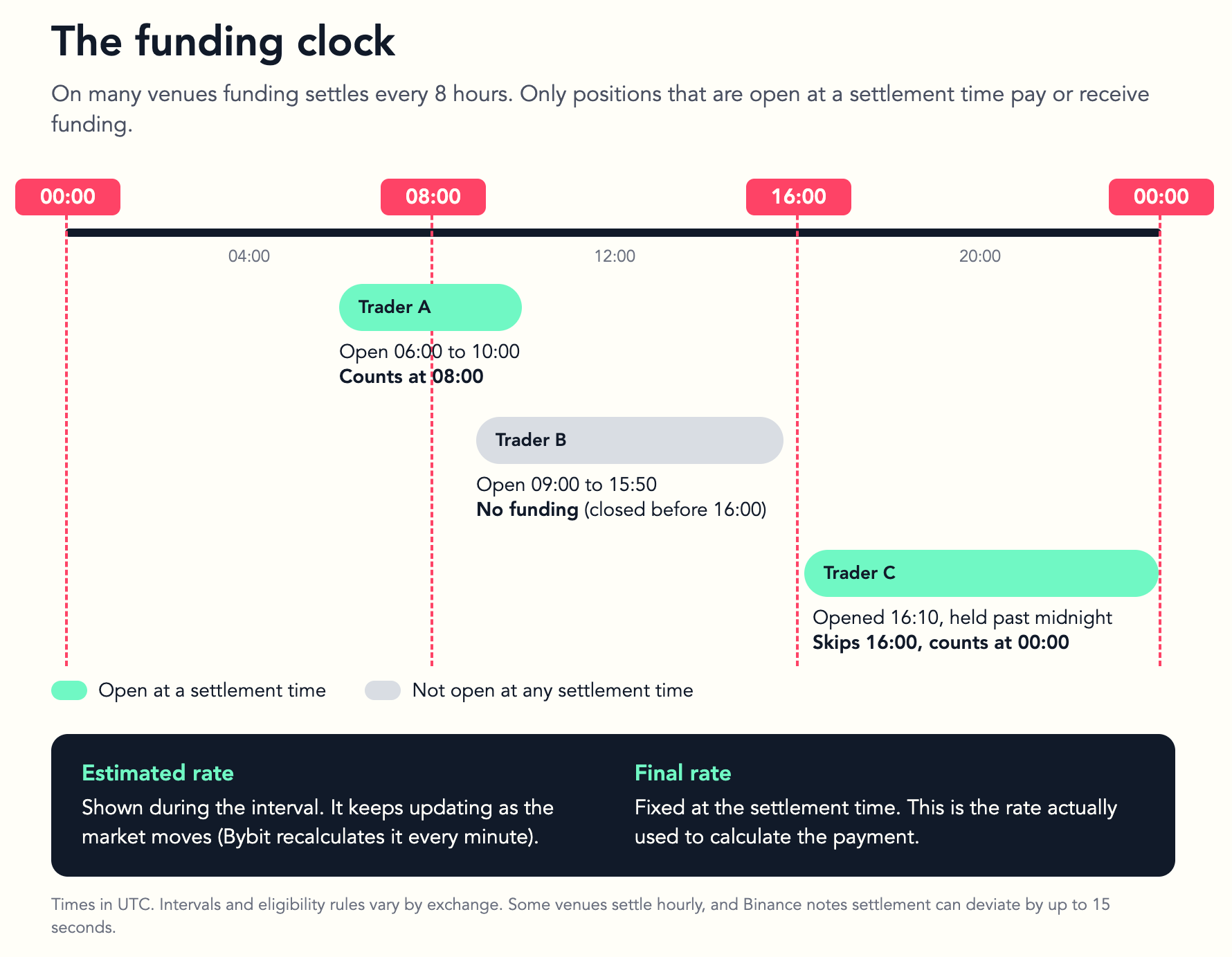
Funding isn't charged continuously. It's exchanged at fixed settlement times, which on many venues fall every eight hours at 00:00, 08:00 and 16:00 UTC (Coordinated Universal Time).
As a general rule, a position in a perpetual contract has to be open at the settlement time to pay or receive funding. Close before it and you're out of that round. Open just after it and you've skipped it.
Each venue words this a little differently. Binance, for one, says the funding transaction can land up to 15 seconds after the timestamp, so a position opened at 08:00:05 UTC could still pay or receive funding. Trading in the seconds around a timestamp leaves it to chance.
It also helps to separate two numbers. The funding rate displayed during the interval is an estimate that keeps updating (Bybit recalculates it every minute). The rate actually applied is the final figure fixed at settlement.
Who Pays When Funding Is Positive or Negative
The usual convention is straightforward. When the funding rate is positive, long positions pay short positions. When it's negative, short positions pay long positions.
A positive rate generally means the perpetual has been trading above spot. The payment makes holding a long slightly more expensive and holding a short slightly more rewarding, which tends to pull the two prices closer. A negative rate works the other way round.
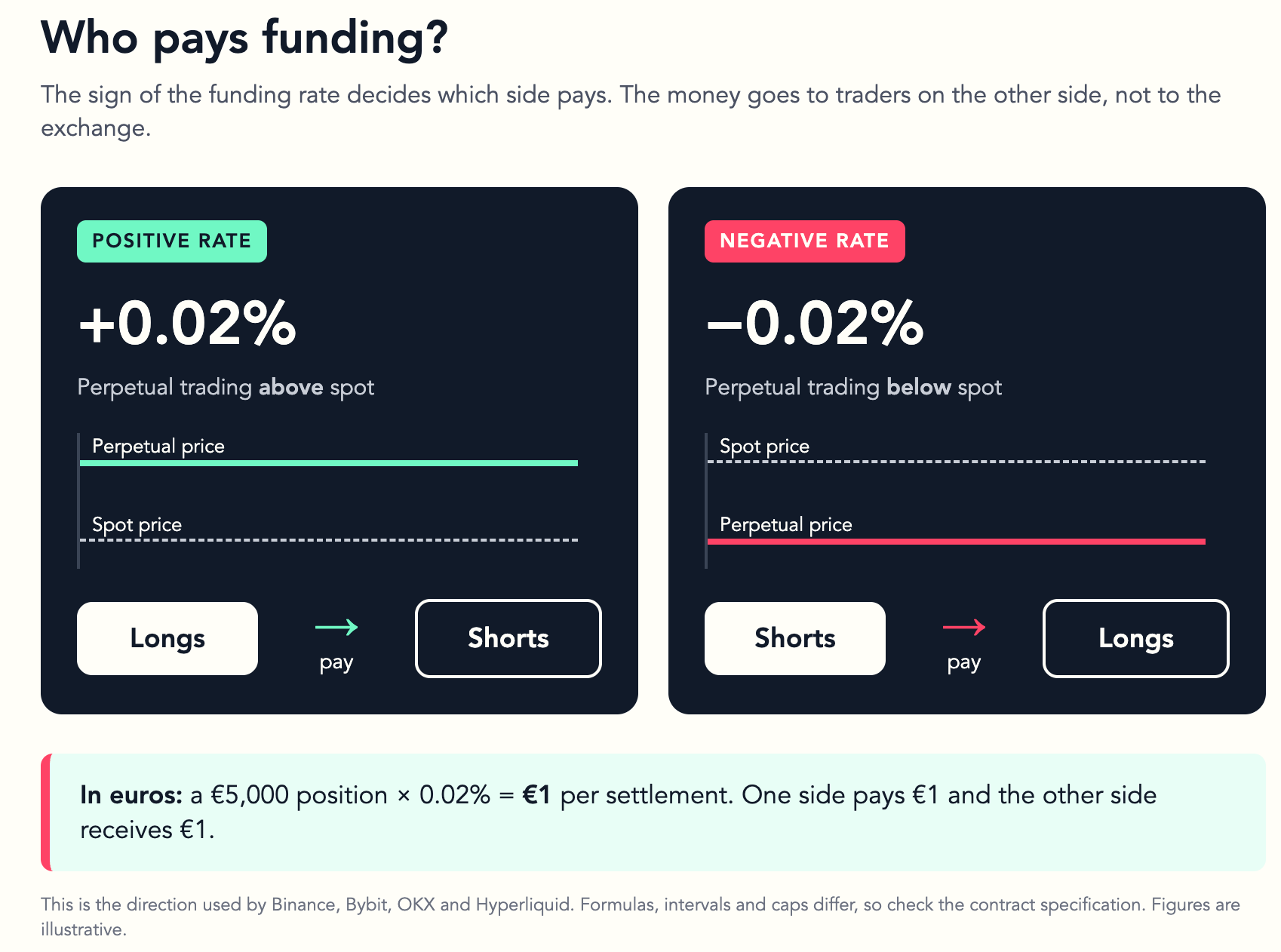
Binance, Bybit, OKX and Hyperliquid all follow this direction. Their formulas, intervals and caps still differ, sometimes between contracts on the same exchange, so the current contract specification is the place to confirm how a given market works.
Funding Rate, Premium and Interest Components
Most large exchanges build funding rates from two ingredients: a premium component and an interest component.
The premium measures how far the perpetual is trading from its index price, a reference spot price blended from several markets. It's sampled repeatedly during the interval and averaged, so one sudden spike can't set the rate by itself.
The interest component is a small fixed baseline. On standard contracts at the four venues covered here, it works out at 0.01% per eight hours. A limiting step, which exchanges call a clamp, keeps the funding rate at that baseline whenever the premium is small.
Because sampling continues until settlement, the displayed rate can drift during the interval. One exchange's formula also shouldn't be transplanted onto another's contract, since averaging methods, price sources and caps all vary.
How a Funding Payment Is Calculated
The general formula is short:
Funding payment = position notional × funding rate
Notional is the full value of the position, usually the contract size multiplied by the mark price (the exchange's fair-value price for the contract). It isn't the margin you put up.
Picture a €5,000 long. Settlement arrives and the funding rate is sitting at +0.02%, so €1 leaves the long's margin (5,000 × 0.0002 = 1). Someone holding a short of the same size receives €1. At −0.02%, the flow reverses.
Leverage doesn't appear in the formula, but it changes how much each payment matters. If that €5,000 long was opened at 5x leverage, the trader's margin is €1,000. The €1 funding payment is then 0.1% of the capital at stake, not 0.02%.
Most perpetuals settle in stablecoins such as USDT or USDC. The euro figures just keep the maths easy to follow.
Annualised Funding Figures Can Mislead
Some dashboards convert funding rates into a yearly figure. The method is simple: multiply the rate per interval by the number of intervals in a year.
Take the common baseline of 0.01% every eight hours. With three settlements a day, the yearly figure is 0.01% × 3 × 365, or 10.95%. Push the funding rate up to 0.05% per interval and the same sum gives 54.75%. On a dashboard, a number like that grabs attention.
The catch is that this assumes the rate stays exactly where it is for twelve months. It won't. Funding can change at every interval, flip from positive to negative, and drift back to the baseline within days.
Why this matters: An annualised funding figure is a comparison aid, handy for putting two venues or two moments side by side. It isn't a promised yearly cost, and it isn't a promised yearly return.
Comparing Funding Rates Across Exchanges
Comparing funding rates between exchanges only works when you compare like with like. That means the same contract (BTC against USDT, say), the same quote currency, the same interval, and rates taken at the same timestamp.
Intervals catch people out most often. Say one venue shows 0.03% and another shows 0.01%. The second looks cheaper. But if it's charged hourly, eight payments of 0.01% come to 0.08%, well over double the first venue's 8-hour charge.
Method matters too. Binance, Bybit, OKX and Hyperliquid, four large venues for crypto futures, each set their own caps, index prices and settlement frequencies. Some shorten the interval automatically once the rate hits its limit.
How Four Major Venues Handle Funding
Contract specifications checked September 2026 from each venue's funding documentation: Binance, Bybit, OKX and Hyperliquid. Exchanges revise them, so the live contract page is always the source to trust.
How Funding Changes the Economics of a Position
A single funding payment is usually small. The effect builds when a position is held through many intervals.
Run the numbers on a €10,000 long. At the 0.01% baseline, funding costs €3 a day and €21 over a week, assuming nothing changes. If the rate climbs to 0.05% and stays there for a week, the bill comes to €105. Those payments come out of available margin, or add to it on the receiving side.
What Funding Costs on a €10,000 Position
Assumes three payments a day and a rate that never changes. Real rates can move at every interval, so treat these as illustrations, not forecasts.
Receiving funding can create a false sense of safety. A €10,000 short collecting 0.03% per interval earns €3 per payment. If the price rises 5% in an afternoon, that short is down €500 before the next payment even lands. The price exposure is almost always the bigger number.
What a High Positive or Negative Rate May Suggest
Start with what the number actually shows. A high positive funding rate means the perpetual has been trading above its index and longs are paying to stay in. A deep negative rate means the opposite. That's the observation.
The inference is a separate step. A persistently high rate often points to crowded positioning, with lots of traders using leverage in the same direction. Crowded trades can unwind abruptly, because forced closures from liquidation push the price further and trigger more of them.
None of this turns the funding rate into a timing signal. Extreme funding rates can last for days or weeks in a strong trend, and anyone betting on a quick reversal pays funding the whole way. Sometimes the reversal comes. Other times the rate cools because the spot price simply catches up.
Funding Alongside Basis and Open Interest
Funding is one reading among several on a derivatives dashboard.
Basis is the difference between a derivative's price and the spot price. Funding rates tend to follow basis, but the two can diverge, particularly when a cap limits how far the rate can move.
Open interest is the total value of contracts still open. Rising open interest alongside high positive funding can mean new leveraged longs are arriving. Falling open interest usually means positions are being closed.
Three Readings, Three Different Questions
Each one adds a separate piece of context. Even when all three point the same way, they describe how the market is positioned now. They don't prove what happens next.
Funding, Leverage and Liquidation
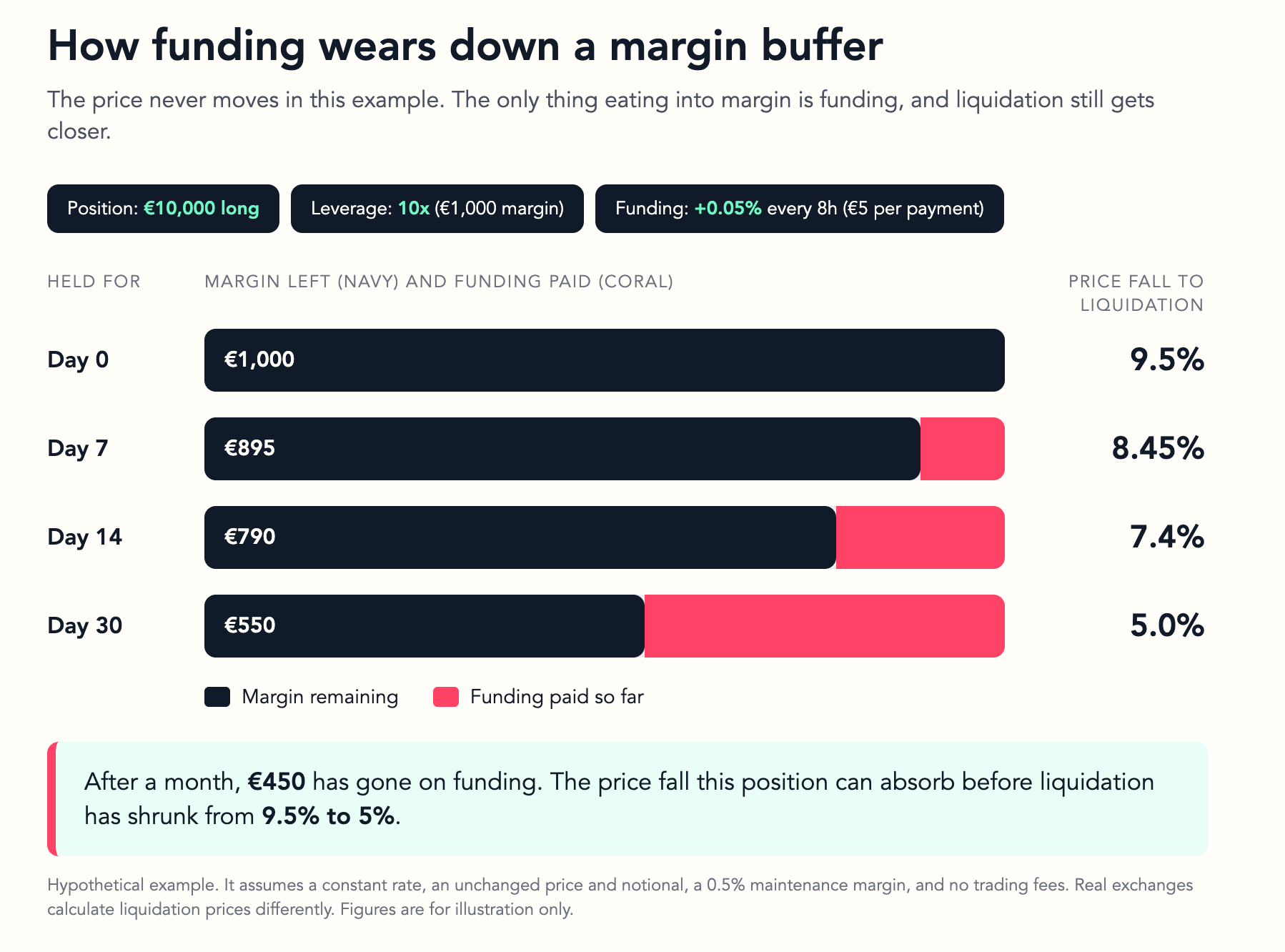
Every leveraged position has a liquidation price. That's the level at which the exchange closes the position because the margin behind it has fallen below the required minimum. How high that minimum sits varies by exchange and often rises with position size.
Funding comes into it because payments are drawn from the margin or account balance backing the position. Each payment that goes against a trader shaves a little off that buffer, nudging the liquidation price closer to the current price.
Higher leverage makes this worse, because the same funding rate takes a bigger bite out of a smaller pool of margin.
This isn't only theory. Take 10 October 2025. Over $19 billion of leveraged crypto positions were force-closed that day, more than on any other day on record.
Funding-Based Strategies and Their Risks
Some traders aim to earn funding rather than pay it. The best-known approach is a cash-and-carry, or basis, trade. When funding is positive, the trader buys the asset on the spot market and opens a short perpetual of the same size.
On paper, the price exposure cancels out. If the price rises, the spot holding gains roughly what the short loses, and the short keeps collecting funding at each interval.
In practice, several things can go wrong:
- Funding can fall or turn negative before the income covers fees on both legs.
- The gap between perpetual and spot can widen, producing a loss on paper, or a real one if the trade is closed.
- A sharp rally can liquidate the short leg even though the spot leg has gained, unless extra margin arrives in time.
- Two legs mean two executions, often on two platforms, each with its own slippage.
- Assets held on an exchange carry counterparty risk if that platform runs into trouble.
That's why returns on these trades tend to be modest, and harder to capture than they look.
Worked Scenario: Holding Through Three Funding Times
Here's how three funding times could play out for one position. All the numbers are made up. We'll also pretend the position stays worth €10,000 the whole time, which real positions don't, since notional moves with the mark price.
Our trader goes long €10,000 a few minutes past midnight UTC, then sits tight through three settlements.
Worked Scenario: €10,000 Long Over Three Funding Times
After a full day, funding has cost the long €3. Any price movement on a €10,000 position would almost certainly outweigh that, in either direction.
Timing changes the outcome. Had the trader closed a minute before 16:00, they'd have paid only the first €1. Eligibility at each timestamp is what decides who pays.
Availability and Regulatory Context in Spain and the EU
Whether perpetual futures are available to you, and what protections come with them, depends on the provider, your client classification (retail or professional) and the legal structure of the product.
MiCA, the EU's Markets in Crypto-Assets Regulation, gets a lot of attention, but it doesn't cover crypto futures or other derivatives. Those usually count as financial instruments, which puts them under MiFID II (the Markets in Financial Instruments Directive) instead.
ESMA, the European Securities and Markets Authority, addressed perpetuals directly on 24 February 2026. Its message to firms was that perpetual futures giving leveraged crypto exposure are likely caught by existing national rules on CFDs (contracts for difference). If a product is caught, retail clients are covered by capped leverage and automatic margin close-out. They also get negative balance protection, meaning losses can't exceed the money in the account, plus standard risk warnings.
In Spain, a resolution by the CNMV (Comisión Nacional del Mercado de Valores) dated 27 June 2019 caps retail leverage on crypto CFDs at 2:1. It also requires positions to be closed once margin falls to half of the initial amount. A further CNMV resolution, in force since 3 August 2023, bans advertising these products to retail clients in Spain.
Products offered outside this framework may not carry the same protections.
EU and Spain: Dates That Matter
Conclusion: Funding Is a Variable Cost, Not a Compass
Funding exists because perpetual futures never expire. It's a periodic transfer between longs and shorts that nudges the contract towards spot, with longs usually paying when the rate is positive and shorts paying when it's negative.
For anyone holding a position, it behaves like a cost or an income that can change at every interval. It adds up over time, draws on margin, and can bring liquidation closer on a leveraged trade.
What it doesn't do is predict price. A funding rate describes how traders are positioned right now. Before it feeds into any decision, the contract specification, fee schedule and margin rules for that specific market are the documents worth reading.
Disclaimer: The content provided in this article is for educational and informational purposes only and should not be considered financial or investment advice. Interacting with blockchain, crypto assets, and Web3 applications involves risks, including the potential loss of funds. Venga encourages readers to conduct thorough research and understand the risks before engaging with any crypto assets or blockchain technologies. For more details, please refer to our terms of service.