
Table of Contents
At the World Economic Forum 2026 in Davos, crypto was no longer a side topic but a central one being from presidents to central bankers, CEOs, and even the United Nations.
Here’s a clearer look at what mattered.
Trump’s Message: The U.S. Wants to Win Crypto
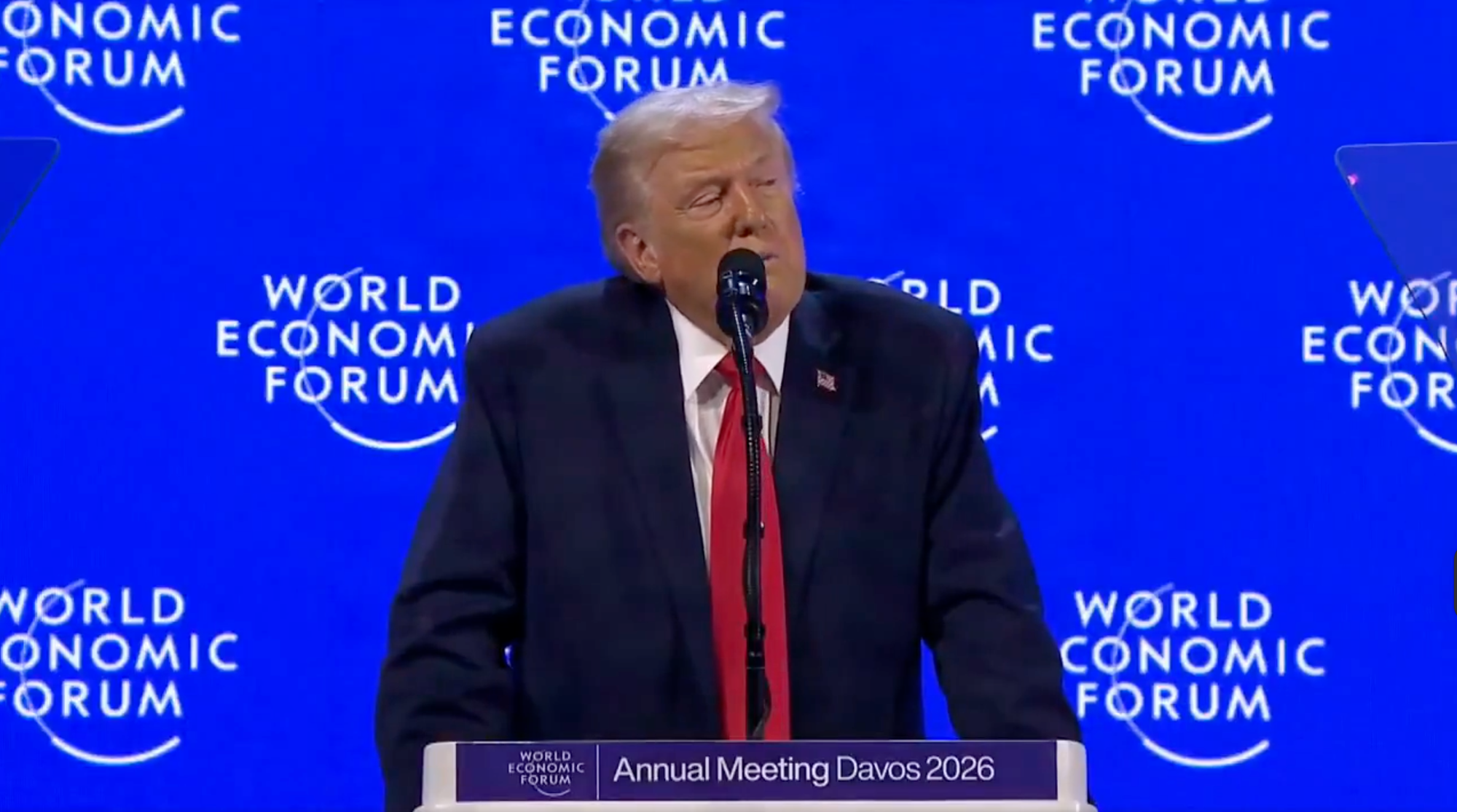
Donald Trump used his Davos speech to repeat a clear strategic polestar: making the United States the crypto capital of the world.
He came back on the GENIUS Act, which established a federal framework for stablecoins, and more importantly confirmed that a broader crypto market legislation is on the way.
There is a clear shift from the regulatory uncertainty of previous years. Since Trump returned to office, the U.S. crypto landscape has changed:
- Federal agencies have taken a friendlier approach
- Pro-crypto figures have been appointed to key roles
- Several major lawsuits against crypto companies have been dropped
- A Bitcoin Strategic Reserve has been announced (leveraging seized BTC as long-term government holdings)
Crypto is now treated as a strategic industry by the country’s government, alongside AI, semiconductors, and energy, with a clear geopolitical angle. Trump framed crypto as another technology race the U.S. cannot afford to lose… especially referring to China of course. But there is a major different approach from both countries. While China banned most crypto activity and focused on its digital yuan, the U.S. bets on regulated innovation.
So yeah, to sum it up, the U.S. aims to lead the crypto industry.
Crypto vs Banks: The Big Debate in Davos
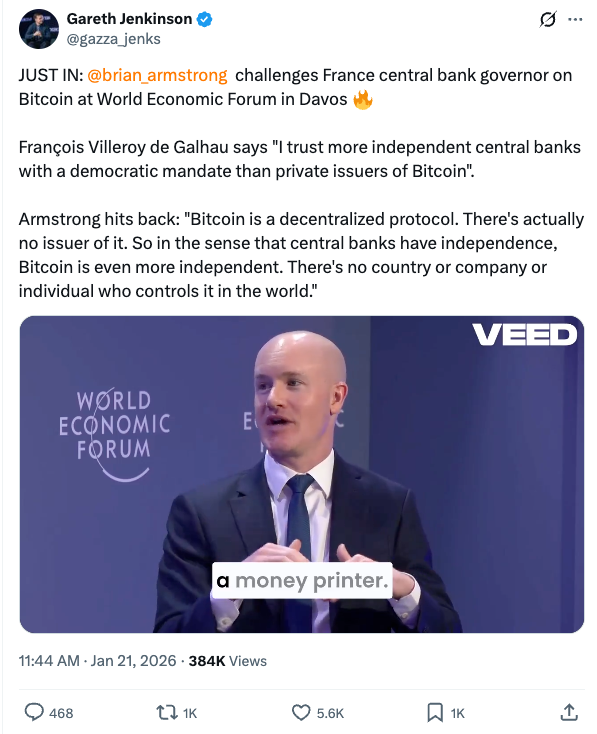
The debate highlights of the week were definitely around Coinbase CEO Brian Armstrong and France’s central bank governor, François Villeroy de Galhau.
Armstrong was present in Davos working on the U.S. market structure bill — even after Coinbase temporarily pulled its support due to concerns around stablecoin yield — but also went on stage for a panel around tokenization, where things got a bit… spicy.
What started as a simple panel turned into a direct debate about Bitcoin, stablecoins, and who to trust. After a comment on Bitcoin’s nature from the central banker — who also warned about financial stability and loss of monetary sovereignty — Armstrong defended Bitcoin’s decentralization and invited the people to make their own mind on which system to trust. That was an interesting moment, but of course wider topics were addressed, such as whether stablecoins should be allowed to offer yield or not.
The public disagreements showed a deeper and concrete economic conflict.
Banks fear deposits would flow out into crypto platforms offering better returns, while crypto companies accuse banks of lobbying regulators to block competition (particularly through restrictions on stablecoin yield) rather than innovate to catch up.
Crypto Goes Institutional and Humanitarian
Not all crypto news in Davos was confrontational.
Circle announced its first international grant through the newly created Circle Foundation to support the United Nations’ Digital Hub of Treasury Solutions (DHoTS), which is a shared financial infrastructure platform led by UNHCR.
The problem DHoTS is trying to solve is massive. More than $38 billion in humanitarian aid moves every year, but much of it is doing so through slow, expensive, and opaque banking systems.
UNHCR has already been experimenting since 2022 with blockchain-based aid delivery, including USDC payouts to Ukraine. Those pilots showed promising results with faster payments, full traceability, stronger accountability, and cost savings of up to 20%.
Circle aims to scale this approach across the UN system. DHoTS now includes 15 agencies and is designed to enable:
- Near-instant cross-border transfers
- Easier conversion into local currencies via banks and mobile money providers
- Programmable disbursements to reduce manual work
- System-wide transparency and reporting
The goal here is to modernize cross-border aid payments using digital infrastructure and stablecoins.
Hong Kong Is on the Move
While others debated, Hong Kong executed.
Officials reaffirmed their “same activity, same risk, same regulation” approach, meaning crypto businesses are regulated based on what they do and not the technology they use.
This follows the recently increasing crypto push for Hong Kong:
- Stablecoin licenses are expected to be issued in early 2026
- The city has already issued $2.1 billion worth of tokenized green bonds since 2023 (through three rounds)
- The Hong Kong Monetary Authority is running several pilots using tokenized deposits and digital assets
- A $3.8B tokenized money market fund was issued by a subsidiary of China Merchants Bank in October
- Cross-border tokenization pilots have been completed with Brazil, testing real-world trade finance flows
In a longer term perspective, Hong Kong, under its Fintech 2030 strategy, has made tokenization a core priority (alongside AI and data infrastructure) with more than 40 initiatives to push their ecosystem strongly in the next five years.
This is another clear contradicting positioning to China. While the country tightens control over crypto, Hong Kong is opening its door to it.
Bottom Line
At WEF 2026, crypto showed up everywhere, from countries’ strategy to big players’ debates, from humanitarian aid to global regulation.
The conversations have matured. The question is no longer whether crypto matters, but who is going to lead the industry, how it’s getting regulated, and what it’s actually used for.
These questions are only getting louder.
Disclaimer: The content provided in this article is for educational and informational purposes only and should not be considered financial or investment advice. Interacting with blockchain, crypto assets, and Web3 applications involves risks, including the potential loss of funds. Venga encourages readers to conduct thorough research and understand the risks before engaging with any crypto assets or blockchain technologies. For more details, please refer to our terms of service.